



Key Considerations for Deploying DIY Robotics Cells in Your Production Line
Welcome to Part Two of our collaborative series with DIY Robotics and Exact Automation. In Part One we explored the strategic value of investing in automation. If you haven’t read it yet, you can access the full discussion here: Future Evolution of an Automated Production Line.
In this installment, we answer the most common questions about robotic cells and illustrate why robotic equipment is a proven way to elevate workplace productivity. While a broad spectrum of products, models, and components exists to automate manufacturing processes, integrating robotics into a production floor is a complex undertaking that demands careful planning and precise execution. At DIY Robotics, we provide comprehensive product pages, streamlined contact options, and an active online forum to ensure you have all the information you need for a successful deployment.
Frequently Asked Questions
Is our product more durable than other mobile solutions?
Many mobile robotic cells rely on lightweight aluminium framing to reduce weight, which can compromise stability and lead to unwanted vibrations at higher operating speeds. Our cells are built from robust materials designed to absorb motion and maintain structural integrity. We offer a range of configurations to match different robot sizes, each engineered to provide the stability necessary for full‑speed operation.
Why is modularity and mobility advantageous?
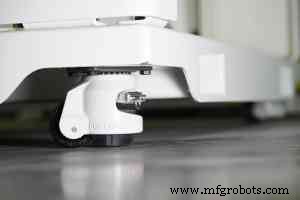
Modularity allows our experts to tailor a cell’s layout—adding conveyor passages, product‑exit openings, or maintenance doors—to integrate seamlessly with adjacent equipment. Mobility means the entire cell can be repositioned or reconfigured with minimal downtime. Traditional robots are bolted to the floor, making relocation time‑consuming and costly. Our pre‑assembled, fully mobile cells reduce installation time to a fraction of the usual effort, freeing up valuable production hours.
What exactly is inside a DIY Robotics cell?
Beyond a protective enclosure, each cell includes essential safety and control components: emergency stops, control panels, tower lights, and a full suite of integrated programs. Depending on the model, cells accommodate a variety of robot sizes and payloads. All DIY Classic and Advanced cells ship with a baseline program to simplify integration, and can be expanded with custom logic as needed.
Included Programs
- Background logic for alarms, lighting, lock‑out sequences, and timers.
- Two HMI pages—one for general operation, one for product selection.
- Ten product‑selection HMI scripts.
- Standard 3‑button interface (stop, reset, start) that launches the main program.
- Configurable homing routine via macro.
Will my products fit inside the cell?
Each model’s workspace dimensions are clearly listed on our website, enabling you to verify compatibility with your robot and payload. Wall panels can be customized to better align with surrounding equipment on your floor.
Are the wheels robust enough for heavy loads?
All cells feature industrial‑grade wheels rated far above the combined weight of the cell, robot, and payload. Below is a concise reference of load capacities:
| Model | Average Weight | Overall Capacity |
|---|---|---|
| Astro‑3326 | 1 kg (2.2 lb) | 500 kg (1 102 lb) |
| Astro‑5375 | 0 kg (0 lb) | 500 kg (1 102 lb) |
| Astro‑6622 | 50 kg (110 lb) | 1 100 kg (2 425 lb) |
| Comet‑3334 | 0 kg (0 lb) | 500 kg (1 102 lb) |
| Comet‑4459 | 0 kg (0 lb) | 500 kg (1 102 lb) |
| Satellite‑5511 | 1 kg (2.2 lb) | 600 kg (1 322 lb) |
| Satellite‑6612 | 9 kg (20 lb) | 600 kg (1 322 lb) |
Will the cell remain stationary at high robot speeds?
Our cells are engineered with rigid frames and secure leveling pads to eliminate vibration and movement, effectively behaving as if the robot were bolted to the floor.
Is robotics limited to large enterprises?
Robotics benefits businesses of all sizes. DIY Robotics focuses on delivering cost‑effective, modular, and mobile solutions that are especially attractive to medium and small manufacturers looking to adopt automation or expand their existing arsenal.
What time and cost savings can I expect versus standard robotics?
Standard open‑system robots often require extensive fencing or dedicated floor space to ensure safety, limiting operating speed. By encapsulating the robot within a DIY cell, you create a private workspace that permits higher speeds without compromising safety, thereby boosting throughput. Installation is typically a fraction of the time required for bolted robots, reducing downtime and accelerating return on investment.
How do I integrate external equipment with my DIY cell?
Our modular design lets you add doors, openings, and conveyor interfaces to accommodate other machines such as CNCs, injection molders, or additional robots. The cells include Euromap connectors for seamless communication, and are fully compatible with FANUC and ABB robots for direct teach‑pendant programming.
Conclusion
DIY Robotics cells deliver a scalable, efficient, and cost‑effective addition to any automated production line. They streamline installation, enhance safety, and enable higher operating speeds—unlocking tangible productivity gains and a rapid return on investment. For more detailed information or to speak with one of our robotics specialists, please visit our product page or contact us directly.
Industrial equipment
- 6 Essential Pre-Programming Steps for Reliable CNC Operations
- Doosan Machine Tools: Global Leader in Precision Metalworking Solutions
- 9 Essential Winter Maintenance Tips for Construction Equipment
- Precision Coding & Printing Solutions for Wires & Cables Manufacturers
- ProX 800 SLA 3D Printer – Precision, Efficiency, and Material Flexibility
- Streamlining Pharmaceutical Fluid Control System Delivery with a Specialist Project Partner
- Choosing the Optimal CFM Air Compressor for Industrial Operations
- Vickers V10/V20 Series Single Vane Pumps: High Efficiency, Reliability & Long Service Life
- Servo Kinetics Completes Space Shuttle Training Simulator Overhaul Ahead of Program Conclusion
- The Hunter Process: An Overview of Titanium Purification