



The Core of EVs: A Comprehensive Guide to Battery Systems
The Heart of Every Electric Vehicle: Its Battery
Designing an electric vehicle (EV) demands a deep understanding of its most critical component— the battery pack. From cell architecture to safety systems, every detail influences performance, range, and reliability.
EV Battery Specifications: Voltage and Capacity
EV batteries are built from hundreds of small cells arranged in a series‑parallel network to deliver the required voltage and capacity. A typical 400 V nominal pack, like that used in the Tesla Model 3, contains about 96 series blocks of 18–30 cells each.
Modern EVs use nominal pack voltages from 100 V to 200 V for hybrids and plug‑in hybrids, and 400 V to 800 V (or higher) for pure electric vehicles. Higher voltages reduce copper losses, enabling lighter and more efficient powertrains.
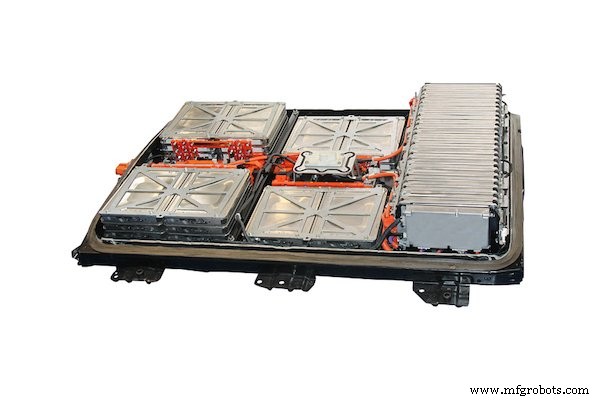
An example EV battery system with individual cells in series.
Higher voltages also require higher‑rated components and can limit compatibility with lower‑voltage DC fast chargers unless a DC‑DC boost converter is included.
Typical capacity ranges:
- Hybrid vehicles: 0.5–2 kWh
- Plug‑in hybrids: 4–20 kWh
- Pure electric vehicles: 30–100 kWh or more
Safety Architecture: Contactors, Pyro Fuses, and Isolation
High voltage and large currents pose significant safety challenges. Inside the pack, fuses sit before the output connector on both positive and negative sides. Contactors—high‑current, sealed relays—bridge the fuses to the battery.
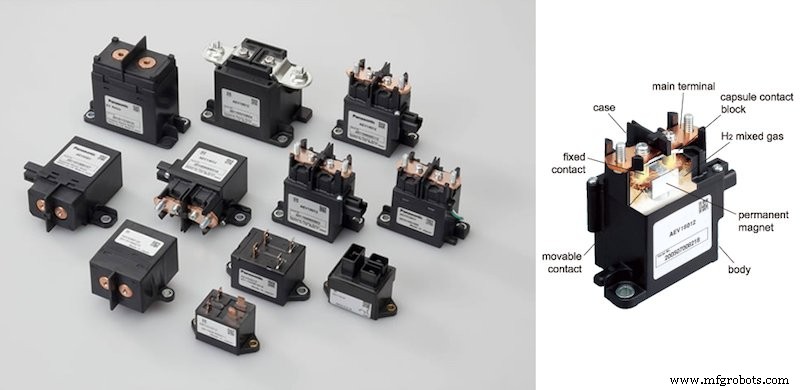
A series of Panasonic EV relays/DC contactors (left) and a breakdown of a contactor’s structure. Images from Panasonic
Key features of contactors include sacrificial contacts to mitigate resistance growth and auxiliary contacts that detect internal welding. The coil power is routed through a high‑voltage interlock loop (HVIL) that prevents the contactor from energizing unless all high‑voltage connections are secure.
Before the main contactors close, a pre‑charge contactor limits inrush current by allowing a small current through a large resistor. This protects the battery management system (BMS) from sudden surges.
Isolation is continuously monitored on both sides of the main contactors. A fault is triggered if isolation drops below 500 Ω per volt.
Tesla’s Model 3 and newer packs introduced pyro fuses—small pyrotechnic devices that open automatically if contactors weld, enabling the use of less robust contactors. A discharge resistor and contactor across the output facilitate safe voltage de‑energization after shutdown.
Cell‑Level Monitoring: Dedicated PCBs
Each block of cells is monitored by its own PCB, which must isolate its communication interface because each block’s ground reference can differ by hundreds of volts. These boards track block voltage, temperature, and inter‑block connector temperature.
Balancing—necessary due to manufacturing variances—drains a small amount of power from higher‑voltage blocks during charging to keep all blocks within a few millivolts of each other. This ensures optimal power transfer and prolongs cell life.
Precise temperature monitoring also serves as an early warning system. If a cell or connector overheats, the BMS can raise a fault before a fire or catastrophic failure occurs.
Battery Management System (BMS)
The BMS is the brain of the battery pack. It aggregates data from shunts, voltage sensors, temperature sensors, and the block‑level PCBs to control charging, discharging, and balancing. It also manages contactor operation and monitors system and connector temperatures to detect loose connections.
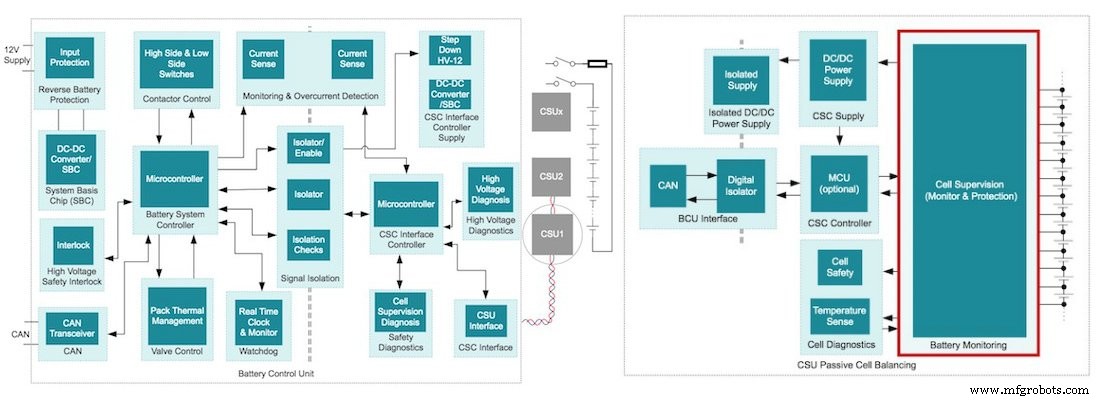
Reference design block diagram for a 400 V battery pack. Image from Texas Instruments
The BMS communicates with the rest of the vehicle via automotive Ethernet or CAN bus, relaying state‑of‑charge, state‑of‑health, current limits, and contactor status to the inverter, charger, and vehicle control units.
Understanding the battery pack’s architecture, safety systems, and management software is essential to appreciate the engineering that powers modern EVs. Share your questions or topics you’d like us to cover in the comments below!
Industrial equipment
- A Primer on Vacuum (Electron) Tubes: Foundations of Modern Electronics
- How Car Suspension Systems Work—and Why They’re Critical for Safety
- Optimizing Motor Drivers for Battery‑Powered IoT Devices
- Understanding Battery Management Systems (BMS): Core Concepts and Key Components
- Rivian Announces $5B Second U.S. Factory in Atlanta, Aiming to Produce 400,000 EVs Annually
- Continental Launches Central Server for VW ID Electric Vehicles, Boosting Connectivity and OTA Updates
- Electric Vehicle Battery Systems: Design, Development, and Emerging Trends
- Mastering Profile Cutting Systems: Advanced Techniques for Modern Metalworking
- Mastering Manufacturing Automation: Strategies, Benefits, and Industry 4.0 Insights
- The Complete Guide to Electric Vehicle Components: What You Need to Know