



Operating System Fundamentals: Key Components and Functions
An operating system (OS) is a crucial software layer that mediates between the user and the computer hardware, managing memory, files, I/O, security, and peripheral devices. Popular OS families include Windows, Linux, AIX, VMS, and z/OS.
What is an Operating System (OS)?
Definition: An OS is a sophisticated system that orchestrates all hardware and software resources, providing a unified interface for applications to interact with the machine. It divides the system into well‑defined modules—file handling, I/O, memory management, and process control—each governed by clear interfaces and functions.
Because every program ultimately relies on an OS, it is the backbone of computer operation. The OS interprets keyboard input, renders output to the screen, organizes file systems, manages storage, and controls peripheral devices such as printers.
Components of Operating System
The components of an operating system play a key role in making a variety of computer system parts work together. The operating components are discussed below.
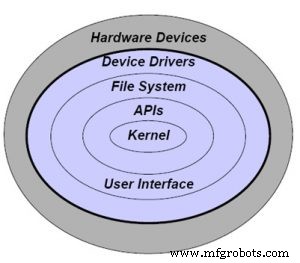
Kernel
The kernel is the OS core that runs in privileged mode and manages direct interaction with hardware. It remains loaded in main memory, handling CPU scheduling, device drivers, and memory allocation to ensure efficient resource use.
Process Execution
The OS creates and schedules processes, allocating CPU time, memory, and other resources. It provides a uniform interface between applications and hardware, simplifying program execution.
Interrupt
Interrupts enable the OS to respond instantly to hardware or software events. When an interrupt occurs, the current task is paused, its state saved, and the corresponding handler runs before resuming the previous task.
Memory Management
Memory management is the OS function that controls the allocation and deallocation of main memory. It tracks which memory blocks are free or occupied, decides when to swap pages to disk, and ensures isolation between processes. The strategy includes hardware support, kernel algorithms, and application‑level allocation.
Multitasking
Multitasking allows multiple processes to run concurrently by rapidly switching CPU time between them. Time‑sharing and pre‑emptive scheduling give the illusion of simultaneous execution, maximizing system responsiveness.
Networking
Networking capabilities let the OS communicate over wired or wireless links, handling protocols, routing, and security. Modern OSes provide robust networking stacks, enabling devices to share resources like files, printers, and internet connectivity.
Security
Security mechanisms protect the system from unauthorized access and malicious actions. The OS enforces authentication, access control, encryption, and auditing, distinguishing legitimate requests from threats and logging activity for compliance.
User Interface
The user interface is the bridge between the human user and the OS. It can be graphical (GUI) or command‑line (CLI). The UI captures user input and presents output, facilitating interaction with applications and system settings.
Thus, this is all about an overview of an operating system. The main components of an OS mainly include kernel, API or application program interface, user interface & file system, hardware devices and device drivers. Here is a question for you, what are the different types of an OS?
Embedded
- Control Unit Explained: Components & Design in CPUs
- Embedded System Programming: Languages, Architecture, and Applications
- Interrupts Explained: Types, Mechanisms, and Applications in Modern Computing
- Virtual Machines Explained: Types, Architecture, and Key Advantages
- Embedded Operating Systems: History, Architecture, and Real‑World Applications
- Investment Casting Explained: History, Process, and Modern Techniques
- Smart Manufacturing: Definition, Benefits, and Implementation
- Terotechnology Explained: Definition, Goals, and Business Benefits
- Graphene: The Ultra‑Strong, Ultra‑Conductive Carbon Layer Changing Technology
- S8050 Transistor Explained: Applications & Features