



Xilinx Unveils Composable SmartNICs, AI Video Analytics, Low‑Latency Trading, and an App Store for Data Center Acceleration
Xilinx has introduced a suite of data‑center solutions built on composable hardware, designed to enhance adaptability and flexibility in response to evolving workloads, while also tackling latency challenges in video analytics and algorithmic trading.
The lineup features a new family of Alveo SmartNICs, AI‑driven video analytics tools, a reference design for sub‑microsecond algorithmic trading, and the Xilinx App Store. These offerings empower developers to deliver compute‑intensive workloads without the cost and time of traditional hardware design, effectively removing obstacles to rapid, software‑defined, hardware‑accelerated deployment on Alveo cards.
Data centers face soaring bandwidth demands and the need to optimize AI and real‑time analytics workloads that continually evolve, straining existing infrastructure. Xilinx argues this drives the demand for fully composable, software‑defined accelerators that can be tuned for demanding applications, quickly adopt new protocols, and deliver line‑rate performance.
“Composable” SmartNIC
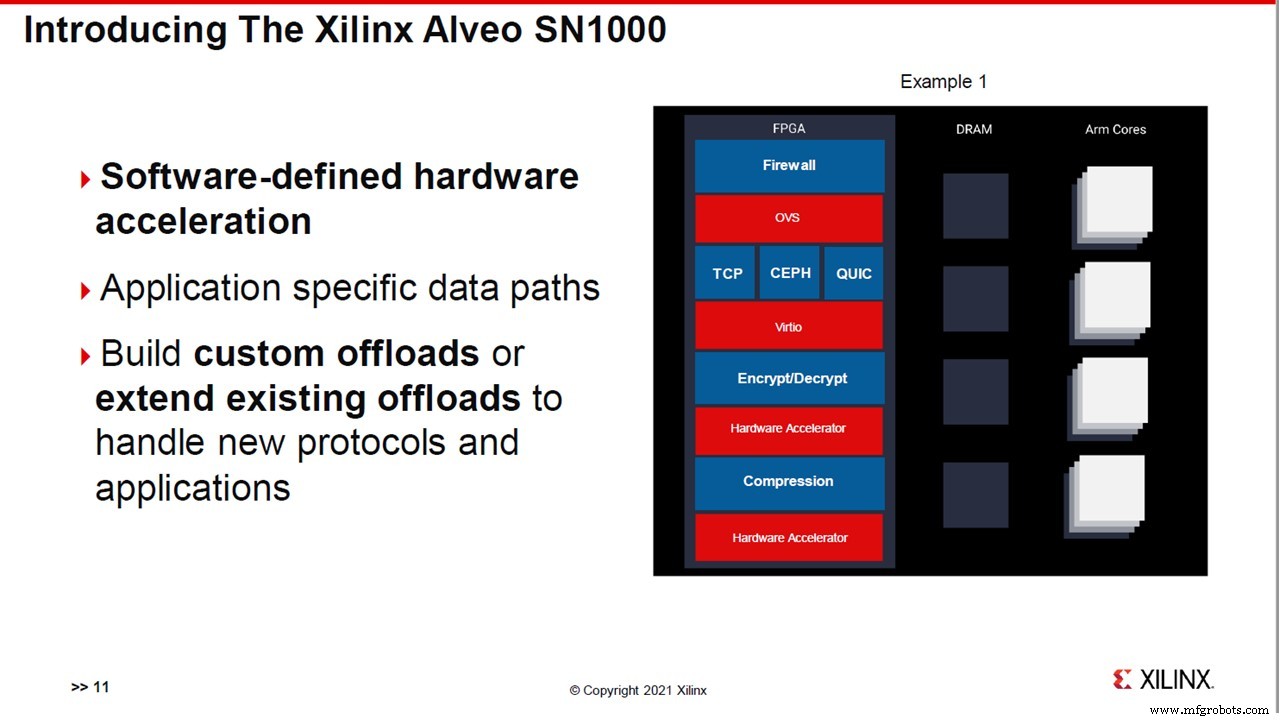
The flagship of this new data‑center family is the Xilinx Alveo SN1000, a line of composable SmartNICs that provide software‑defined hardware acceleration for every offload function.
In a briefing with embedded.com, Kartik Srinivasan, director of product marketing for the data center group at Xilinx, said, “In our engagement with hyperscalers and early adopters, everyone has different needs, but all need continuous feature innovation, while not having to compromise on performance. With the NIC being a critical component in the I/O of a server, beyond 25Gb, offload NICs started emerging.”
“With ASIC implementations of these offload NICs, there is no programmability and hence no way to scale and adapt for different needs. Similarly, for CPU implementations, while some may have aspects of programmability, they are not efficient and can’t scale to 100Gb connectivity and beyond.”
The SN1000 SmartNICs offload CPU‑intensive tasks to boost networking throughput, featuring an open architecture that accelerates diverse network functions at line rate. They deliver software‑defined acceleration for networking, security, and storage offloads—including Open vSwitch, Virtio.NET virtualization, IPsec, kTLS, SSL/TLS, Virtio.blk, NVMe‑over‑TCP, Ceph, as well as compression and cryptographic services.
Developers leverage the Vitis Networking platform, along with high‑level languages like P4, C, and C++, to program network functions, protocols, and applications that run natively in hardware on the SmartNIC. This framework lets organizations rapidly compose or adjust functions to support emerging protocols, eliminating the need for hardware changes and safeguarding future investments.
Srinivasan added, “Customers get an out‑of‑the‑box plug and play experience. We program some features which we think customers require, plus acceleration, and then customer can remove blocks or add their own custom accelerators.”
At launch, Xilinx said it has good industry support for its SmartNICs. Lee Caswell, vice president of marketing at VMware’s cloud platform business unit, said, “VMware is defining the hybrid cloud architecture for next‑generation applications with heightened security requirements. SmartNICs will play a critical role in the VMware cloud foundation architecture by giving customers a unified management, security, and resiliency model that spans both bare metal and virtualized environments where the composability of Xilinx Alveo SN1000 SmartNICs will provide a flexible, integrated, and qualified solution for customers.”
Ben Li, general manager of the network business unit at Inspur, added, “Today’s software‑defined data center demands flexibility and scalability to meet the ever‑changing needs of customer workloads. The innovative composable offload framework of the Xilinx Alveo SN1000 SmartNIC family gives Inspur the agility to adapt to evolving customer needs by rapidly developing and deploying custom workloads.”
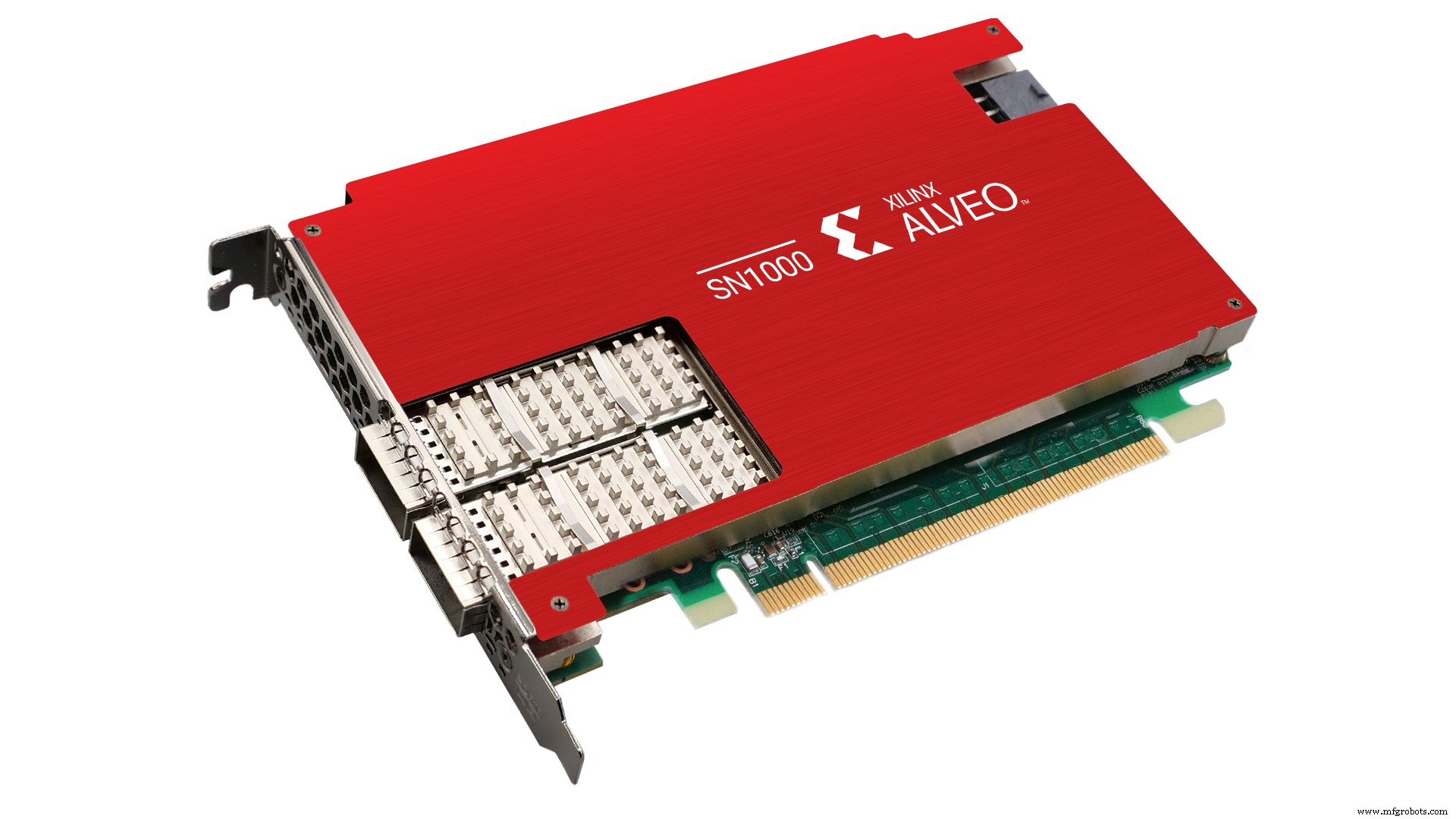
Based on the Xilinx 16nm UltraScale+™ architecture, the SN1000 family of SmartNICs is powered by the low‑latency Xilinx XCU26 FPGA and a 16‑core Arm® processor. SN1000 SmartNICs deliver dual‑QSFP ports for 10/25/100Gb/s connectivity with leading small packet performance and a PCIe Gen 4 interconnect. The first model in the family is the SN1022, which is offered in a full‑height, half‑length form factor within a 75‑Watt power envelope.
Video analytics platform targets latency‑sensitive AI video inferencing
The second of Xilinx data‑center products to launch is its smart world video analytics platform, coupled with an ecosystem of partner solutions designed to accelerate the most complex and latency‑sensitive AI video inferencing workloads.
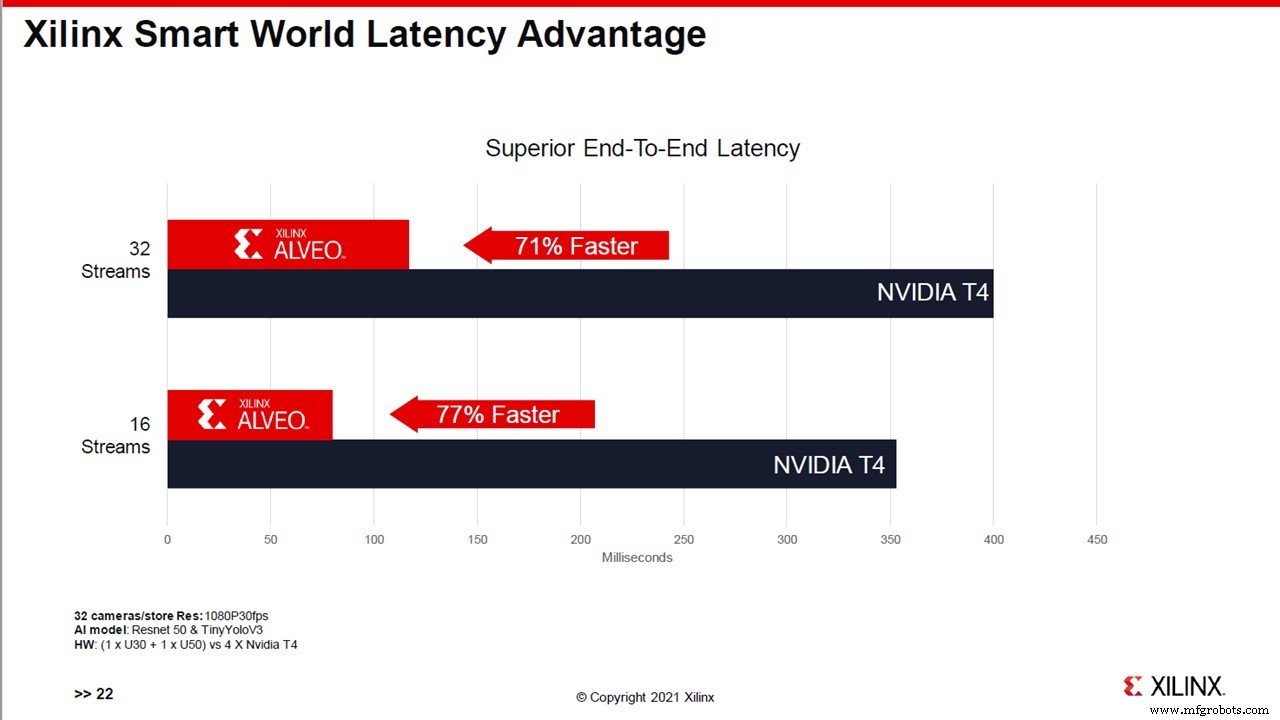
Powered by the Xilinx video machine‑learning streaming server, it delivers full‑application acceleration and can run multiple neural networks on a single Alveo accelerator card with deterministic sub‑100ms pipeline latency. Xilinx claims this results in the industry’s lowest total cost of ownership for demanding AI video analytics applications.
The partner solutions available at launch include:
- Aupera: offering turnkey smart‑city and smart‑retail solutions that combine Aupera’s intelligent video processing with Alveo accelerators.
- Mipsology: providing a toolset for easy migration of existing AI applications from GPU‑based architectures to the Alveo platform, as well as plug‑and‑play, high‑performance AI inference acceleration.
- DeepAI: delivering AI training at the edge on Alveo accelerators with up to a 10× performance‑per‑cost advantage compared to GPU‑based solutions.
Xilinx told embedded.com that the retail market is a key vertical target for this product platform, given that shrinkage from theft is a major issue in the sector.
Reference design for low‑latency electronic financial trading
Achieving sub‑microsecond latency in algorithmic trading has traditionally required costly and time‑consuming hardware development. The Vitis development platform now includes an accelerated algorithmic trading (AAT) reference design, enabling software developers to quickly and cost‑effectively deliver sub‑microscond trading performance without custom hardware.
AAT, implemented on Alveo accelerator cards, provides a modular design that encompasses all components of an end‑to‑end, low‑latency trading solution. Each module can be customized using C and C++ in the Vitis platform to meet firm‑specific requirements. The AAT reference design is available today at no cost for Alveo accelerator card customers.
App store with ready‑to‑deploy video analytics and financial trading solutions
Completing its lineup, Xilinx has also launched an app store offering pre‑built, containerized applications that span smart‑world AI video analytics, anti‑money laundering, and live video transcoding. Developed by Xilinx ecosystem partners, these ready‑to‑deploy solutions let customers evaluate, purchase, and deploy accelerated applications in minutes.
Embedded
- Interrupts Explained: Types, Mechanisms, and Applications in Modern Computing
- Accelerate Industrial Automation: Optimizing RS‑485 Fieldbus for Speed, Reach, and EMC
- Leveraging Embedded AI to Convert Big Data into Actionable Smart Insights
- Würth Electronics Unveils WSEN‑ITDS: A Compact, Low‑Power 3‑Axis MEMS Accelerometer for Industrial IoT
- AImotive Launches aiWare3P Neural Network Accelerator for High-Performance Automotive Vision
- How Hardware Accelerators Power Modern AI Systems
- DARPA Awards Contracts to Four Teams for ASIC Accelerators in Fully Homomorphic Encryption
- Harnessing Data in the Internet of Reliability: Strategies for Effective Management
- Pandemic-Proof Edge Data Centers: IoT Monitoring for Secure, Low-Latency Performance
- Choosing the Right CNC Machining Center for Your Applications