



Dialog’s DA16200 SoC Delivers Ultra‑Low‑Power Wi‑Fi for Battery‑Powered IoT
Battery‑operated IoT devices often struggle to stay online: Wi‑Fi connectivity tends to drain power faster than other communication protocols. Dialog Semiconductor’s latest solution, the DA16200 SoC, changes that narrative by offering ultra‑low‑power Wi‑Fi that can keep a device running for years on a single coin cell or AAA battery.
The DA16200 integrates a power amplifier (PA) capable of +20 dBm output and a low‑noise amplifier (LNA) with –99.5 dBm receiver sensitivity, eliminating the need for external RF components. This compact design is paired with Dialog’s proprietary VirtualZero technology, which keeps the average current consumption down to just 200 nA in a “Wi‑Fi ready” state. According to Senior Marketing Director David Cohen, this translates to typical battery lifetimes of one year and, in many scenarios, three to five years.
VirtualZero’s efficiency is achieved by reducing the time the RF front‑end spends in high‑power modes. Devices can maintain network connectivity even when the energy harvesting source supplies only about 85 mA in active transmit mode, while the rest of the time they rely on micro‑amp level consumption.
Designing for Longevity
Modern mixed‑signal SoCs offer significant size and power savings compared to discrete component assemblies, but they also bring added design complexity. Engineers must balance processor performance, display, and wireless interfaces against a tight energy budget. The DA16200’s low average current in idle mode is especially valuable for devices such as smart locks, thermostats, or remote sensors that spend most of their time idle but must remain reachable.
“In many IoT scenarios the real data traffic is minimal—perhaps 1–20 payload exchanges per day—yet the device must stay connected for the rest of the time. The key to long battery life is reducing the average current in that Wi‑Fi ready state,” Cohen explained.
Range is another critical factor. The DA16200’s high output power and low sensitivity ensure reliable connectivity in congested environments, which is essential for fixed installations that cannot be repositioned like a laptop.
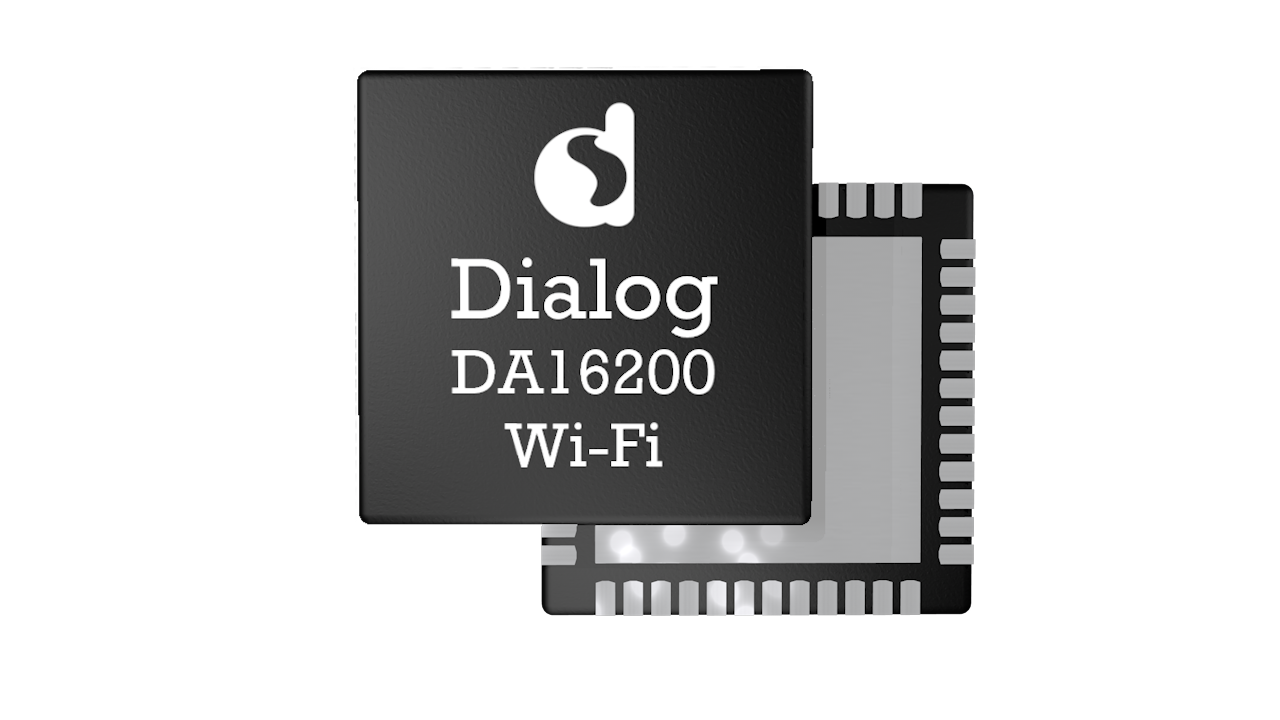
DA16200 SoC (Image: Dialog)
Robust Security for the Connected World
The DA16200 embeds a full suite of security features to protect both the device and the data it transmits. It supports WPA2 and WPA3, both personal and enterprise modes, and includes Extensible Authentication Protocol (EAP) support. Hardware‑accelerated TLS allows the SoC to establish secure HTTPS connections directly to cloud platforms such as Amazon Web Services, Microsoft Azure, and Google Cloud.
Additional encryption primitives—AES, Diffie‑Hellman, hash functions, and elliptic‑curve cryptography—are all accelerated in silicon. The platform also offers secure boot, secure debug via JTAG or SWD, and secure asset storage, enabling customers to embed license keys and certificates with a one‑time password mechanism.
As IoT devices proliferate, the integration of big data, AI, and real‑time analytics will only increase. The DA16200’s combination of low power consumption, reliable connectivity, and hardened security makes it a strong foundation for the next generation of intelligent, battery‑powered products.
>> This article was originally published on our sister site, EE Times.
Embedded
- Eclipse Hono 1.0.0 Launches: Unified, Open‑Source IoT Connectivity Platform
- Cellular IoT: Unlocking the Advantages of CIoT Connectivity
- Silicon Labs Launches Power‑Efficient Wi‑Fi Modules, Halving Energy Use for IoT Devices
- Renesas Expands Azure RTOS Integration Across RA, RX, and RZ/A Lines with FSP
- Silicon Labs’ EFR32BG22: Bluetooth 5.2 SoC Delivers Ultra‑Low Power, Robust Security, and Sub‑Meter Positioning for High‑Volume IoT
- Renesas Licenses 3db Access Ultra‑Wideband Technology for Secure IoT Connectivity
- Microchip Launches Secure, Cloud‑Connected IoT Development Boards for Rapid Prototyping
- TRITON‑TX8M: A Cost‑Effective Quad‑Core SoM for 64‑bit Embedded Systems
- Secure 32‑bit Wi‑Fi MCU Module Pre‑Provisioned for Cloud Connectivity
- Why Wi‑Fi‑Enabled IoT Devices Pose a Growing Security Threat