



TRITON‑TX8M: A Cost‑Effective Quad‑Core SoM for 64‑bit Embedded Systems
At Embedded World 2020, Direct Insight unveiled the TRITON‑TX8M system‑on‑module (SoM) in a compact SODIMM form factor. Built around NXP’s i.MX8M Mini, the module packs four 64‑bit ARM Cortex‑A53 cores running up to 1.6 GHz, delivering robust performance without compromising on size or power consumption.
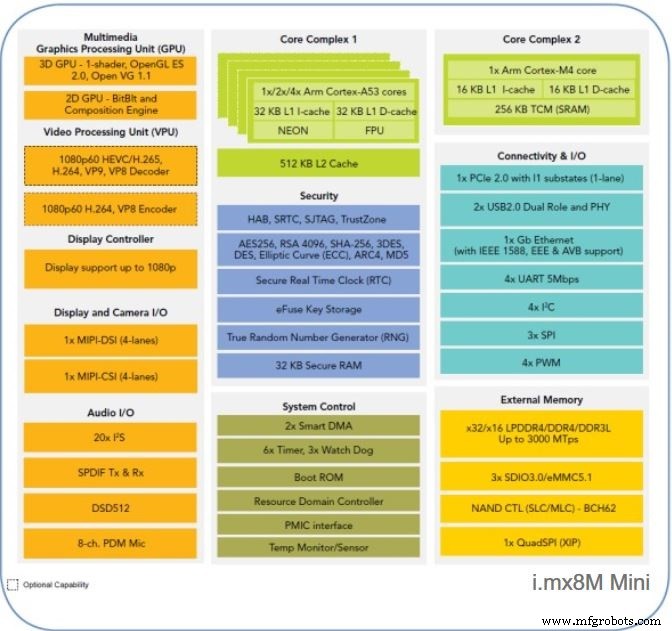
Figure 1: i.MX8M Mini block diagram
A system‑on‑module extends beyond a single chip by integrating connectivity, multimedia, display interfaces, GPIO, and an operating system into one cohesive unit. Unlike a system‑on‑chip (SoC), which locks in a fixed set of functions and pin count, an SoM can be swapped or upgraded on a carrier board, offering unparalleled flexibility for custom applications.
“SODIMM modules are ideal because they use a standard format—plug, unplug, and reprogram with ease,” explains David Pashley, Direct Insight’s Managing Director.
SoCs are prized for their energy efficiency and tight integration, but once fabricated, their hardware configuration is immutable. This limitation forces developers to constrain software within predefined boundaries, which can delay time‑to‑market. The TRITON‑TX8M mitigates these constraints by exposing a richer set of interfaces while still keeping the footprint minimal.
“Adopting an SoM can be complex because of APIs and integration requirements,” notes Pashley. “However, the benefits—cost savings, reduced design risk, and rapid prototyping—outweigh the challenges for most manufacturers.”
Hardware differences are clear: the SODIMM module offers 200 pins, whereas a comparable SoC can expose over 400. While this reduces the absolute number of interfaces, the TRITON‑TX8M still supports a broad range of connectivity options.
Physical dimensions are 68 mm × 26 mm (28 mm for the LVDS version). It ships with either 1 GB or 2 GB of DDR3L RAM and a 4 GB eMMC flash. A secondary Cortex‑M4F microcontroller handles real‑time tasks, and dedicated 3D/2D GPUs provide powerful graphics acceleration.
Connectivity options include an Ethernet port, two USB 2.0 ports, MIPI‑DSI or LVDS display outputs, MIPI‑CSI camera input, and additional I/O through a 120‑pin expansion header. The integrated VPU supports 1080p video encoding and decoding, making the module suitable for media‑rich applications.
The TRITON‑TX8M ships with pre‑built BSPs for Linux and Windows 10 IoT Core, and Direct Insight is developing a QNX 7.0 BSP to broaden its ecosystem. A single 3.3 V‑to‑5.5 V power rail supplies the module, delivering up to 300 mA at 3.3 V for baseboard use.
For developers, Direct Insight also offers a TRITON‑TX8M development kit featuring a 10‑inch capacitive touchscreen (1280 × 800), MiniPCIe expansion, RJ45 Ethernet, 3.5 mm audio jack, 120‑pin header, MIPI‑CSI camera port, and micro‑SD slot (see Figure 2).
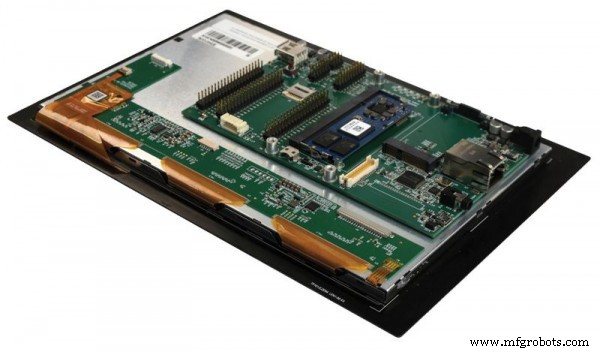
Figure 2: TRITON‑TX8M development kit
Embedded
- Embedded System Programming: Languages, Architecture, and Applications
- Embedded Systems Fundamentals & Real-World Applications
- Automating C Test Generation for Comprehensive Embedded SoC Verification
- NVIDIA GTC Unveils Jetson AGX Orin: 200 TOPS in the Smallest Edge AI Supercomputer
- Dialog’s DA16200 SoC Delivers Ultra‑Low‑Power Wi‑Fi for Battery‑Powered IoT
- Rugged CB71C COM Express Module Powered by AMD Ryzen Embedded V1000/R1000 SoCs
- Kontron Launches AMD Ryzen Embedded R1000‑Based COM Express Compact Modules for High‑Performance, Fanless Embedded Systems
- IBASE Launches ET976 COM Express Compact Type‑6 Module with AMD Ryzen Embedded V1000 for High‑Performance Industrial Applications
- IBASE CMI300‑988: Ultra‑Compact Mini‑ITX PC with AMD Ryzen Embedded V1807B
- Java 9 Module System: Enhancements, Link‑Time, and Custom Runtime Images