



Maxim’s MAX31889 & MAX31825: Precision, Low‑Power Temperature Sensors for Cold‑Chain and Multi‑Device Systems
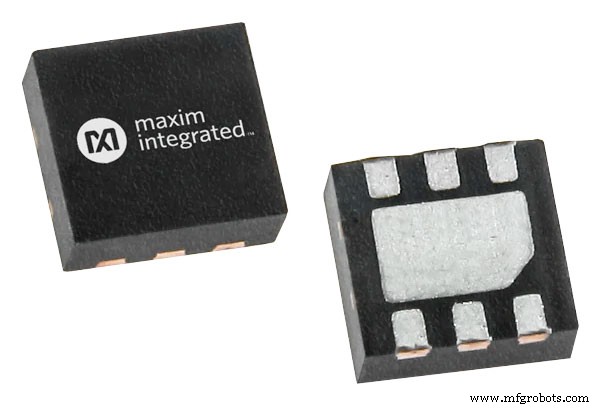 Maxim’s latest temperature‑sensing ICs, the MAX31889 and MAX31825, deliver industry‑leading accuracy while keeping power consumption and wiring complexity to a minimum. These sensors are ideal for pharmaceutical cold‑chain monitoring, lab instrumentation, and any application where reliable temperature data is critical.
MAX31889 – A Digital RTD Replacement
• Accuracy: ±0.25 °C across –20 °C to +105 °C, matching or exceeding most commercial RTDs.
• Resolution: 16‑bit, 0.005 °C increments for fine‑grained monitoring.
• Interface: I²C serial, enabling seamless integration with microcontrollers and SoCs.
• Power: 35 % lower consumption than competing RTD solutions, ideal for battery‑powered or energy‑sensitive deployments.
• Cost: $1.65 per unit in 1,000‑piece lots, and a $56 evaluation kit is available.
MAX31825 – 1‑Wire, Multi‑Device Connectivity
The MAX31825 is engineered for dense, space‑constrained designs that require many sensors on a single bus.
• Device Capacity: Up to 64 ICs per 1‑Wire bus, each parasitically powered—no additional power lines needed.
• Serial ID: Unique 64‑bit code ensures reliable addressing of each device.
• Accuracy: ±1 °C from 0 °C to +70 °C and ±1.75 °C from –45 °C to +145 °C, covering most industrial and environmental ranges.
• Package: 6‑pin μDFN for compact footprint; priced at $1.55 per unit in 1,000‑piece lots.
• Evaluation Kit: $56, facilitating rapid prototyping.
Why Choose Maxim’s Sensors?
• Proven Precision: Data sheets confirm tight tolerance and low drift over long periods.
• Reduced Wiring: 1‑Wire parasitic power cuts PCB complexity, lowering BOM costs.
• Energy Efficiency: Lower power translates to longer battery life for field‑deployed units.
• Rapid Time‑to‑Market: Ready‑to‑use evaluation kits speed development cycles.
Note: This article was originally published on Maxim’s sister site, EDN.
Embedded
- Software‑Driven Power Analysis: Optimizing Semiconductor Design for Efficiency
- ON Semiconductor Launches Low‑Power, High‑Frame‑Rate ARX3A0 Image Sensor for Intelligent Vision
- STTS22H: 0.25 °C Accuracy, Ultra‑Low‑Power Digital Temperature Sensor
- AMS Launches AS621x Series: Ultra‑Low‑Power, High‑Accuracy Temperature Sensors in a Tiny Package
- Texas Instruments Launches Zero‑Drift Hall‑Effect Current Sensors with Unmatched Accuracy
- Boreas Launches Ultra‑Low‑Power Piezo Haptic Engine for Wearables
- Ultra‑Low Power Substrate‑Emitting DFB Quantum Cascade Laser: 0.43 W Threshold at 25 °C
- Low Power Factor Explained: Key Causes & How to Fix Them
- Kaman Precision Launches Durable Displacement Sensors for Extreme High‑Pressure, Low‑Temperature, and High‑Temperature Environments
- Infrared Temperature Sensors: Accurate, Non-Contact Thermal Measurement