



Ambarella Introduces AI‑Powered SoCs for Multi‑Sensor Video Streams
Ambarella, a leading image‑processing company, has announced two new system‑on‑chip (SoC) solutions that combine high‑resolution video capture with advanced artificial‑intelligence (AI) processing. Designed for security cameras and smart‑city deployments, the CV5S and CV52S deliver 4K video encoding and sophisticated AI tasks such as facial and license‑plate recognition.
The CV5S targets multi‑sensor camera systems, handling up to four 8‑megapixel (8MP) feeds—equivalent to 4K resolution—at 30 frames per second (fps) each. It can process 14 separate video streams simultaneously, performing real‑time AI on every 4K frame. Compared with Ambarella’s prior generation, the CV5S doubles both encoding resolution and memory bandwidth while cutting power consumption by 30 percent. It operates below 5 W and delivers 12 eTOPS (an Ambarella metric for GPU‑equivalent performance).
The CV52S is optimized for single‑sensor cameras and supports 4K resolution at 60 fps. It offers four‑fold AI performance, double CPU throughput, and 50 % more memory bandwidth relative to earlier models. Consuming under 3 W, it provides 6 eTOPS of computational power.
Both SoCs are built on Ambarella’s 5‑nm process and feature an expanded CVflow AI accelerator, enabling efficient convolution and other deep‑learning operations. “Having an AI accelerator alone isn’t enough; the entire imaging pipeline must work harmoniously,” said Jerome Gigot, Ambarella’s senior director of marketing. “Our integrated ISP, memory controller, and software stack allow us to keep data in‑place, eliminating costly copies and achieving low‑power, high‑quality video processing.”
In addition to the CVflow engine, each SoC includes Ambarella’s long‑standing image signal processor (ISP), which handles color correction, auto‑exposure, auto‑white balance, and noise filtering. Gigot highlighted the ISP’s 16‑year development history, underscoring the depth of integration that new entrants typically lack.
The AI accelerator is a vector processor that can accelerate convolutional neural networks (CNNs) and classical computer‑vision algorithms. It supports sparsification—pruning near‑zero coefficients—to reduce computational load by up to 80 %. After a brief retraining phase, models regain accuracy within 1 % of the original, while the model size can shrink five‑fold.
With its ability to handle up to 14 independent video streams, the CV5S can run multiple neural networks concurrently. Gigot explained that the CVflow engine employs time‑multiplexing and parallel paths, enabling efficient operation across different networks without the need for batch processing typical of GPUs.
Both CV5S and CV52S will enter sampling in October 2021.
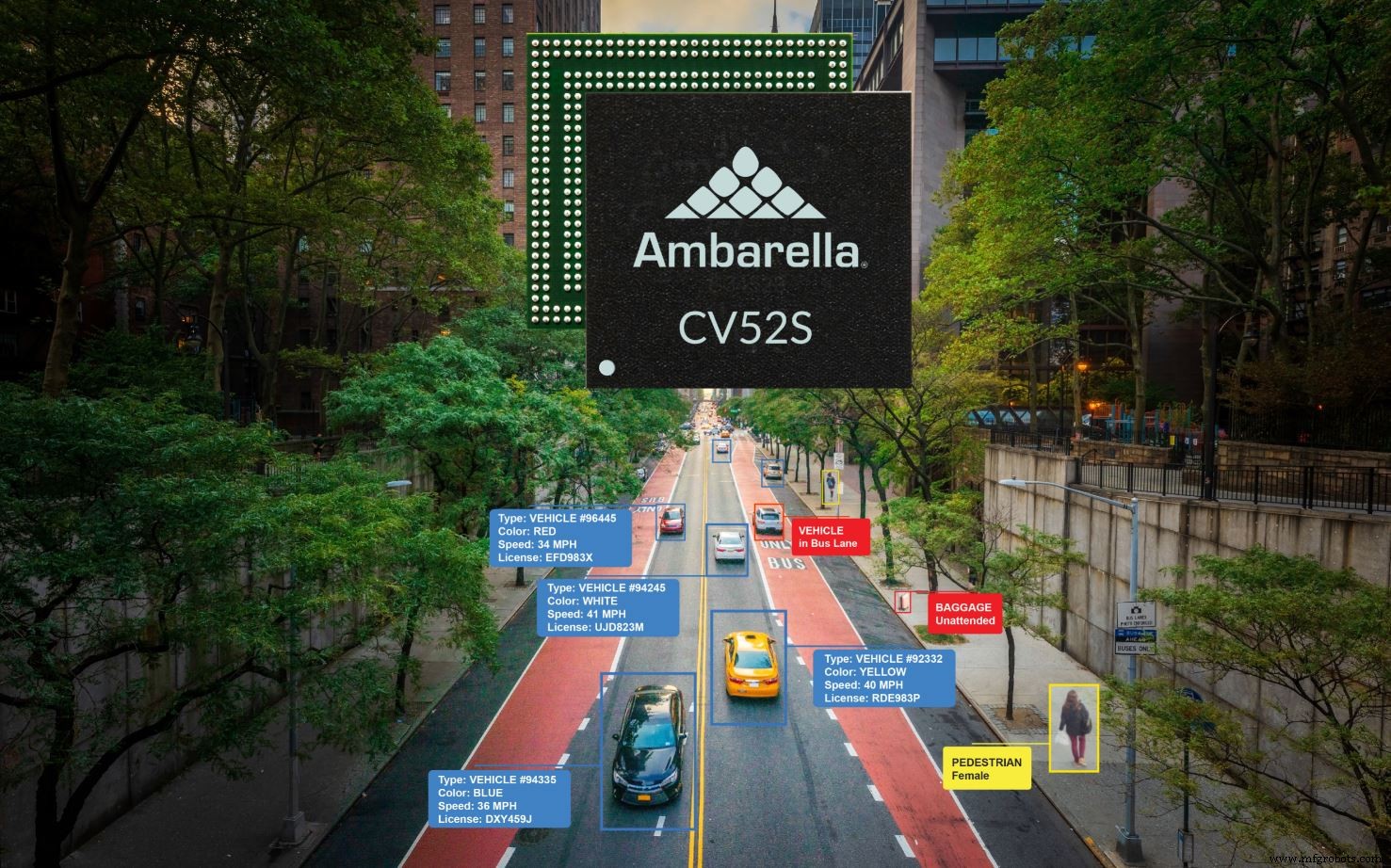
The CV52S targets single‑sensor designs such as traffic monitoring and other smart‑city applications (Source: Ambarella)
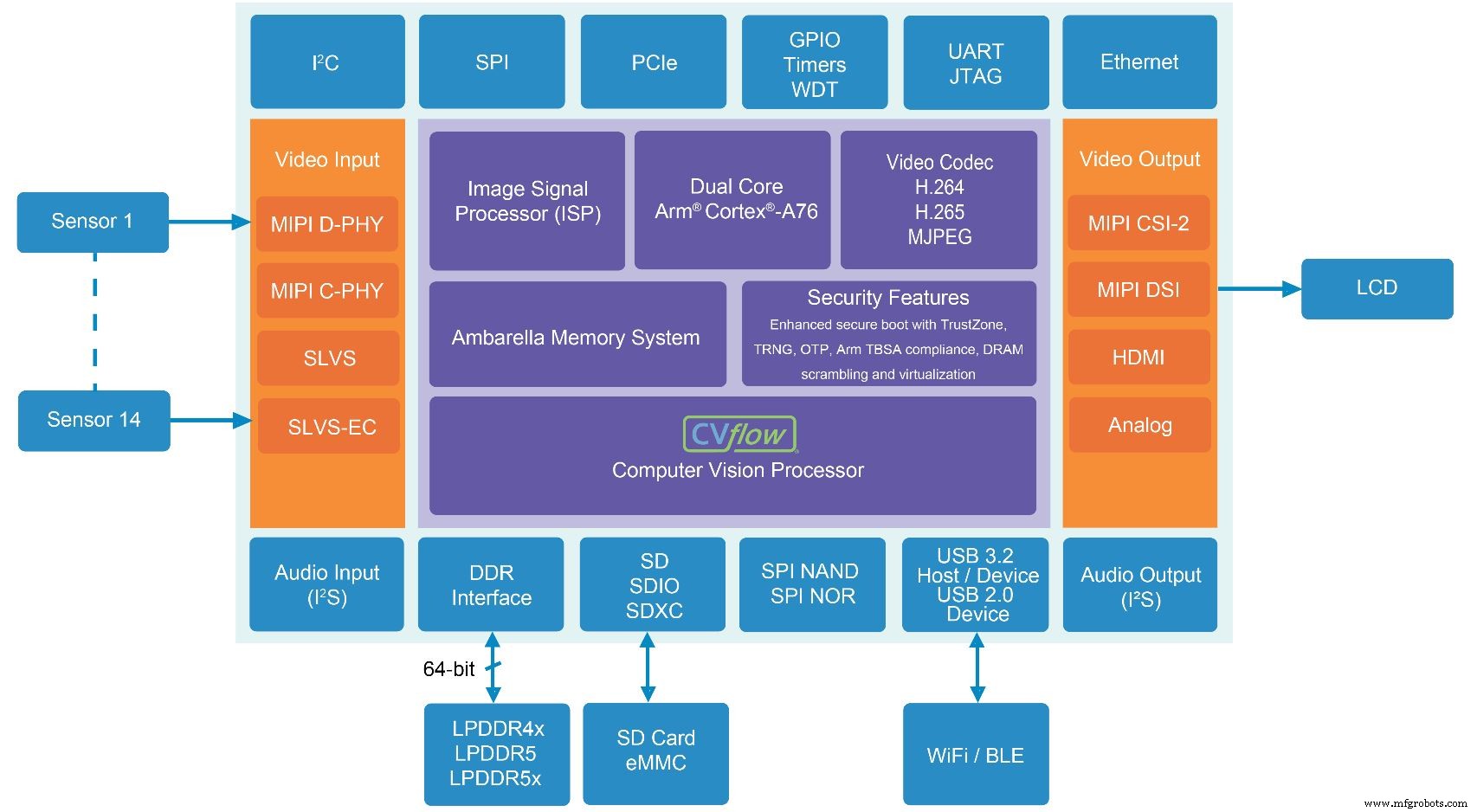
The CV5S SoC for multi‑sensor camera systems includes the latest generation of Ambarella’s CVflow AI and computer‑vision accelerator (Source: Ambarella)

Jerome Gigot (Source: Ambarella)
For further details, see the original publication on EE Times.
Related Contents:
- AI vision processor enables 8K video at 30fps in under 2W
- Ambarella targets intelligent edge sensing with new camera SoC
- FPGAs displace ASICs in Subaru Eyesight vision‑based ADAS
- Arm adds CPU, GPU and ISP for autonomous and vision safety
- Low power AI vision board lasts ‘years’ on single battery
For more Embedded content, subscribe to Embedded’s weekly email newsletter.
Embedded
- Mastering Multi‑Exception Handling in Java
- Ambarella Launches CV5 AI Vision Processor: 8K at 30fps in <2W, Redefining Power‑Efficient Imaging
- Designing High‑Performance Interconnects Across PCIe Generations
- Qualcomm Launches 5G‑Enabled AI Drone Platform to Drive Autonomous UAV Innovation
- ADLINK Unveils Rugged AI-Powered Video Analytics Platform for Railways
- Eliminate Jumper Wires: How BreadShield Connects Arduino Directly to Breadboards
- Compact OB1203 Biosensor Module Unites Heart Rate, Pulse Oximetry, and More for Wearables
- How to Return Multiple Values in Python: A Simple Guide
- Java 8 Streams: A Declarative Approach to Data Processing
- CNC Machining Tutorial: Live Lathe Machine Demo