



Wi‑Fi Evolution: 802.11ad, 802.11ah HaLow, and More – What They Mean for Range, Speed, and IoT
Over the past fifteen years, Wi‑Fi has transitioned from a nascent, low‑performance technology to a cornerstone of modern connectivity. With billions of devices now relying on Wi‑Fi for everyday tasks, continuous innovation is essential. The key questions driving recent standards are twofold: can they deliver greater range and higher speed?

The Institute of Electrical and Electronics Engineers (IEEE) is the authority that defines the protocols governing wireless communication. Every IEEE standard receives a unique number; the “802” prefix designates local area networking protocols, and the sub‑number identifies the specific technology. For example, Ethernet LANs are 802.3, Bluetooth PANs are 802.15, and wireless LANs—our focus—are 802.11.
Which wireless technology is best suited for your IoT application? Download this white paper to find out!
Since its initial release in 1997, the 802.11 family has expanded through numerous amendments. In this article we examine three of the most recent additions that target either extended range or ultra‑high speed:
- 802.11ah (HaLow) – a low‑power, long‑range protocol operating at 900 MHz.
- 802.11af (White‑Fi) – a TV‑white‑space solution that leverages unused UHF/VHF spectrum.
- 802.11ad (Wi‑Gig) – a 60 GHz technology delivering multi‑gigabit throughput for short‑range, high‑bandwidth scenarios.
After exploring these three standards, we’ll provide a concise history of the broader 802.11 lineage.
802.11ah (HaLow) – 2016
Traditional Wi‑Fi (802.11a/b/g/n/ac) operates at 2.4 GHz or 5 GHz, frequencies that offer high data rates but limited penetration and range. HaLow was introduced to fill the gap for IoT sensors that prioritize long reach and low power consumption over peak throughput. Operating at 900 MHz, HaLow can transmit data across greater distances and through obstacles such as walls.
Key technical features include Target Wake Time, which allows devices to wake only for brief, scheduled windows—reducing power draw by up to 80% compared with continuous listening. This is analogous to LTE‑M’s extended Discontinuous Reception (eDRX) mechanism.
Who can benefit? Companies deploying Wi‑Fi‑enabled sensors—smart lighting, HVAC controls, security systems, and smart‑city infrastructure like parking meters—stand to gain from HaLow’s long‑range, low‑power profile.
Benefits:
- Superior wall penetration relative to high‑frequency Wi‑Fi.
- Efficient for bursty, low‑volume data typical of many IoT use cases.
- Compatible with existing IP‑based networks.
Challenges:
- 900 MHz is not a global standard; adoption is largely U.S.‑centric.
- Market penetration remains low—no mainstream products currently support HaLow.
- Competing LPWAN technologies (e.g., Symphony Link) offer even lower data rates and reduced IP overhead, making them attractive for ultra‑low‑power deployments.
802.11af (White‑Fi) – 2014
White‑Fi exploits unused television broadcast spectrum (54–790 MHz) to deliver wide‑area, low‑power connectivity. Because these frequencies propagate over several miles, the standard promises both extended reach and respectable data rates.
However, the need for precise geolocation—ensuring that a channel is free of licensed broadcasters in the local area—adds regulatory and engineering complexity. Moreover, designing hardware that can operate across hundreds of MHz of UHF spectrum drives up costs.
Ideal use cases:
- Large‑scale, long‑range networks for municipal infrastructure or rural IoT deployments.
Advantages:
- Potential to support several TV channels simultaneously, yielding up to several miles of coverage.
- Low‑power operation suitable for battery‑operated sensors.
Limitations:
- Requires expensive, band‑specific front‑ends.
- White‑space availability varies by city, limiting deployment in dense urban areas.
- Not a global standard; certification is country‑specific.
802.11ad (Wi‑Gig) – 2012
Wi‑Gig operates at 60 GHz, delivering up to 8 Gbps—approximately 50 times faster than legacy 802.11n. Its ultra‑high bandwidth makes it ideal for applications that demand raw video streaming or wireless storage solutions that match the performance of wired connections.
Its main drawback is the short communication range, typically a few meters, and its susceptibility to physical obstructions. Consequently, Wi‑Gig has found niche adoption in enterprise environments where high‑throughput, low‑latency links are required within confined spaces.
Target audience:
- Enterprise‑grade environments needing high‑bandwidth, short‑range connectivity (e.g., wireless cameras, VR/AR workstations).
Strengths:
- Exceptional data rates suitable for uncompressed or lightly compressed media.
- Potential to enable new categories of devices, such as wireless external hard drives with near‑native performance.
Weaknesses:
- High manufacturing costs for compliant hardware.
- Limited range necessitates strategic placement of access points.
- Lacks broad international standardization, restricting global interoperability.
Additional Past & Current 802.11 Amendments
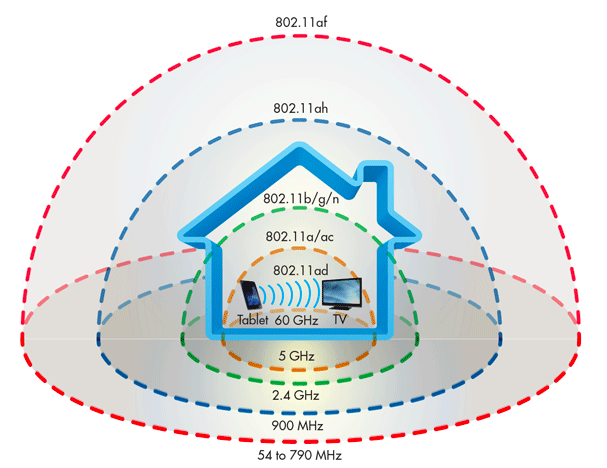
Graphic courtesy of Microwaves & RF
802.11a (1990) – The first amendment, introducing OFDM on the 5 GHz band to alleviate congestion in the 2.4 GHz spectrum.
802.11b (2000) – Brought a modest speed increase to 11 Mbps on 2.4 GHz, still widely used but now largely superseded.
802.11g (2003) – Increased maximum throughput to 54 Mbps on 2.4 GHz, offering a better balance between speed and range.
802.11n (2007) – Introduced MIMO and dual‑band support, achieving 300–450 Mbps and improving range.
802.11ac (2013) – Launched gigabit‑class speeds (up to 1 Gbps) on 5 GHz, marking the advent of “Gigabit Wi‑Fi.” Subsequent amendments further boosted performance.
Where is Wi‑Fi Heading?
While HaLow, White‑Fi, and Wi‑Gig promise to expand Wi‑Fi’s capabilities, real‑world adoption has been modest to negligible. The IEEE continues to review and refine the 802.11 family, and the next few years may see new breakthroughs or the gradual integration of these standards into mainstream devices.
Internet of Things Technology
- How Live TV Will Transform: The Computing‑Driven Future of Broadcast
- The Future of Automotive Testing: Integrating HIL Systems with RTI DDS
- Robotics in the 21st Century: Distributed Systems, Telepresence, and Space Exploration
- Digital Twin Technology: Shaping the Future of Manufacturing
- Edge Computing: The Architecture Driving Tomorrow’s Intelligent Networks
- Preparing for an Autonomous Future: How Fleet Owners Can Get Ahead
- Retaining Humanity in the Age of Disruptive Technology
- How AR & VR Are Redefining Plant Maintenance
- How AI Will Transform Human Resources: Benefits, Risks, and Implementation
- The Future of Data Centers: Trends, Tech, and Sustainability