



Designing 5G Devices: Selecting the Ideal Performance Band for Your Application
How Engineers Select the Optimal 5G Performance Band
The 5G revolution is well underway, with networks now delivering higher data rates, lower latency, and greater bandwidth than ever before. 5G is not a single technology; it comprises three distinct frequency ranges, each offering unique trade‑offs between coverage, capacity, and performance.
- Low‑band (600 MHz – 3 GHz): the most widely deployed tier, providing broad coverage and robust indoor penetration.
- Mid‑band (3 GHz – 6 GHz): balances capacity and range, ideal for urban and suburban deployments.
- Millimeter‑wave (mmWave, >10 GHz): delivers 5–10× higher data rates and 10–20× lower latency, but requires dense infrastructure and is highly susceptible to obstacles.
While low‑ and mid‑band deployments dominate current rollouts—offering faster download and upload speeds than LTE and easier installation—mmWave is the “holy grail” that will unlock true ultra‑high‑speed, ultra‑low‑latency applications such as autonomous driving, remote surgery, and real‑time gaming.
Deployment hurdles for mmWave are significant: the signal travels only about 20% of the distance of low‑band waves, cannot penetrate walls or severe weather, and demands a comprehensive infrastructure upgrade. Selecting the wrong band can inflate costs or fall short of the performance required by your application.
Markets Poised to Leverage 5G First
A recent Molex study, “The State of 5G,” surveyed R&D, engineering, and product leaders on which sectors would first generate substantial revenue from 5G. The top picks were:
- Consumer devices (43%) – gaming, smart home, wearables, security
- Industrial & IIoT (35%) – automation, robotics, smart grid, logistics
- Fixed wireless access (33%) – home connectivity
- Automotive (29%) – telematics, passenger Wi‑Fi, autonomous control
- Enterprise private networks (25%)
- Medical devices (19%) – wearables, implants, remote surgery, tele‑therapy
These findings underscore the breadth of 5G’s growth potential across consumer, industrial, and professional domains.
Key Design Considerations for 5G Devices
Successful 5G products must address three core use‑case categories:
- Enhanced Mobile Broadband (EMBB)
- Ultra‑Reliable Low‑Latency (URLL)
- Massive Machine‑Type Communication (mMTC)
At the heart of each use case lies RF antenna design. 5G’s higher frequencies demand far more antennas for Massive MIMO (mMIMO) beamforming than 4G, which in turn drives complex packaging, placement, and beam‑steering decisions. Efficient analog‑to‑digital conversion and connector technology are also critical to maintain signal integrity at these frequencies.
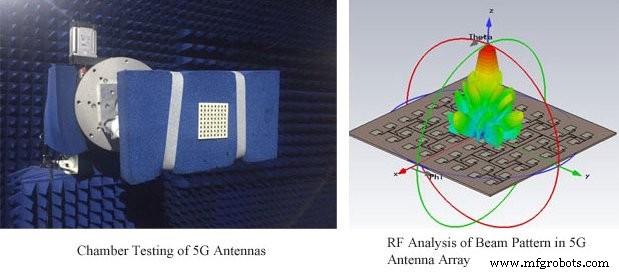 An example testing chamber for 5G antennas (left) and a representation of a beam‑pattern analysis for a 5G antenna array (right). Image from Molex
Advanced Testing for 5G Devices
Comprehensive testing—both simulation and physical—is essential to meet evolving international standards and ensure reliable performance. Even a tenth of a millimeter in antenna placement can alter a device’s behavior, making precision critical.
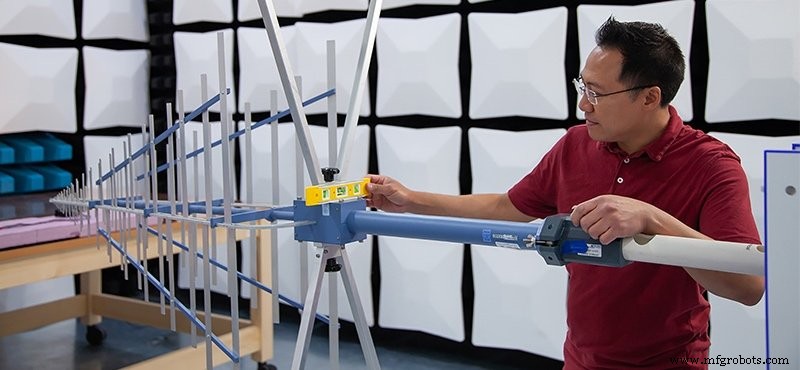 An engineer adjusts a testing chamber. Image from Molex
Testing must cover radiation emissions, beam‑forming accuracy, high‑gain antenna performance, and environmental resilience. Ultra‑high‑precision positioners and dedicated frequency‑range facilities enable accurate assessment across the entire 5G spectrum.
In short, mastering antenna design, beamforming, and rigorous testing is the pathway to reliable 5G devices that exceed international standards.
Molex supplies the components and solutions required to transition a 5G concept into market reality. As an early adopter of mmWave testing technology, Molex remains a leader in 5G design and testing expertise. Through its authorized distributor, Sager Electronics, customers gain access to an extensive Molex connectivity portfolio—plus complementary electromechanical, power, and thermal products—to build complete 5G systems.
Industry Articles provide industry partners with a platform to share news, insights, and technology. All content is subject to editorial guidelines, and opinions expressed reflect the partner’s views, not necessarily those of All About Circuits or its writers.
Internet of Things Technology
- Insertion Loss & EMI Filter Performance: Expert Guide to Optimal Design
- TI Unveils Ethernet PHYs That Streamline Design and Boost Network Performance
- Renesas Launches Ultra‑Compact 8.2‑mm Creepage Photocouplers to Shrink Industrial Automation and Solar Inverter Designs
- Low‑Cost Autonomous Inspection Robot: Design, Development, and Field Validation
- Expert Guide to Planning & Designing Power Distribution Systems
- Optimizing Blast Furnace Design for Superior Performance and Longevity
- Overcoming New Product Development Challenges: Strategies for Success
- Mastering IoT Development: Solving Key Challenges for Seamless Connectivity and Security
- Key Safety Devices & Considerations for Manufacturing Systems
- Mastering 3D Printed Lattice Structures: Design, Properties, and Performance Insights