Industrial manufacturing
 MfgRobots >> Industrial manufacturing > >> Industrial Internet of Things >> Internet of Things Technology
Internet of Things Technology

The ocean presents both challenges and opportunities. While climate change accelerates sea‑level rise—already eroding coastlines—its vast, predictable motion offers a powerful, untapped energy source.Experts such as IoT specialist Nick Booth describe the sea as a natural energy reservoir, powered by
Market Overview Modern vehicles increasingly rely on frequent over‑the‑air software updates and a dense network of on‑board sensors. As Bob Emmerson notes, this complexity demands robust security solutions to shield against unauthorised external access. The Challenge Designing a unified hardware‑so
The Internet of Things (IoT) has emerged as a powerful new business frontier, offering service providers a gateway to innovative consumer and enterprise solutions. Yet, a critical question remains: are providers delivering real value beyond mere connectivity? According to Paul Hughes, Director of St
The vision of a smarter world—where systems equipped with local processing and sensors seamlessly share data—is accelerating. Connecting these systems to one another and to end‑users empowers businesses to make data‑driven decisions. While the term “Internet of Things” (IoT) covers a wide range o
IBM and Cisco announced a global partnership a year ago to bring real‑time business insights to the network edge through IoT. Since then, the alliance has enabled enterprises across industries to harness the combined power of IBM Watson IoT in the cloud and Cisco Kinetic, our industrial IoT data‑man
Wi‑Fi is already woven into the fabric of our digital lives, yet its role will expand dramatically as every sector embraces “Smart Everything.” From entire megacities to individual homes, the demand for reliable, high‑capacity Wi‑Fi will grow exponentially. According to the United Nations, 60 % of
This blog is the fourth installment of a five‑part series exploring the tangible impact of the Internet of Things (IoT) on modern industry. Frequently, readers ask, “What concrete value does the IoT deliver?” Here we examine electric motors—critical components in factories—and illustrate how connec

Smart devices alone don’t generate profit; they create the foundation for new revenue streams. The true power lies in the interconnected ecosystem that drives the Internet of Things (IoT) from concept to commercial impact.“Anything that can connect to a computer network must do so effectively,” note
Retailers are increasingly embracing artificial intelligence (AI) to enhance the shopping experience, especially online where chatbots, search engines, and recommendation engines have already proven their value. Yet, with roughly 90% of sales still coming from physical stores and only a handful of
New CEOs often seek bold initiatives that leave a lasting mark on their organizations. Roger Fleury, Managing Director at Microsoft Dynamics provider Ardent Solutions, explains how re‑examining supply‑chain operations—particularly through demand‑driven material requirements planning (DDMRP)—can be
Today’s commercial‑vehicle makers routinely ship factory‑installed telematics modules that deliver a spectrum of fleet‑management (FM) features—either on their own or in partnership with seasoned FM providers. In Europe, heavy‑commercial‑vehicle (HCV) giants have long cultivated in‑house FM platfor

Recent weather events—from nor’easters on the East Coast and tornadoes in the South to atmospheric river floods on the West and the lingering power outages in Puerto Rico after Hurricane Maria—illustrate how extreme weather is becoming a routine disruption. For businesses unprepared for these condit
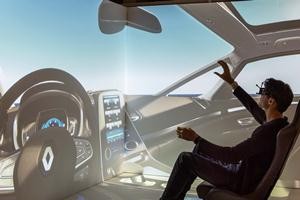
Beyond gaming, VR is reshaping how companies develop and validate products in lifelike virtual environments. As CEO of OPTIS, Jacques Delacour explains that virtual testing makes vehicle prototypes safer and accelerates time to market.In automotive testing, virtual drivers and pedestrians eliminate
It’s a pleasure to witness the rapid growth of the international IoT fleet‑management market as established players and new entrants race to seize emerging opportunities. Antony Savvas, a seasoned technology writer, argues that the fleet sector is already shaping a vital IoT ecosystem—and now mobi
On World IoT Day, April 9, we celebrate how far the Internet of Things has come. The installed base of connected devices grew from 15 billion in 2015 to 30 billion in 2020 and is projected to hit 75 billion by 2025. These devices generate insights that drive productivity, solve complex problems, an
Yash Mehta While estimates of the IoT markets potential vary, McKinsey projects it to reach between $2.7 trillion (€2.19 trillion) and $6.2 trillion (€5.04 trillion) by 2025. The number of connected devices is expected to grow five‑fold, from 27 billion in 2017 to 125 billion by 2030. Realizing thi
By 2030, autonomous vehicles are projected to comprise roughly 25 % of all passenger cars worldwide. In the UK, regulators have already approved trials of convoys of partially self‑driving lorries. While robust infrastructure, legislation and public confidence will take time to mature, fleet opera
For many of us, the smartphone has become the primary gateway to communication, entertainment, news, and commerce. According to Marco Dallabora, senior director of the Mobile Business Unit at Micron Semiconductor Italia, the smartphone remains the most frequently used digital device in daily life.
\nRobert Haim of ACG Research explains why the Internet of Things (IoT) must be fortified before malicious actors can cause harm.\nFormer U.S. Vice President Dick Cheney famously disabled wireless access to his pacemaker to avoid a terrorist‑induced heart attack. In the 2007 film “Live Free or Die H
While many organizations are experimenting with Internet‑of‑Things (IoT) initiatives, the security implications differ markedly from those in traditional IT environments. Understanding these distinct challenges is essential for a safe and effective IoT rollout.Conventional security strategies—such a
Internet of Things Technology