



Beryllium Copper vs. Regular Copper: Key Differences and Applications
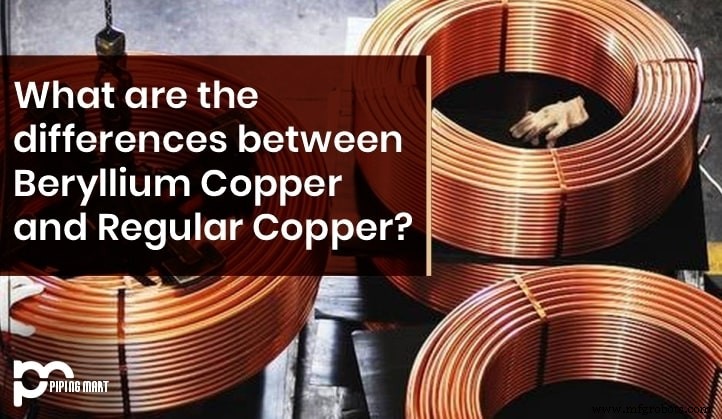
Beryllium Copper
Beryllium copper (BeCu) is a copper alloy containing up to 3 % beryllium, often blended with small amounts of cobalt, nickel, iron or zinc. It combines high tensile strength, excellent fatigue resistance, non‑magnetic behavior, and negligible spark generation. These traits make it ideal for precision components in aerospace, defense, instrumentation, and high‑performance musical instruments. Because beryllium is a respiratory irritant, machining or grinding BeCu requires proper dust control and protective equipment.
Regular Copper
Pure copper is a lightweight metal prized for its outstanding electrical and thermal conductivity, ductility, and corrosion resistance. Freshly exposed copper displays a characteristic pink‑orange luster. It is widely used in electrical wiring, heat exchangers, architectural cladding, and as a base for alloys such as sterling silver, cupronickel (used in marine hardware and coins), and constantan (a temperature‑stable alloy for strain gauges and thermocouples).
Comparing BeCu and Pure Copper
Although both materials share a copper base, their properties diverge significantly. BeCu offers superior mechanical strength while retaining a respectable conductivity of 15–30 % IACS, compared to 100 % IACS for pure copper. This balance of strength and conductivity is unique among copper alloys.
Electrical & Thermal Conductivity
• Pure copper: 100 % IACS (International Annealed Copper Standard)
• BeCu: 15–30 % IACS, still adequate for many high‑performance electrical applications.
Hardness & Formability
• Pure copper is highly malleable and weldable but lacks the hardness required for many structural parts.
• BeCu can be hardened to exceptional levels (up to 850 HB) after forming, making it suitable for springs, connectors, and wear‑resistant assemblies. It also exhibits excellent formability in both the rolling direction and transversely.
Applications
• Pure copper is chosen primarily for conductivity, corrosion resistance, and aesthetic finish—common in wiring, heat sinks, decorative fixtures, and coinage.
• BeCu is selected for its mechanical robustness and non‑spark, non‑magnetic properties—used in aerospace fasteners, high‑speed bearings, electromagnetic shielding, precision instrumentation, and safety‑critical military components.
Safety Considerations
Handling BeCu requires strict adherence to occupational safety guidelines due to the potential for beryllium dust inhalation, which can cause chronic beryllium disease. Pure copper poses no such respiratory hazard.
Metal
- Tungsten Silver vs. Tungsten Copper Alloys: Key Differences & Applications
- Aluminum vs. Steel Piano Hinges: Which Material Wins for Weight, Strength, and Corrosion Resistance?
- Electropolishing vs. Passivation: Choosing the Right Metal Finish
- Copper, Bronze, and Brass: How to Distinguish Between Them
- Copper, Brass, and Bronze: Key Differences and Practical Uses of Red Metals
- Java vs. C#: 10 Key Differences Explained
- Java vs Python: Core Differences and Choosing the Right Language
- PLCs vs RTUs: Key Differences and Market Trends
- SCADA vs. HMI: Key Differences and Their Role in Industry 4.0
- Understanding G‑Code vs M‑Code: Key Differences for CNC Operators