



Java vs Python: Core Differences and Choosing the Right Language
What is Java?
Java is a platform‑agnostic, object‑oriented language that runs on the Java Virtual Machine (JVM). First released by Sun Microsystems in 1995 and now maintained by Oracle, Java powers everything from Android apps to enterprise web services.
In this comparison you’ll learn:
- The fundamentals of Java and Python
- Why developers choose each language
- Key historical milestones
- Features, advantages, and trade‑offs
- Use‑case scenarios and industry adoption
- Salary expectations and career paths
What is Python?
Python is a high‑level, dynamically typed language known for its readability and concise syntax. Developed by Guido van Rossum and first released in 1991, Python excels in rapid prototyping, scientific computing, and data science, thanks to a rich ecosystem of libraries.
Key Differences
- Java is a compiled language that executes on the JVM; Python is an interpreted language that runs directly from source code.
- Java is statically typed, requiring explicit type declarations; Python is dynamically typed, resolving types at runtime.
- Java’s learning curve is steeper, especially for concurrency and memory management; Python’s syntax is often praised for its simplicity.
- Java uses curly braces and semicolons to delimit blocks; Python relies on indentation for block structure.
- Java supports single inheritance and multiple inheritance through interfaces; Python allows both single and multiple inheritance directly.
- String manipulation in Java is more verbose; Python provides extensive built‑in string methods.
- Java code can run on any device with a JVM; Python requires an interpreter installed on the target system.
- Java excels in large‑scale, high‑performance backend services; Python shines in data science, machine learning, and quick scripting.
- Java’s bytecode is compiled to machine‑independent code, often delivering faster runtime performance compared to Python’s interpreter overhead.
Why Java?
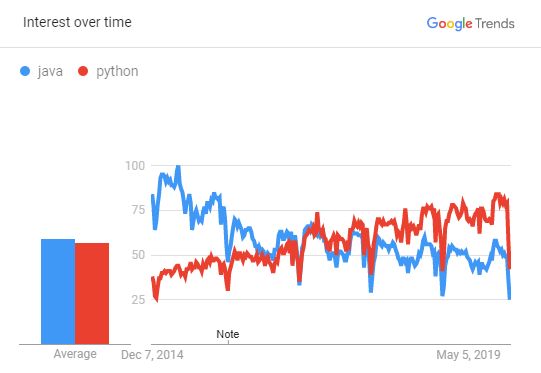
- Comprehensive documentation and community support.
- Extensive library ecosystem (e.g., Spring, Hibernate).
- Strong multithreading and concurrency support.
- Robust tooling (IDE, build tools, profilers).
- Enterprise‑grade performance and stability.
Why Python?
- Readable, English‑like syntax reduces onboarding time.
- Rapid development cycle and interactive shell.
- Wide array of scientific and machine‑learning libraries (NumPy, Pandas, TensorFlow).
- Cross‑platform portability; runs on Windows, macOS, Linux, and embedded devices.
- Strong support for both procedural and functional programming styles.
- Growing adoption in AI, IoT, and web development.
History of Java
- Originated as “Oak” for interactive television, renamed “Java” in 1995 to target the Web.
- Acquired by Oracle in 2009, which now oversees Java SE, EE, and the OpenJDK.
History of Python
- Conceptualized in 1988, first implementation released in 1991.
- First public release (0.9.0) in 1991; version 1.0 launched in 1994.
- Maintained by an active core team, with Guido van Rossum still guiding its evolution.
Comparison Table
| Parameter | Java | Python |
|---|---|---|
| Compilation | Compiled to bytecode (JVM) | Interpreted by CPython |
| Typing | Static | Dynamic |
| String Operations | Limited standard library methods | Rich set of string methods |
| Learning Curve | Steeper | Gentle |
| Multiple Inheritance | Via interfaces | Direct support |
| Block Delimiters | Curly braces and semicolons | Indentation |
| Performance | Generally faster due to JIT and bytecode | Interpreted overhead leads to slower execution |
| Portability | Runs on any JVM | Requires interpreter on target machine |
| File I/O | ~10 lines for simple read | ~2 lines with built‑ins |
| Runtime Architecture | JVM bytecode execution | CPython bytecode translation |
| Popular Back‑end Frameworks | Spring, Jakarta EE | Django, Flask |
| ML Libraries | Weka, Deeplearning4j | TensorFlow, PyTorch |
| Game Engines | JMonkeyEngine | Cocos2d, Panda3D |
| Industry Adoption | Airbnb, Netflix, Spotify, Instagram | Uber, Dropbox, Google, Airbnb (Python‑heavy) |
| Key Strengths | Robust tooling, scalability, performance | Rapid development, readability, data science |
| Typical Use‑Cases | Enterprise back‑ends, Android, high‑performance services | Data analysis, AI, scripting, web dev |
| Database Connectivity | JDBC – stable, mature | DB‑API – flexible but varies by driver |
| Code Sample | public class HelloWorld {
public static void main(String[] args) {
System.out.println("Hello, World!");
}
} |
print("Hello, World!") |
| TIOBE Rank | 1 | 3 |
| Average Salary (US) | $103,464 | $118,626 |
Disadvantages of Java
- Just‑in‑time compilation can introduce startup latency.
- Memory footprint is higher compared to lightweight scripting languages.
- Limited low‑level control; no explicit pointer manipulation.
- Garbage collection is automatic but offers limited fine‑grained tuning.
Disadvantages of Python
- Interpreter overhead results in slower execution for CPU‑intensive tasks.
- Less suitable for mobile or embedded development without additional tooling.
- Dynamic typing can lead to runtime errors that static analysis misses.
- Database abstraction layers are less mature in some contexts.
Summary
Core Differences
Java is a statically typed, compiled language with robust concurrency support, while Python is a dynamically typed, interpreted language celebrated for its simplicity and data‑science ecosystem.
Choosing the Right Language
For large‑scale, performance‑critical back‑ends and mobile applications, Java remains the go‑to choice. For rapid prototyping, scientific research, and AI projects, Python’s expressive syntax and extensive libraries give it a decisive edge. Ultimately, the decision hinges on project requirements, team expertise, and long‑term maintenance goals.
Java
- Beryllium Copper vs. Regular Copper: Key Differences and Applications
- C vs Java: A Comprehensive Comparison of Features, History, and Applications
- JDK, JRE, and JVM Explained: Key Differences and How They Work Together
- Java vs. C#: 10 Key Differences Explained
- Python vs JavaScript: Key Differences, Features, and When to Choose Each
- Python vs Ruby: A Comprehensive Comparison of Features, Advantages, and Use Cases
- Python 2 vs Python 3: Key Differences and Choosing the Right Version
- Flush-Head vs. Concealed-Head Fasteners: Key Differences Explained
- Alloy Steel vs. Carbon Steel: Key Differences Explained for Optimal Material Selection
- SCADA vs. HMI: Key Differences and Their Role in Industry 4.0