



Ti0.91O2/CdS Hybrid Spheres: Synthesis, Structural Characterization, and Exceptional Indirect Optical Transition
Abstract
We report the fabrication of Ti0.91O2 nanosheet/CdS quantum‑dot hybrid spheres by a layer‑by‑layer self‑assembly route. Photoluminescence (PL) measurements reveal a pronounced spectral shift and a markedly prolonged PL lifetime of 3.75 ns, compared with 0.43 ns for Ti0.91O2 alone and 0.35 ns for CdS. The enhancement arises from a new type‑II indirect optical transition (IOT) that spatially separates electrons in Ti0.91O2 and holes in CdS, thereby extending carrier recombination time. These findings establish a robust platform for photovoltaic and optoelectronic devices that require efficient charge separation.
Background
Semiconductor composites that combine the conduction and valence band edges of two materials offer superior performance in photovoltaic and light‑emitting devices [1–4]. Type‑II heterostructures, where electrons and holes reside in different layers, are particularly attractive because they can lengthen carrier lifetimes and suppress recombination [5–11]. TiO2 is a well‑studied photocatalyst but its wide bandgap (3.2 eV) limits visible‑light activity. Coupling TiO2 nanosheets with CdS quantum dots (bandgap 2.4 eV) can shift absorption into the visible and improve charge extraction [14–18, 19–21]. While TiO2/CdS composites have been extensively studied, the fundamental photophysics of Ti0.91O2/CdS hybrid spheres remains underexplored. This work addresses that gap by characterizing PL spectra, time‑resolved PL decay, and the underlying charge‑transfer mechanisms in these nanostructures.
Methods
Synthesis of Hybrid Spheres
Poly(methyl methacrylate) (PMMA) spheres were first coated with protonic polyethylenimine (PEI) to provide a positively charged surface. Alternating layers of negatively charged Ti0.91O2 nanosheets and CdS nanoparticles were then deposited via electrostatic adsorption. Repeating the PEI/Ti0.91O2/PEI/CdS cycle produced multilayered PEI/Ti0.91O2/PEI/CdS hybrid spheres. Microwave irradiation removed PEI and decomposed the PMMA core, yielding hollow Ti0.91O2/CdS spheres; residual PMMA was extracted with tetrahydrofuran (THF). The resulting solid and hollow hybrid spheres were characterized by TEM and SEM.
Optical Characterization
Samples were spin‑coated onto silica coverslips and excited with 266 nm and 400 nm laser pulses generated from a Ti:Sapphire laser (800 nm fundamental) using second‑ and third‑harmonic conversion. PL spectra were recorded with an Acton SP‑2500i monochromator and a Princeton Instruments CCD. Time‑resolved PL (TRPL) decay was measured using a 250 ps single‑photon counting system, with band‑pass filters at 450, 500, and 550 nm.
Results and Discussion
Structural Confirmation. SEM and TEM images confirm smooth, micron‑scale hollow spheres with alternating Ti0.91O2 layers and CdS quantum dots (Figure 1b–d). XRD patterns show characteristic peaks of cubic CdS (peaks 2 and 4) absent in pure PMMA, confirming successful composite formation. XPS spectra (Figure 1f) verify the Ti0.91O2/CdS composition.
Photoluminescence Spectra. At 266 nm excitation, Ti0.91O2 emits near 450 nm and CdS near 530 nm. The Ti0.91O2/CdS hybrid emits a blue‑shifted peak at 500 nm, indicating an IOT at the interface. This shift is absent at 400 nm excitation, suggesting selective activation of the type‑II pathway.
Time‑Resolved PL. Biexponential fitting of TRPL data yields average lifetimes of 0.43 ns (Ti0.91O2) and 0.35 ns (CdS). The hybrid spheres exhibit a substantially extended lifetime of 3.75 ns, evidencing reduced recombination due to spatial charge separation. Solid hybrids (with residual PEI/PMMA) show slightly longer lifetimes (4.25 ns) than hollow ones (3.69 ns), underscoring the importance of removing insulating surfactants to enhance charge transfer.
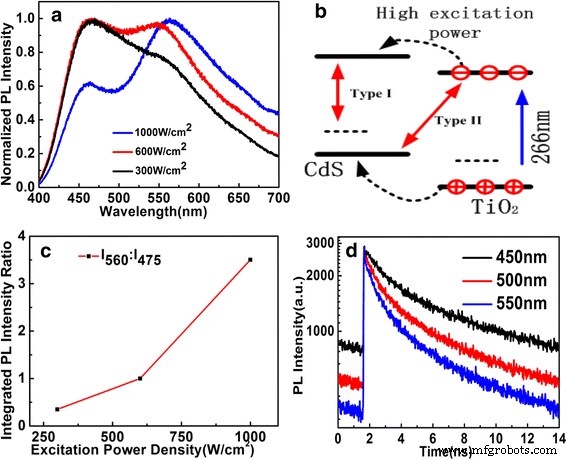
Excitation Power Dependence. Increasing 266 nm power shifts the PL peak from 475 nm to 560 nm, reflecting a competition between type‑II (Ti0.91O2 → CdS) and type‑I (CdS internal) recombination channels. The 560 nm emission grows more rapidly with power, but remains weaker overall, indicating that electron transfer to CdS conduction band plays a minor role in emission.
Wavelength‑Dependent TRPL. Decay lifetimes at 450 nm (3.72 ns) exceed those at 550 nm (1.61 ns), confirming that recombination at the Ti0.91O2/CdS interface is longer due to reduced electron–hole overlap. This extended lifetime is advantageous for photovoltaic applications where charge extraction is critical.
Linear J–V measurements (Supplementary Fig. S4) show enhanced photocurrent after CdS sensitization, further supporting the superior charge‑separation performance of the hybrid spheres.
Conclusions
We have demonstrated a novel indirect optical transition in Ti0.91O2/CdS hybrid spheres that produces a blue‑shifted PL emission and a dramatic increase in lifetime. The type‑II electron–hole separation across the Ti0.91O2/CdS interface underpins this behavior. By tuning excitation wavelength and power, we can modulate the emission characteristics, offering a tunable platform for optoelectronic and photovoltaic devices.
Abbreviations
- IOT
- Indirect optical transition
- PL
- Photoluminescence
- PMMA
- Polymethyl methacrylate
- QDs
- Quantum dots
- TRPL
- Time‑resolved photoluminescence
Figure 1. (a) Energy band diagram of Ti0.91O2 and CdS. (b) SEM image of hybrid spheres. (c) TEM of solid spheres. (d) TEM of hollow spheres. (e) XRD patterns. (f) XPS spectrum.
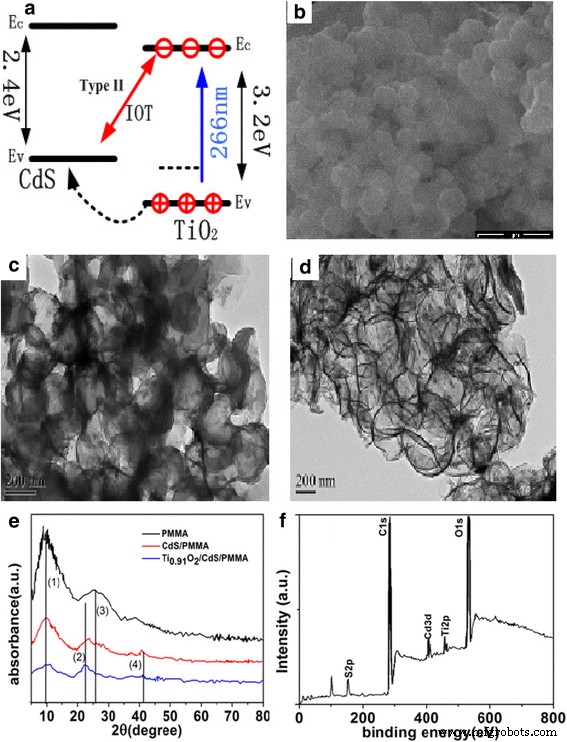
Figure 2. (a) PL spectra of Ti0.91O2, CdS, and Ti0.91O2/CdS at 266 nm. (b) TRPL decay curves.
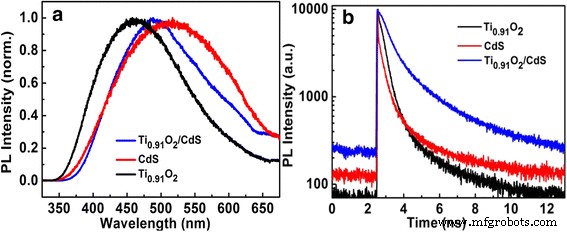
Figure 3. (a) PL spectra of hollow vs. solid Ti0.91O2/CdS at 266 nm. (b) TRPL decay curves. (c) PL spectra at 400 nm. (d) TRPL decay at 400 nm.
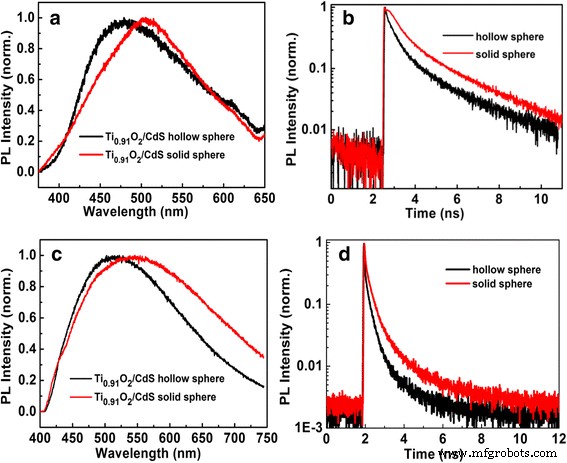
Figure 4. (a) Power‑dependent PL spectra. (b) Schematic of electron transfer at high power. (c) Integrated intensity ratio of 560 nm/475 nm. (d) TRPL lifetimes at 450, 500, and 550 nm.
Nanomaterials
- Efficient Synthesis and Optical Characterization of Sub‑Micron Selenium Nanocrystals and Nanorods
- Cellulose–POSS–Silica/Gold Core–Shell Hybrid Nanocomposites: One‑Step Sol‑Gel Synthesis and Multifunctional Properties
- Electroless HF/AgNO3 Etching of n‑Si(100) Wafers: High‑Density Silicon Nanowire Arrays with Low Reflectance and Ohmic Conductance
- Optimizing Gold Nanoparticle Placement in TiO₂ Enhances Dye‑Sensitized Solar Cell Efficiency
- Heat Transfer and Flow Enhancement of TiO2‑Water Nanofluids in Spirally Fluted vs. Smooth Tubes
- Chromium‑Doped Titanium Dioxide: A Novel Colored Cool Pigment with High Near‑Infrared Reflectance
- Titania Nanotube Arrays via Electrochemical Anodization: Synthesis, Modifications, and Biomedical Applications
- Fe3O4@C Core–Shell Nanoparticles: Hydrothermal Synthesis and Magnetic Removal of Heavy Metals from Water
- Dual‑Mode MRI/Fluorescence Nanoprobe cRGD‑Gd‑Cy5.5 for Targeted Imaging of Integrin αvβ3‑Positive Tumors
- Hierarchical Au@CdS‑CdS Nanoflowers: Stepwise Fabrication and Superior Photocatalytic Performance