



IBM 5 in 5: On‑Chip Medical Labs Detect Disease at the Nanoscale
Early detection dramatically improves outcomes. For instance, breast and prostate cancers diagnosed at stage I achieve almost 100 % five‑year survival, whereas stage IV rates drop to 26 % and 28 %, respectively.
Despite this, many patients seek care only after symptoms appear, by which time the disease has progressed. Current screening methods—such as mammography—are often uncomfortable, inconvenient, and can lack accuracy.
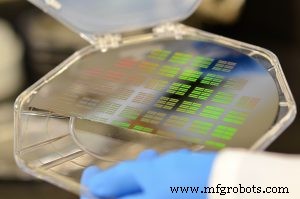
A silicon wafer designed to sort particles from bodily fluids for early disease detection.
IBM’s Nanobiotechnology group is pioneering a new class of diagnostic tools: micro‑ and nano‑technological lab‑on‑chip devices that act as “health detectives,” probing bodily fluids for nanoscopic biomarkers before symptoms arise. In the next five years, we anticipate these devices, powered by artificial intelligence, will enable routine, at‑home screening for conditions such as cancer, infectious diseases, and neurodegenerative disorders.
Why It Matters
Late‑stage cancer treatments can cost $10,000–$30,000 per month. Early detection not only saves lives but also reduces financial risk, with potential cost savings of thousands of dollars per patient. Making early screening as simple as a home pregnancy test could transform the economics of cancer care and lessen its emotional toll.
How It Works
The core technology is nanoscale deterministic lateral displacement (nanoDLD), a silicon chip featuring an asymmetric pillar array. This design separates particles by size: larger entities—such as exosomes carrying disease signals—are deflected along the pillar asymmetry, while smaller particles move in a zig‑zag path. The process is akin to traffic flow on a freeway: large “truck” particles shift lanes, whereas smaller “car” particles travel straight.
Captured particles are then analyzed, and the resulting signal is combined with data from IoT devices—sleep monitors, smartwatches, etc.—to produce a comprehensive health snapshot via cognitive systems.
Supporting Research
Key publication: Wunsch, B. H., et al. “Nanoscale lateral displacement arrays for the separation of exosomes and colloids down to 20 nm.” Nature Nanotechnology.
Patent: US 9,012,329 – “Nanogap in‑between noble metals.”
For more on IBM’s future technology outlook, read the full IBM 5 in 5 predictions.
Nanomaterials
- Cloud‑Enabled EDA: Accelerating Chip Innovation and Cost Efficiency
- Innodisk: Advanced AIoT Memory & Storage for Medical Innovation
- IBM Engineers Develop Nanoscopic Thermometer, Enabling Precise Temperature Mapping of Quantum Devices
- IBM and Warwick Scientists Capture First High‑Resolution Image of Triangulene, a Highly Reactive Triangular Molecule
- How COVID-19 Is Transforming Global Supply Chains: Lessons and Strategies
- Is Blockchain Ready to Revolutionize Supply Chain Management?
- 9T Labs Elevates Additive Manufacturing for Advanced Medical & Aerospace Applications
- Choosing the Best Materials for Medical Device Prototypes
- Top 4 Digital Transformation Challenges for Medical Device OEMs
- How 5G Will Revolutionize IoT and Industrial IoT