



IBM and Warwick Scientists Capture First High‑Resolution Image of Triangulene, a Highly Reactive Triangular Molecule
Triangulene gets its first close‑up thanks to IBM and University of Warwick researchers.
(7 April, UPDATE: the paper is featured on the cover of the April issue of Nature Nanotechnology).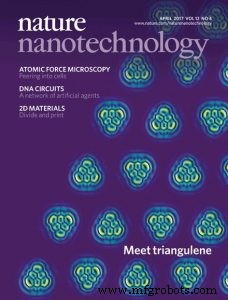
The April 2017 Volume 12 No 4 of Nature Nanotechnology. Image credit Niko Pavlicek, IBM Research. Cover design: Bethany Vukomanovic
Published today in Nature Nanotechnology, IBM scientists are making the invisible visible.
A few weeks ago IBM released its annual five predictions for the next five years. Now, researchers in Zurich add a sixth prediction: the ability to image and manipulate the smallest known molecules with unprecedented precision.
Traditionally, molecules such as pentacene, olympicene, hexabenzocoronene, and cephalandole A are depicted with 2‑D stick models. Thanks to a microscopy method introduced by IBM in 2009, scientists worldwide can now capture these structures in remarkable detail, sometimes for the first time decades after their theoretical proposal.
“Seeing individual molecules at such high resolution is transformative for chemists, especially for unusual or highly reactive species,” says Prof. David Fox, University of Warwick.

Prof. David Fox, University of Warwick, first collaborated with IBM Research in 2012.
The IBM team, featuring two ERC grant winners—Leo Gross and Gerhard Meyer—also performs atomic manipulation, enabling controlled chemical reactions on a surface.
Last year, in partnership with CiQUS at the University of Santiago de Compostela, the team triggered and observed a Bergman cyclisation, while the previous year they visualized arynes—short‑lived, highly reactive molecules first proposed 115 years ago—confirming their existence.
Today, IBM researchers and Warwick chemists have synthesized and characterized triangulene (Clar’s hydrocarbon), a molecule first hypothesized in 1953 but previously deemed too unstable to isolate.
“We added an extra ring to the olympicene framework, increasing complexity but ultimately producing a molecule with fascinating properties,” explains Anish Mistry, University of Warwick.
First author Niko Pavliček, IBM, notes that “we used our atomic manipulation technique from the aryne and Bergman studies to generate triangulene, a previously unsynthesised, highly reactive species with notable magnetic characteristics.”
The work builds on IBM’s pioneering combination of scanning tunneling microscopy (STM) and atomic force microscopy (AFM), technologies that earned former IBM scientists Nobel and Kavli Prizes in the 1980s.
In this study, the STM tip removed two hydrogen atoms from a precursor molecule through voltage‑induced tunneling electrons. The resulting product was imaged at lower voltages to reveal its molecular orbitals. Density functional theory calculations corroborated that triangulene retains its intrinsic properties when adsorbed on a surface.
The AFM, equipped with a carbon‑monoxide–terminated tip, resolved the planar molecule’s six fused benzene rings, forming a symmetric triangle—its first high‑resolution image.
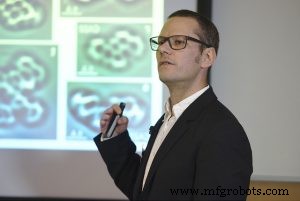
IBM scientist Leo Gross co‑developed the AFM technique used to image triangulene.
Gross explains, “While sigma‑radicals typically bond with copper, triangulene—being a pi‑radical with delocalized unpaired electrons—does not form such bonds on copper, a surprising result that highlights its unique electronic structure.”
Unpaired electrons give rise to magnetic moments at the molecular scale. In conventional hydrocarbons, paired electrons cancel spin effects, but triangulene’s delocalized spins produce measurable magnetism, a property with potential spintronic applications.
Pavliček envisions “triangulene‑like segments incorporated into graphene nanoribbons as a promising route to organic spintronic devices.” Graphene nanoribbons are also being explored for lightweight, high‑strength composites.
“We demonstrated that triangulene’s magnetism persists on xenon or sodium chloride surfaces,” Pavliček adds. “However, our current STM/AFM lacks a magnetic field, leaving the detailed magnetic states and excitations open for further study.”
This research is part of IBM’s new Collaborative Consortium, the IBM Research Frontiers Institute, which brings together members to develop breakthrough technologies and assess business impacts.
Funding was partially provided by the European Commission through the Horizon 2020 PAMS and ITN QTea projects and ERC grants CEMAS and AMSEL.
Save
Nanomaterials
- IBM Engineers Develop Nanoscopic Thermometer, Enabling Precise Temperature Mapping of Quantum Devices
- IBM Master Inventor Lukas Czornomaz: From an 8‑Year‑Old Circuit Builder to Pioneering Hybrid CMOS Technology
- IBM Researchers Measure Energy Levels of Individual Molecules on Insulating Layers Using Atomic Force Microscopy
- IBM Researchers Demonstrate Groundbreaking Rocking Brownian Motors for Precise Nanoparticle Separation
- FRP Grating Lead Times & Why DEFI Is the Industry’s Trusted Choice
- Hexagonal Boron Arsenide as a Highly Sensitive SO₂ Gas Sensor: A First‑Principles Study
- CNT@Li₂FeSiO₄@C Core‑Shell Heterostructure: A Robust Cathode for High‑Performance Lithium‑Ion Batteries
- Why Smart Factories are Essential for Modern Manufacturing
- First-Time Car Insurance: A Step-by-Step Guide to Secure Affordable Coverage
- Reflector-o-Lay: Pioneering Reflective Filament for Advanced 3D Printing