



IBM Breakthrough: Controlling a Single Copper Atom’s Magnetism via NMR
IBM Research has pioneered a technique that precisely controls the magnetism of a single copper atom, laying the groundwork for atomic‑scale data storage and quantum computation.
In a recent publication in Nature Nanotechnology, we demonstrated that nuclear magnetic resonance (NMR) can be applied to a single copper nucleus, a method that underlies magnetic resonance imaging (MRI) and the structural analysis of molecules.
This is the first time single‑atom NMR has been achieved using a scanning tunneling microscope (STM), IBM’s Nobel‑winning invention that allows atoms to be imaged and positioned individually. By scanning the ultra‑sharp tip of the STM’s metal needle across a surface, the instrument can detect the shape of single atoms and even reposition them to study how NMR signals vary with their local environment.
Performing NMR on a single atom requires two key steps: first, we polarize the nucleus’s magnetic orientation; second, we manipulate that orientation by delivering radio‑frequency pulses directly from the STM tip, tuned to the nucleus’s natural resonance frequency.
The copper atom with a magnetic heart
Copper is ubiquitous—from electrical wiring to microchip circuitry—thanks to its exceptional conductivity. While bulk copper is diamagnetic and not attracted to magnets, an isolated copper atom can exhibit magnetism when it is not surrounded by other copper atoms.
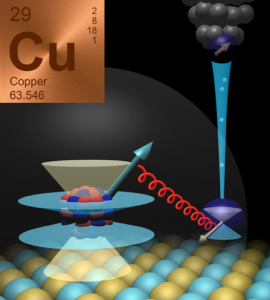
An artist’s view of the nuclear magnetism of a single copper atom. Cones represent different orientations of the nucleus’s magnetic north pole (left) and the electron’s (right). The red spring illustrates their magnetic coupling. An STM tip current controls the atom’s magnetism.
At the atomic scale, a lone copper atom becomes magnetic because its unpaired electrons orbit the nucleus—its “heart”—and generate a magnetic field. When we bonded the copper atom to a carefully chosen magnesium oxide surface, the resulting hyperfine interaction between the electron and nucleus aligned their magnetic moments, creating a detectable magnetic signal.
Harnessing nuclear magnetism
The nuclear magnetic moment is extremely weak, so its orientation fluctuates with thermal motion even at cryogenic temperatures. In MRI, a large external field aligns billions of nuclei, but thermal noise still limits signal strength. To control a single nucleus, we use the surrounding electron as a mediator: its hyperfine coupling nudges the nucleus into a desired orientation, and we then read the resulting state via the same electron.
Our STM tip is specially engineered with a single iron atom at its apex, enabling the precise delivery of radio‑frequency energy and the detection of the faint nuclear signal.
Single‑atom NMR via current‑controlled initialization
By passing an electric current through the STM tip, we transfer the tip’s magnetic orientation to the copper nucleus—an approach analogous to spin‑transfer torque used in MRAM memory technology. Once the nucleus is initialized, we read its state by exploiting electron spin resonance (ESR) on the same atom, a technique we refined in a 2023 study.

An artist’s view of single copper atoms (red) on a magnesium oxide surface. The STM tip (gray pyramid) probes a copper atom by conducting electric current.
We further advanced this work by demonstrating that a radio wave transmitted from the STM tip can induce NMR in a single copper nucleus. The nucleus, being magnetic, precesses in the external field like a spinning top, and its four possible orientations correspond to distinct quantum states. By tuning the radio‑frequency to the nucleus’s resonant frequency, we can rotate its spin with high precision.
This capability—combining atomic‑scale positioning, single‑atom NMR, and electrical control—opens a pathway to building nanoscale magnetic and electronic devices that leverage nuclear spins for quantum information processing.
Reference
Electrically controlled nuclear polarization of individual atoms, Kai Yang, Philip Willke, Yujeong Bae, Alejandro Ferrón, Jose L. Lado, Arzhang Ardavan, Joaquín Fernández‑Rossier, Andreas J. Heinrich, Christopher P. Lutz, Nature Nanotechnology. doi:10.1038/s41565-018-0296-7 (2018)
Nanomaterials
- IIC and OpenFog Unite to Lead Distributed Computing for Industrial IoT
- In‑House Production: The Fuse 1 Builds Its Own Parts
- Harnessing Data in the Internet of Reliability: Strategies for Effective Management
- Measuring the Magnetic Signature of a Single Atom’s Nucleus
- Revealing History: How 3D Printing Transforms Archaeology and Paleontology
- Exfoliation of Trigonal Tellurium: Toward Ultra‑Thin Single‑Atom Chains
- Copper Electroplating Project: Build a Smart System with Arduino UNO
- How Metal Alloys Shape Craft Beer Flavor
- Unlocking Modern Manufacturing: The Power of Advanced Controls & CAD/CAM Technology
- Copper’s Powerful Antimicrobial Power: A Game-Changer for Healthcare & Beyond