



Measuring the Magnetic Signature of a Single Atom’s Nucleus
IBM Research – Almaden, located in Silicon Valley, has, for the first time, measured the magnetic field generated by the nucleus of a single atom. The discovery, published in the journal Science, demonstrates that the subtle magnetic influence of a nucleus can be detected via its effect on the surrounding electrons. This technique delivers isotopic information—specifically the neutron count—and maps how an atom’s magnetization changes with its local atomic environment. The result opens a new frontier for nanoscale sensing and is a pivotal advance toward nuclear‑based spintronic devices.

Figure 1: Sketch of the experiment. Each red ball represents a magnetic atom bonded to a surface. Some naturally have a nuclear spin, a small magnet, in their core. The sharp tip of a STM probes a single magnetic atom. Image courtesy QNS.
Collaborating with the Center for Quantum Nanoscience (QNS), the University of Oxford, and the International Iberian Nanotechnology Laboratory, we positioned isolated iron and titanium atoms on a meticulously prepared substrate. The measurements were performed with a scanning tunneling microscope (STM)—IBM’s Nobel‑prize‑winning instrument—which employs a nanometre‑sharp metallic tip to image and manipulate individual atoms with atomic precision.
In 2021, our team demonstrated the ability to detect an atom’s electronic magnetism and exploit it as a nanoscale magnetic probe. Building on that work, we have now pushed the sensitivity to the nuclear level, uncovering the far weaker magnetic signature of the atom’s core.

Figure 2: Scanning tunneling microscope image of the magnesium oxide surface, where the small protrusions are individual iron atoms. Image courtesy QNS.
The hyperfine interaction—the coupling between nuclear spin and electronic states—provides a conduit for detecting nuclear magnetism. We observed that relocating a single atom or bringing a second atom into proximity altered the hyperfine splitting. By using the STM to reposition individual atoms, we demonstrated that this interaction is highly sensitive to the chemical bonding environment. For example, a titanium atom bonded to four neighbors exhibited a markedly stronger hyperfine signal than when isolated atop a single oxygen atom. The data also revealed that neighboring magnetic atoms modulate the interaction, thereby illustrating how the combined magnetism follows quantum mechanical rules.
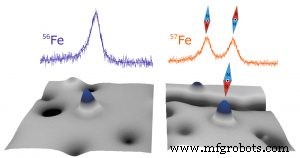
Figure 3: Two iron atoms, seen as blue hills in the lower images, having different isotopes. The right atom is the isotope iron-57, which has a nuclear spin. As a result, two peaks are observed in its energy spectrum, corresponding to the two possible orientations for the spin of the nucleus. Image courtesy QNS.
An atom’s nucleus consists of protons and neutrons; the proton count defines the element, while the arrangement of neutrons gives rise to different isotopes. Nuclear magnetism originates from spin—a quantum property that behaves like a tiny rotating charged sphere. Only select isotopes possess a nuclear spin, producing a minuscule magnetic field comparable to that of the Earth’s core. Detecting this field is exceptionally challenging; conventional MRI, for instance, relies on the collective signal from trillions of nuclei.
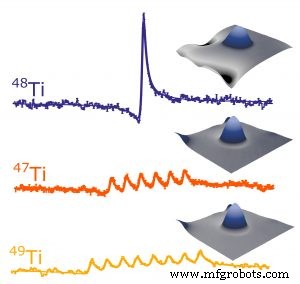
Figure 4: Energy spectra measured on individual titanium atoms. Two isotopes have a high nuclear spin and thus display multiple peaks, one peak for each orientation of the nucleus. Image courtesy QNS.
To probe a single nucleus, we harness the magnetic field of its surrounding electrons. Although electron spins generate a field roughly a thousand times stronger than that of a nucleus, measuring them at the single‑atom level remains demanding. Our approach combines ultra‑low temperatures, vibration isolation, and cryogenic vacuum to keep the atoms immobile and the measurements noise‑free.
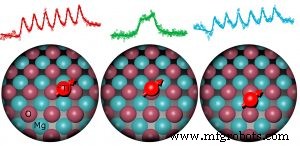
Figure 5: A single titanium atom is moved to three different positions on the surface. This changes the spectrum, because the interaction with the nuclear spin is sensitive to the chemistry of the binding site. Image courtesy QNS.
We employ spin‑resolved electron spin resonance (ESR) with the STM tip as both probe and antenna. By tuning the microwave frequency to the electron precession rate—billions of cycles per second—we detect shifts in the resonant frequency that reflect subtle changes in the local magnetic field. This method allows us to resolve the spin state of a single atom while simultaneously imaging its position and the surrounding lattice, providing an unprecedented view of magnetic interactions at the atomic scale.
Previously, we used this technique to map the magnetic fields of neighboring iron and titanium atoms on the surface. We also discovered that isolated holmium atoms act as stable, nanoscale magnetic memories. These foundational studies culminated in the current breakthrough, wherein we successfully measured the magnetism of an individual nucleus and extracted its isotopic information.
Paper: Hyperfine interaction of individual atoms on a surface
Nanomaterials
- Single‑Arm vs Multi‑Arm Levers: How They Differ and Which to Choose
- IBM Nanoscientists Store a Data Bit on a Single Atom—A Breakthrough in Ultra‑Miniaturized Memory
- IBM Breakthrough: Controlling a Single Copper Atom’s Magnetism via NMR
- IBM Researchers Measure Energy Levels of Individual Molecules on Insulating Layers Using Atomic Force Microscopy
- Exfoliation of Trigonal Tellurium: Toward Ultra‑Thin Single‑Atom Chains
- Hexagonal Boron Arsenide as a Highly Sensitive SO₂ Gas Sensor: A First‑Principles Study
- Choosing the Right ERP Strategy: Best-of-Breed vs. All-in-One Suites
- Build an Accurate Heart‑Rate Monitor with a Photoresistor and Arduino
- How Many Lights Can Fit on a Single Circuit Breaker? Expert Guide for 15A, 20A & 10A Circuits
- Determining the Number of Outlets per Circuit Breaker: A Practical Guide