



IBM Nanoscientists Store a Data Bit on a Single Atom—A Breakthrough in Ultra‑Miniaturized Memory
Imagine fitting the entire iTunes library of 35 million songs onto a credit‑card‑sized device. While still a dream, a recent study by IBM Research‑Almaden in San Jose, California, brings us closer to that reality. Published in Nature, the research shows how to read and write one bit of data on a single atom—remarkably, a whole hard‑disk drive uses 100,000 to one million atoms for a single bit.

A single holmium atom, a rare earth element, serves as the world’s smallest magnet to encode one bit of data.
How It Works
Bits— the fundamental units of information—can only assume the values 0 or 1, much like a light switch. Determining the minimum number of atoms needed to create a reliable magnetic bit has been a longstanding challenge. In this study, the team engineered the smallest magnet ever: a single holmium atom. Attached to a magnesium oxide surface, the atom’s north and south poles remain stably aligned even when neighboring magnets interfere. These two orientations define the bit’s 0 and 1.
A custom, IBM‑invented, Nobel‑prize‑winning scanning tunneling microscope (STM) delivers a focused current that flips the atom’s magnetic orientation, enabling the “write” operation. The same STM measures the resulting magnetic current to read the bit’s value. This dual read/write capability marks a significant milestone in atomic‑scale memory technology.
Meet the Researchers

Christopher Lutz, IBM nanoscience researcher, uses the STM to record data on the world’s smallest magnet.
Christopher Lutz, a physicist with a background in computer science, has long been a pioneer in atom‑scale manipulation. After a brief hiatus from his UC Santa Cruz doctoral program, he joined IBM Research‑Almaden in 1985, where he built a parallel computer to simulate atomic physics. Collaborating with Nobel laureate Don Eigler and later with Andreas Heinrich, Lutz has led over 25 years of groundbreaking research, including the creation of the world’s smallest movie, “A Boy and His Atom.”
“I view the world as a series of computations,” Lutz explains. “By arranging atoms with nanometer precision, we can build logic gates and, as shown in this study, a single atom can reliably store a data bit.”
Post‑doctoral researcher Kai Yang, originally from a small city in China, joined the team after volunteering as a campus tour guide during an IBM visit. He recalls how close the project came to failure: after a month of failed attempts to detect two stable magnetic states, the team faced a six‑week deadline. Working day and night, they finally succeeded at 4 a.m. with a breakthrough pulse‑current technique, a result they published in Nature.
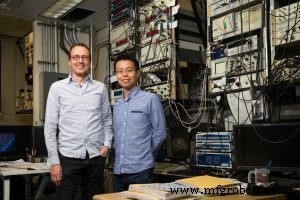
IBM nanoscientists Christopher Lutz (left) and Kai Yang (right) at IBM Research‑Almaden.
Thanks to this work, Yang has been recognized as one of MIT Technology Review’s 35 Innovators Under 35 and now serves as a post‑doctoral researcher at IBM.
Looking ahead, the team continues to explore the magnetism of individual atoms and their interactions. By arranging atoms into novel structures on surfaces, they employ single‑atom spin resonance—an MRI‑inspired technique—to probe magnetic properties at unprecedented resolution.
Save
Save
Save
Nanomaterials
- The Cloud Revolution: How Cloud Computing Transforms IT, Security, and Careers
- Unlocking IoT Data: How Business Rules Management Drives Enterprise Value
- IBM Master Inventor Lukas Czornomaz: From an 8‑Year‑Old Circuit Builder to Pioneering Hybrid CMOS Technology
- Measuring the Magnetic Signature of a Single Atom’s Nucleus
- IBM Researchers Measure Energy Levels of Individual Molecules on Insulating Layers Using Atomic Force Microscopy
- Enhancing Insight into the Internet of Things: Leveraging Data Visualization and Graph Databases
- Ensuring Trustworthy Supply‑Chain Data: A Proven Strategy
- How AI Solves ‘Dirty’ Data Challenges in Supply Chains
- Data Fabrics Explained: Enhancing Efficiency and Resilience in Supply Chains
- How Much Data Can a Barcode Store? A Comprehensive Guide