



Unlocking Hidden Oil Reserves: How Nanoscale Science is Driving a New Boom
Last year the world consumed almost 97 million barrels of oil per day. Yet, a significant portion of that reserve remains trapped within the same wells—up to 60 % of a reservoir’s oil can be locked in capillaries only tens to hundreds of nanometers wide (for context, DNA is 2.5 nm across). The porous nature of sandstone and shale allows oil to seep into these minuscule pores, but extracting it has long been a technical challenge—until now.
Our industrial technology & science team in Rio de Janeiro published a pivotal study in Scientific Reports titled “Adsorption Energy as a Metric for Wettability at the Nanoscale.” The research demonstrates that oil molecules behave in unexpected ways when confined to a solid surface at the nanoscale, fundamentally altering the energy calculations used to drive extraction.
Simulating and Measuring Wettability Weirdness
At the attoliter scale (10-18 L), a droplet no longer appears spherical or teardrop-shaped. Instead, our experiments revealed that the oil droplet flattens against the solid, creating a much larger contact area than previously assumed. This increased wetting surface demands higher energy for extraction—a factor that traditional macroscopic models overlook.
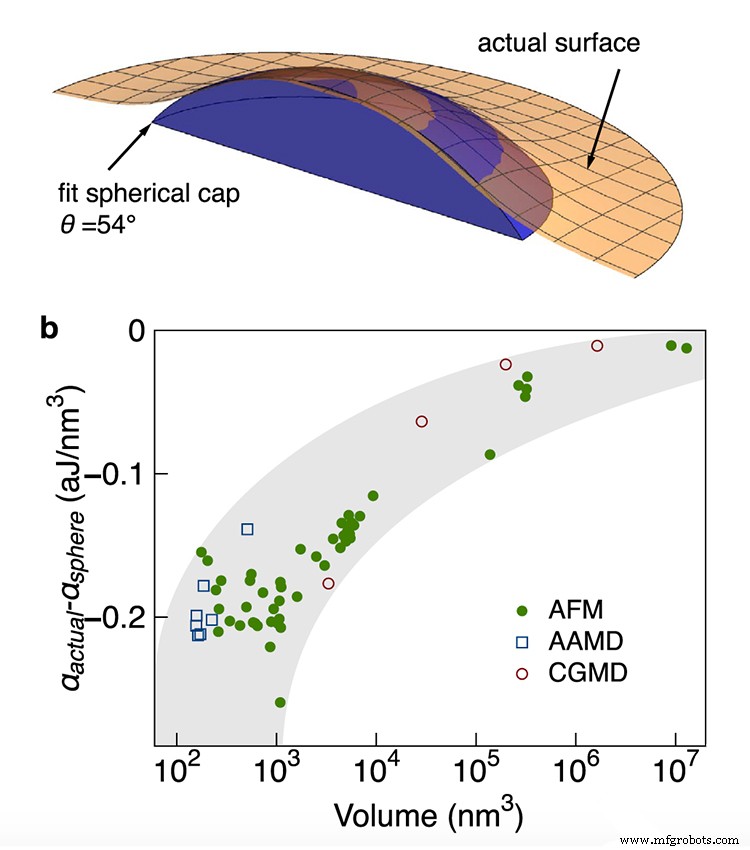
Figure 3. Droplet adsorption energy: underestimated at the nanoscale. (a) Comparison of the actual surface with an idealized spherical cap fit to the same data. (b) Difference between adsorption energy for the actual surface and that of the spherical cap approximation. Negative differences indicate that the fitted spherical cap underestimates adsorption energy, just as it underestimates contact area. For volumes larger than 106 nm3 a spherical cap fit provides a robust estimate of the adsorption energy α. Notes: Figure 3b acronyms: AFM–Atomic Force Microscope Measurement, AAMD–All Atom Molecular Dynamics Simulation, CGMD–Course Grain Molecular Dynamics Simulation. Image reprinted from Scientific Reports “Adsorption energy as a metric for wettability at the nanoscale.”
Recognizing this nanoscale shape change enabled us to develop more accurate oil‑flow simulations, predicting how trapped oil can be mobilized from reservoirs.
While IBM is not an oil and gas company, we leveraged publicly available rock‑characterization data (e.g., ETH Zurich’s Rock Physics Network) to construct a realistic nanoscale reservoir model. This framework integrates the newly discovered wetting behavior into flow simulations—an approach that was previously unattainable.
We presented this model to oil and gas partners, illustrating how nanoscale flow dynamics can inform new extraction strategies. Although the simulation does not guarantee full recovery, it suggests that tailored materials and techniques could unlock an additional 1 % of trapped oil. In Brazil—where 2.4 million barrels are produced daily—a 1 % boost translates to 24,000 extra barrels per day, or roughly 8.8 million barrels annually.
From Flow Simulations to Oil‑Filtering Chips
Our wettability breakthrough is a critical step toward surpassing the industry’s average recovery rate of 40 %. The next milestone involves studying oil flow within nano‑capillaries. To this end, we have engineered an integrated chip platform that allows experimental validation and calibration of nanoscale flow models. Details were presented at the 2016 Rio Oil & Gas Expo & Conference in the paper “Multiscale Science Enables High‑Accuracy Simulations Of Enhanced Oil Recovery.”
The workflow begins with a physical map of a capillary network obtained via scanning electron microscopy or X‑ray computed tomography. This data feeds an experimentally calibrated flow simulation that determines the pressure required to drive water—potentially augmented with bespoke chemicals—to displace oil from the rock. Our patented technology, “Method and Integrated Device for Analyzing Liquid Flow and Liquid‑Solid Interface Interaction,” underpins this approach.
Current industry models rely on incomplete physical representations, limiting recovery predictions. By incorporating nanoscale dynamics, we can refine these models, potentially adding another 1 % yield. Combined with advanced simulation tools and functional materials, this could bring us closer to recovering the remaining 59 % of trapped oil.
Learn more about our work at the new NanoLab in Rio: https://www.ibm.com/research/labs/rio-nanolab.
Nanomaterials
- How Smart IoT is Transforming the Oil & Gas Industry
- Maximizing Value from Big Data: Strategies for Manufacturing Success
- The Internet of Boxes: How Smart Packaging Is Revolutionizing Business
- Augmented Reality: The Future of HR and Workplace Innovation
- Sustainability: The Next Priority for Wireless Technology
- Season's Greetings: Wishing You Health, Prosperity, and Joy
- Hair Drug Testing: The Emerging Standard for Driver Safety and Compliance
- How 3D Printing is Transforming Modern Manufacturing
- Next-Gen Subsea Technology: Revolutionizing Oil & Gas Operations
- Why Chemical-Free PCBs Are the Future of Sustainable Electronics