



Advances in 3D DNA Nanostructures: From Folding to Functional Applications
Folding the DNA
DNA nanotechnology, often likened to paper folding, emerged three decades ago. In 2006, Paul Rothemund at Caltech demonstrated that long single‑stranded DNA can be coaxed into a variety of predetermined shapes by a library of short staple strands (Rothemund 2006). These nanostructures serve as scaffolds or miniature circuit boards, enabling the precise placement of carbon nanotubes and nanowires. However, creating multi‑fold structures requires hundreds of staples, and each new design demands a fresh set of staples. Moreover, the resulting structures often adsorb randomly onto substrates, complicating their integration into electronic circuits.
DNA Brick
To address these limitations, Harvard researchers pioneered the DNA‑brick method. This approach assembles complex 3D nanostructures from short, synthetic “brick” strands—each 32 nucleotides long—by exploiting the specificity of Watson–Crick base pairing. Bricks can be mixed in predetermined ratios to construct intricate geometries, much like LEGO blocks. The technique uses short complementary “sticky ends” that guide bricks to their exact positions, allowing for the rapid prototyping of thousands of distinct shapes from a single master design.
Technique
Each DNA brick contains four binding domains that connect to neighboring bricks at 90° angles, forming a three‑dimensional lattice. The self‑assembly process is entirely sequence‑driven: a brick will only bind to its intended partner if the complementary sequences match. This programmability enables the construction of DNA cubes, cages, and even open‑framework structures with precise internal cavities.
Applications
The DNA‑brick platform offers unparalleled flexibility. By selecting subsets of bricks from a master set, researchers can generate a wide range of morphologies—channels, surface textures, and hollow cores—without redesigning the core scaffold. Potential uses include:
- Programmable molecular probes for imaging and diagnostics.
- Drug‑delivery vehicles that release cargo in response to cellular signals.
- High‑throughput inorganic device fabrication for electronics and photonics.
- Smart medical devices for targeted therapy.
Replacing natural DNA with synthetic polymers could further enhance stability across diverse environments, expanding the technology’s commercial viability.
DNA Microchip
IBM is exploring DNA nanostructures as a foundation for next‑generation microchips. By leveraging DNA’s inherent repeatability and nanoscale precision, these biological components could enable smaller, cheaper, and more energy‑efficient processors (IBM 2021).
Gene Detection
A recent platform uses self‑assembled DNA nanostructures with up to 100 trillion reactive sites to amplify molecular signals. By attaching distinguishable labels, the system can barcode individual molecules, enabling rapid and precise detection of genetic markers.
Bio Sensing
Hybrid graphene‑DNA nanostructures exhibit enhanced binding: single‑stranded DNA associates strongly with graphene, while double‑stranded DNA shows weaker interactions. Fluorescent tagging reveals that adding complementary strands releases the DNA from graphene, restoring fluorescence—a property that can be harnessed for highly sensitive biosensors (Lee et al. 2020). Applications include cancer diagnostics, toxin detection in food, and rapid screening for biological threats.
DNA Machines
The Oxford Centre for Soft and Biological Matter highlights how Watson–Crick base pairing allows the programming of stable nanoscale machines. By designing strand sequences, researchers can create mechanical cycles and responsive structures that operate autonomously at the molecular level.
DNA Nanostructure Scaffold
Arizona State University has engineered DNA scaffolds that present antigens in geometries mimicking natural viruses. Pyramid‑shaped and branched DNA constructs serve as platforms for synthetic vaccine complexes, offering a promising route to targeted immunotherapies.
DNA Crystals
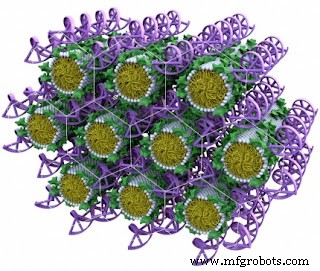
NYU chemists have fabricated three‑dimensional DNA crystals by arranging synthetic strands into triangular motifs with sticky‑end connections. These lattice structures extend in six directions, forming a robust crystal network. Such DNA crystals hold potential for nanoelectronics, drug‑receptor organization, and 3D structural illumination.
Nanomaterials
- How Tungsten Crucibles Are Manufactured
- How Stainless Steel Is Produced: From Smelting to Finished Products
- DNA Synthesis: From Natural Replication to PCR Innovation
- Made in America: A Strategic Imperative for U.S. Manufacturing
- From Silk to Synthetic: How Nylon Is Made
- How FRP Is Made – From History to Modern Production
- From PAN to Performance: The Expert Guide to Carbon Fiber Manufacturing
- How Stainless Steel Is Made: From Raw Materials to Finished Products
- Probing the Electrical Response of Double‑Sided Polymer Surface Nanostructures
- DNA‑Based Nanohydrogel with Potent Anti‑Tumor Immunostimulatory Activity