



How Tungsten Crucibles Are Manufactured
How Tungsten Crucibles Are Manufactured
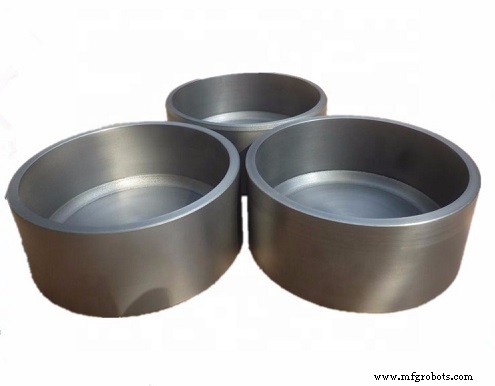
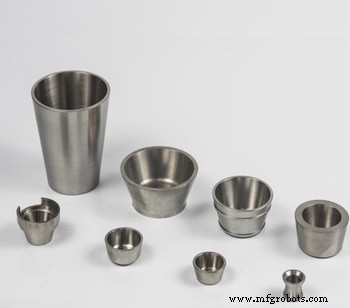
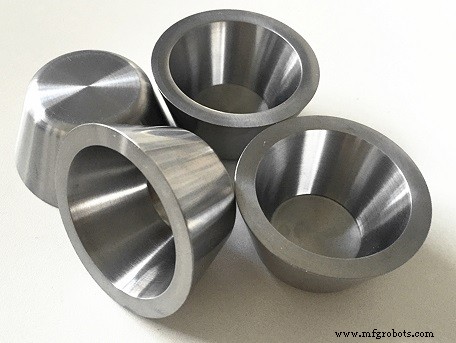
Tungsten crucibles are essential tools in high‑temperature metallurgy, capable of withstanding the metal’s extreme melting point of 3,410℃. They are produced by several techniques—spinning, stamping, forging, and sintering—each chosen for its suitability to specific design requirements and production volumes.
1. Spinning Method
The spinning process begins with a tungsten billet produced via powder metallurgy. The billet is hot‑rolled into thin plates of the required thickness, then cut into circular sheets. These sheets are placed on a hot‑spinning machine where a rotating die shapes them into the crucible form. During each pass, the wall thickness is reduced by about 0.5 mm while the plate remains concentric with the mold. After several iterations the crucible shape is achieved.
To prevent cracking and improve plasticity, the workpiece is heated with a hydrogen‑air flame to ~1,000℃. Once the material has been deformed 50–70% of the final thickness, a 1‑hour anneal at 1,000–1,100℃ in a hydrogen atmosphere relieves internal stresses before the next pass.
2. Stamping Method
Stamping delivers high surface quality, dimensional accuracy, and material efficiency. The process comprises three stages:
- Blanking: Cutting, punching, or trimming the raw tungsten plate to the desired size.
- Bending: Applying pressure to plastically deform the material into the desired curvature.
- Deep Drawing: Forming a hollow part by forcing the material into a die under the punch, producing the crucible’s walls.
Stamping is especially suitable for lightweight, low‑volume production where cost and speed are priorities.
3. Forging Method
Forged crucibles achieve the highest density—typically >19.0 g/cm³—approaching theoretical density, and superior tensile strength and deformation resistance. The process includes:
- Calculating the required size and mass of the tungsten rod; the initial relative density is 90–95%.
- Heating the rod to 1,400–1,600℃ in a hydrogen furnace, followed by multiple forging passes until a total deformation of 50–60% is achieved and the crucible shape is formed.
- Annealing the forged billet and machining it to final dimensions.
4. Sintering Method
Sintering via isostatic pressure is the most common route for large‑scale production. The workflow is:
- Prepare a mold matching the desired blank size and fill it with tungsten powder that meets national standards. The packed density is maintained by applying 180–250 MPa of isostatic pressure.
- Place the billet in a high‑temperature induction furnace. The heating rate is 80–150℃/h, reaching 2,200–2,400℃ for 4–8 hours to achieve full densification.
- Cool, then machine the sintered blank to final tolerances.
- Conduct thorough inspection of appearance, dimensions, and density.
For high‑quality refractory metals and detailed specifications, visit Advanced Refractory Metals (ARM).
Metal
- How Ceramic (Ferrite) Magnets Are Manufactured
- How Stainless Steel Is Produced: From Smelting to Finished Products
- From Silk to Synthetic: How Nylon Is Made
- How FRP Is Made – From History to Modern Production
- From PAN to Performance: The Expert Guide to Carbon Fiber Manufacturing
- How Stainless Steel Is Made: From Raw Materials to Finished Products
- Discover the Production Process of Polyvinyl Chloride (PVC)
- The Steel-Making Process Explained: From Iron Ore to Alloy
- Stainless Steel Fabrication: From Raw Materials to Finished Products
- Inside the Manufacturing of Electronic Circuits