



Intermediate Processing Drives Circularity: How Polymer Centers Reimagine Plastic Recovery
Material recovery facilities (MRFs) bridge waste disposal and remanufacturing by collecting, sorting, and supplying plastics to recyclers. While they reduce landfill volumes, this model often fails to reclaim the embedded value in diverse plastic types.
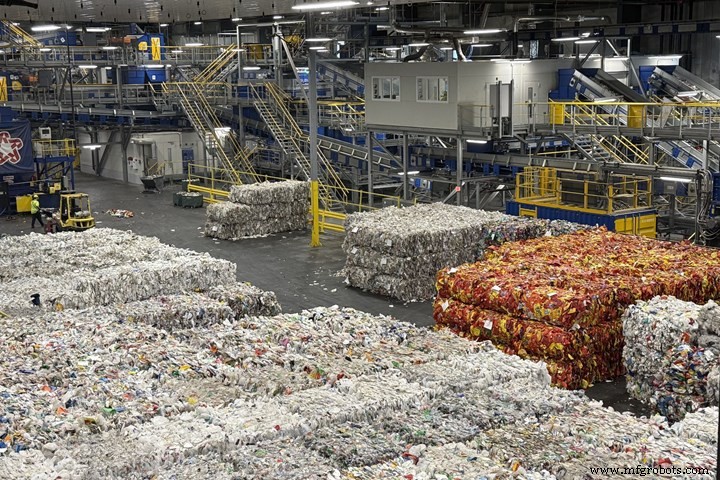
Republic Services, an environmental services leader operating 79 MRFs across the United States, surveyed its customers to pinpoint why recycled outputs fell short of expectations. The analysis revealed a clear opportunity: a secondary sorting hub that could close the performance gap. The result is the Polymer Center—a facility that consolidates and refines plastic streams beyond what municipal MRFs can achieve.
Featured Content
Challenge at the MRF Level: Thin Slices from a Big Pie
Rigid plastics constitute only about 7% of all material recovered at MRFs. To reach usable quality, these materials must be divided by resin, format, and color. Each split produces an ever smaller fraction, diminishing the economic viability of further purification. Investing in high‑purity streams that represent less than 1% of the overall waste is rarely cost‑effective.
Adding to the difficulty is the constantly shifting input stream. After holiday spikes, an MRF may be inundated with paper and cardboard, forcing it to prioritize those streams and inadvertently lowering the quality of side products such as plastics.
As a result, post‑consumer recycling successes at MRFs have traditionally been limited to four outputs: clear PET, natural HDPE, mixed‑color HDPE, and mixed polypropylene.
Enter the Polymer Center
The Polymer Center model aggregates several municipal MRFs into a regional hub that refines plastic material. By isolating plastic streams, the facility can perform finer sorting and produce new, higher‑quality products. Republic Services launched its first Polymer Center in Las Vegas, Nevada, in 2023.
At the center, PET bales are transformed into clean, washed flakes, while polyolefins are sorted into PP and HDPE bales—both natural and colored. The resulting polyolefin products are forwarded to Blue Polymers, a joint venture with Ravago, where they are recycled, pelletized, and compounded.
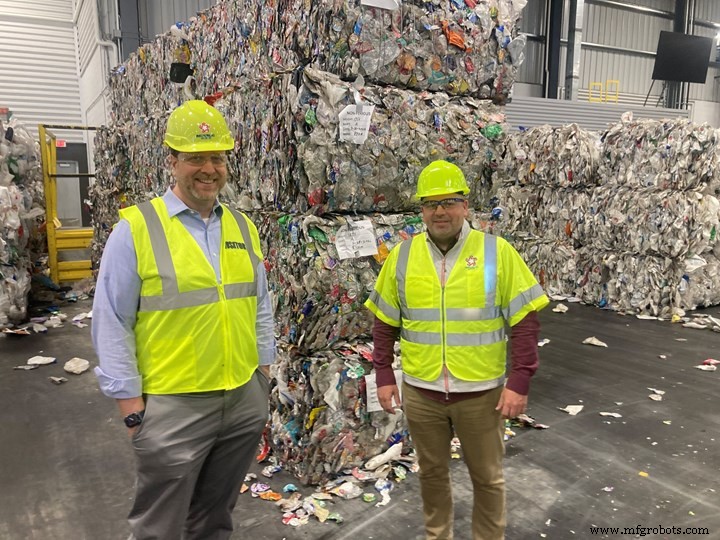
“In the recycling value chain, we’ve always balanced products and services,” says Joe Riconosciuto, Director of Circular Solutions. “Now we’re running a 24/7 manufacturing operation that charges for both labor and finished product.”
The Las Vegas pilot quickly inspired a second site in Indianapolis, Indiana. Riconosciuto and VP of Recycling and Sustainability Pete Keller chose Indianapolis for its existing footprint, business‑friendly climate, robust infrastructure, skilled workforce, and strategic proximity to suppliers—reducing transport distances and emissions.
Indianapolis began operations in 2025, and a third Polymer Center is under construction in Allentown, Pennsylvania.
An Automated, Iterative Process of Sortation
Unlike the Las Vegas plant, the Indianapolis facility was built from the ground up, allowing for newer equipment and a layout optimized for continuous flow. This design introduces buffers that let individual production phases run offline without halting the entire system.
Incoming bales are routed onto dedicated PET or polyolefin lines. Upstream MRFs can now focus on two primary streams—PET bottle bales and mixed polyolefin bales—streamlining their operations. “No plastic in your garbage and no garbage in your plastic,” Riconosciuto explains.
Optical sorting systems provide binary decisions for each item, with early oversorting of labeled or tinted pieces. The process includes a film‑separation screen, a delabeler that cuts labels to expose the underlying plastic, and a series of conveyors that clean the line of sight for sensors.
The plant is highly automated; all systems are remotely monitored, and only a single manual intervention—workers removing bulky items that could damage downstream equipment—remains.
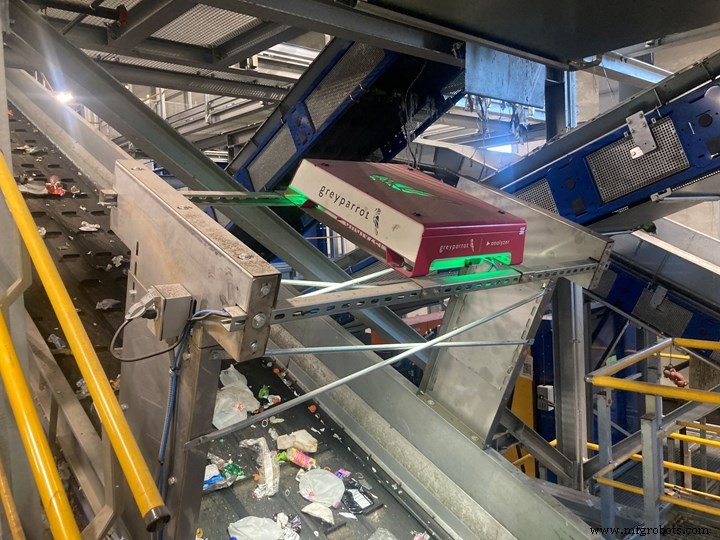
Throughout the conveyor network, Greyparrot AI‑enabled optical analyzers scan each stage, identifying products down to specific packaging types and building a detailed database of sorting performance.
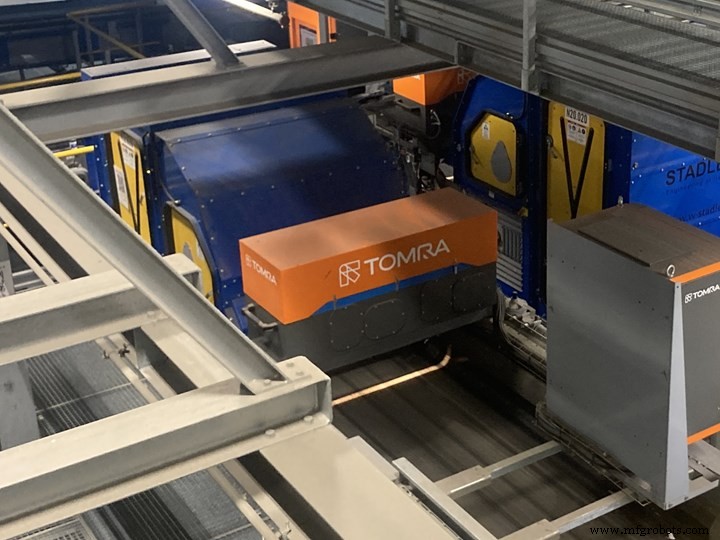
Subsequent Tomra Autosort units—totaling 21—employ NIR spectroscopy and RGB cameras to differentiate resin types and colors. Compressed air jets direct selected materials onto the next conveyor while the rest falls below. Sorted HDPE and PP, separated by color, are baled and shipped to Blue Polymers for pellet production.
Negative fractions are collected and rerouted. For instance, PET found in the polyolefin stream or HDPE detected on the PET side are isolated—much like sorting Skittles and M&M’s separately—to maintain product integrity.
On the PET side, three Herbold grinders reduce the material to flakes, which are then dried and stored. A magnetic separator removes metal, and the flakes pass through a two‑stage washing system: an initial rinse to remove labels and adhesives, followed by a hot, caustic wash to eliminate residual glue. A float‑sink operation captures caps and rings, which are also recycled by Blue Polymers. Process water flows in reverse, conserving fresh water for final cleaning. After drying, two Buhler sorters further separate color and non‑PET contaminants. Remaining oversorted material is processed offline to recover additional value.
Adjacent to the final sorting stage is a laboratory where small batches are examined by an Eagle Vizion optical sorter, delivering contamination data down to parts per million. Manual sampling provides a deeper inspection, while sifting screens assess particle size distribution. All records and physical samples are archived for traceability.
A Step Toward More Complete Recovery of Discarded Plastics
Republic’s Polymer Center extracts red/orange/yellow and blue/green HDPE from post‑consumer streams and converts them into orange and teal HDPE pellets—products that would otherwise be downgraded to mixed‑color recycled material. These pellets are suitable for consumer packaged goods (CPG) brands seeking a quality tier between expensive PCR and low‑grade recycled content.
Blue Polymers’ portfolio also includes white HDPE, natural HDPE, mixed‑color HDPE, white PP, and mixed‑color PP. Bycatch—caps, rings, fines, and even aluminum—from the negative fraction is directed to established recycling endpoints.
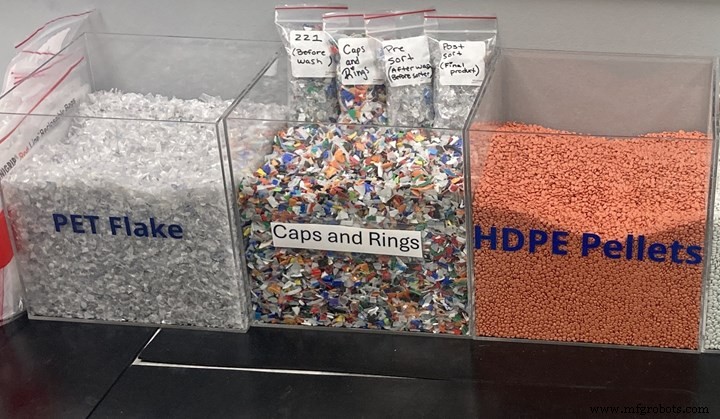
“Consumer product and beverage companies demand post‑consumer recycled content for circularity—and beyond. By extracting every valuable component from a bale, we deliver a lower‑carbon product,” says Tony Fritz, Director of Sustainability at Republic Services. “The hub‑and‑spoke model enables us to apply scale and achieve traceability.”
Circularity at a Reduced Carbon Footprint
External assessment by Sphera Consulting measured the cradle‑to‑gate carbon footprint of the Las Vegas PET flake operation. Results showed an 82% reduction versus virgin PET and a 54% reduction versus other recycled PET alternatives.
Energy sourcing plays a key role; Nevada’s electricity mix—natural gas, geothermal, and solar—contributes to the lower footprint. The hub‑and‑spoke strategy further curtails shipping distances, enhancing both impact and traceability across the Midwest and beyond.
Sorting efficiency directly influences per‑unit energy consumption. “The higher the usable material fraction, the lower the energy intensity per unit of product,” explains Sean Daley, Director of Sustainability Consulting at Sphera. “Intermediate processing simplifies MRF operations, increases total recovery, elevates purity, and unlocks multiple downstream pathways.”
Resin
- Restore Time‑Worn Wooden Furniture with Epoxy Resin: A Step‑by‑Step Guide
- Polyolefin Prices Ascend: Q3 Market Dynamics and Supply Constraints
- Mitsubishi Chemical Announces New CFRTP Pilot Plant in Fukui
- SABIC Showcases Virtual Reality-Driven Digital Composite Manufacturing at JEC World 2019
- SABIC Launches First Certified Circular PC Resin from Upcycled Post‑Consumer Plastic
- Revive Your Vintage Wooden Trunk with Resin and Fluorescent Pigment
- Expert Guide to Plastic Stamping: Process, Materials, and Benefits
- How to Add Crush Ribs for Stronger Injection Molded Parts
- FACC Accelerates Next-Gen Aerostructure Sustainability with Fast-Cure Prepregs, Thermoplastics, and Bio-Based Composites
- From Ivory to Bakelite: Tracing the Evolution of Modern Plastics