



Craftech’s TPU Fasteners Empower Global Aquaculture with Rapid, Durable Fish‑Farm Containment
When Ray Lawrence, Production Manager at Ocean Farm Technologies, Inc., received a time‑critical call from a client in Mexico, he knew swift action was essential.
Ocean Farm Technologies has pioneered the Aquapod™, a spherical fish‑farm containment system built from individual triangular net panels. Each pod comprises 200 or more panels, and the netting can be tailored for fish of various sizes—including shrimp—by adjusting panel dimensions and mesh density.
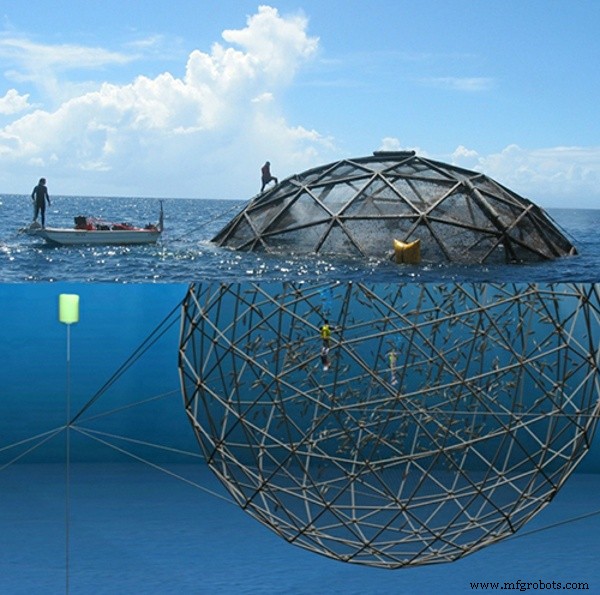
The panels are configurable for access, feeding, transfer, grading, and harvesting, ensuring that the pod meets operational needs throughout a fish’s life cycle.
The Aquapod™ is engineered to withstand harsh marine conditions, whether fully or partially submerged, and is deployed worldwide for both private and government projects.
Lawrence understood that transferring Totoaba—an endangered species protected by Mexico’s 1975 ban on commercial fishing—into an Aquapod™ is a time‑sensitive operation. Hatchery‑raised Totoaba must be moved offshore when they reach a critical size, and delays can jeopardize growth and market value.
Initially, Ocean Farm Technologies used galvanized steel to assemble the Aquapod™. However, steel corrodes in saltwater and is susceptible to UV degradation, compromising structural integrity over time. After evaluating high‑performance plastics such as Delrin® and nylon, the company adopted thermoplastic polyurethane (TPU). TPU boasts a tensile strength of 29,977 PSI (186 MPa) and excels in chemical and environmental resistance, including saltwater exposure and UV radiation. Its low water absorption allows long‑term submersion without swelling.
In the original Aquapod™ design, corroded steel fixtures made panel removal laborious and risky for underwater technicians. TPU fasteners, on the other hand, can be disengaged with standard wrenches even after years underwater, dramatically simplifying repairs and reducing downtime.
Craftech now supplies vinyl‑ester rods and a range of TPU fasteners specifically engineered for the Aquapod™.  The vinyl‑ester rod forms the pod’s frame, while Craftech’s TPU hardware holds the structure together. Lawrence’s Mexican customer had an older model that relied on steel fixtures. To prevent delayed fish transfers, the Ocean Farm Technologies team urgently replaced the steel components with plastic ones.
After receiving Lawrence’s request, Craftech’s production line dispatched 13,000+ rods and fasteners within seven business days—an express shipment that enabled the Mexican pod to be upgraded in time.
Considering a switch from metal to plastic fasteners? Explore Craftech’s full product line online for solutions that combine durability, safety, and cost savings.

Resin
- Cushioning Laminates: Production, Materials, and Future Trends
- Top 3 High‑Strength Materials for Plastic Fasteners
- Are Plastic Hardware Truly 100% Plastic? The Role of Plastic Fillers Explained
- Craftech’s Durable Plastic Fasteners Empower APH’s Educational Tools for the Blind
- Understanding Glass Fibers in Reinforced Plastics: Production, Types, and Applications
- What Plastic Makes LEGO Bricks? A Deep Dive into ABS and Production
- Vented Plastic Screws for High‑Vacuum Systems: Design, Materials, and Leak Prevention
- Resin Identification Codes: A Comprehensive Guide to Plastic Recycling
- Evonik Opens State‑of‑the‑Art 3D Printing Center in Austin to Advance Structured Polymer Technologies
- Polypropylene: Key Features, Uses, and Production