



Understanding Glass Fibers in Reinforced Plastics: Production, Types, and Applications
As highlighted in our previous discussion, adding reinforcing fibers to plastic resins boosts tensile strength, flexural modulus, and the heat‑deflection temperature of the composite. This post dives deeper into the role of glass fibers in achieving these performance gains.
Glass fibers are a primary reinforcement in many plastic composites. Commonly referred to as GRP (glass‑reinforced plastics), these materials consist of fine glass filaments embedded within a polymer matrix. The manufacturing of glass fibers follows a well‑defined five‑step process:
- Batching
Silica forms the core glass material, while limestone and soda ash lower the melting point. Additional additives—such as borax for chemical resistance, calcined alumina, feldspar, nepheline syenite, magnesium, kaolin clay, and boron—are included to tailor specific properties. Precise weighing of these raw materials creates the batch. - Melting
The batch is heated in a forehearth furnace at approximately 2500 °F (about 1370 °C). Maintaining strict temperature control is essential for producing high‑quality glass fibers. - Fiberization
Molten glass is extruded through a bushing containing 200 to 8,000 fine orifices. The extruded streams are then drawn—attenuated—into filaments less than a human hair in diameter. Cooling via water jets stabilizes the filaments at roughly 2200 °F (1204 °C). - Coating
During this stage, a chemical sizing or coating is applied to the filaments to enhance adhesion to the resin matrix and improve handling. - Packaging
The coated filaments are bundled into spools ranging from 51 to 1,624 strands. After drying in an oven, these spools are shipped as‑is or processed further into chopped fiber, roving, or yarn.
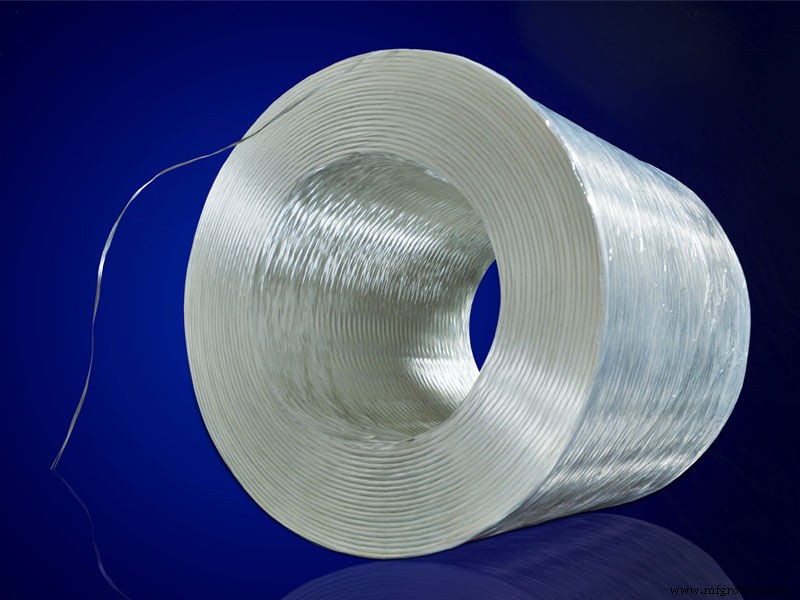
Glass fibers come in several varieties, each engineered for particular performance characteristics:
- E‑glass – An alumino‑borosilicate glass with <1 % alkali oxides, originally designed for electrical applications but now the most common reinforcing fiber in plastics. It offers excellent mechanical properties but is vulnerable to chloride‑ion attack, limiting marine use.
- A‑glass – An alkali‑lime glass with negligible boron oxide, suitable for general-purpose reinforcement.
- E‑CR glass – Electrical/chemical resistant glass with high acid tolerance.
- C‑glass – A high‑boron alkali‑lime glass used for staple fibers and insulation.
- T‑glass – North American equivalent of C‑glass, prized for thermal insulation in blown glass.
- D‑glass – Borosilicate glass with a low dielectric constant.
- R‑glass – Reinforcement glass composed of alumino‑silicate without MgO and CaO, demanding high mechanical performance.
- S‑glass – Stiff glass with alumino‑silicate and MgO, delivering superior tensile strength; widely used in aircraft composites and structural applications.
Unlike carbon fibers, glass fibers are nonconductive, cheaper, and less brittle, yet they still substantially increase the tensile strength and flexural modulus of composites. Their cost‑effectiveness makes them ideal for a broad spectrum of products, from bathtubs and boats to surfboards, fishing rods, automotive components, skis, golf clubs, swimming pools, aircraft parts, and even the chassis of amusement‑ride vehicles.
Questions? Let us know in the comments below.
Looking for more information on FRP? Download our free high‑performance plastics guide.

Resin
- Cushioning Laminates: Production, Materials, and Future Trends
- Fiberglass: Production, Materials, and Industry Outlook
- Fiber‑Reinforced Plastic (FRP): A Game‑Changing Alternative to Steel
- Basalt and Aramid Fiber‑Reinforced Plastics: Advanced Materials for High‑Performance Applications
- Carbon Fiber Reinforced Plastic (CFRP): Strength, Weight Savings, and Emerging Applications
- Resin Identification Codes: A Comprehensive Guide to Plastic Recycling
- Glass-Filled vs. Glass-Reinforced Acetal: Understanding the Difference and Its Impact on Performance
- Polypropylene: Key Features, Uses, and Production
- Mastering Overmolding: A Comprehensive Guide to Advanced Plastic Joining Techniques
- Laser Engraving Explained: Applications Across Industries