



LEO Lane’s VP Business Lee‑Bath Nelson on Secure Digital Supply Chains and the Future of Additive Manufacturing
Featured: LEO Lane's Co-Founders: Moshe Molcho – CEO, Tessa Blokland – Industrial Design Expert, and Lee‑Bath Nelson – VP Business. Image credit: Beau Jackson.
3D printing is a leading force behind distributed, digital manufacturing. By fabricating parts directly from digital files, it unlocks virtual inventories and on‑demand, localised production.
However, this shift brings security challenges. Digital files contain proprietary design data, and unauthorised access can jeopardise a company’s intellectual property and competitive edge.
Fortunately, the industry is countering this risk with secure additive manufacturing solutions. One pioneer is LEO Lane, an Israeli cloud‑based SaaS provider that gives IP owners full control over how 3D print designs are produced.
In this interview, LEO Lane Co‑Founder and VP Business Lee‑Bath Nelson explains the company’s mission, the advantages of digital inventory, and how 3D printing can strengthen supply chains during global crises.
What is LEO Lane’s mission?
LEO Lane delivers SaaS solutions that ensure consistency, repeatability, and protection across large corporations’ additive manufacturing workflows. We safeguard intellectual property and enforce quantity control so every part meets exact specifications.
Why was LEO Lane founded?
Lee‑Bath Nelson’s 20‑year journey in the AM ecosystem began with venture‑capital investments in early 3D‑printing pioneers like Stratasys. He witnessed the evolution from prototyping to end‑part production and identified the gaps in repeatability, consistency, and digital asset protection that needed to be filled.
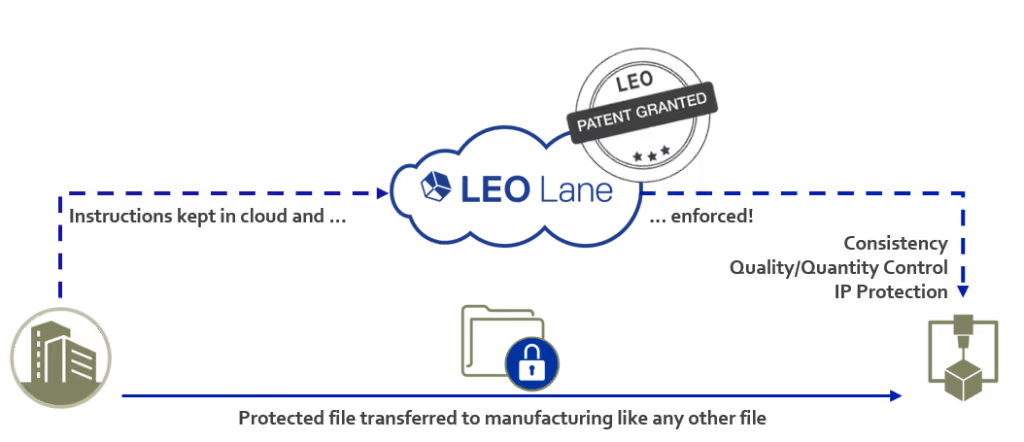
Image credit: LEO Lane
How does LEO Lane’s software guarantee repeatability?
Our platform allows manufacturers to prescribe the exact machine, material, and settings for every build. Whether a jeweller wants a specific SLS nylon or an aerospace firm requires a certified jetting process, LEO Lane enforces those parameters end‑to‑end.
What are the benefits of digital inventory?
Digital inventory eliminates the need for costly physical stock, reduces logistics, and removes obsolescence risk. It also ensures that only the latest design versions are used, preventing errors from outdated tooling.
In a distributed supply chain, digital files can be shared instantly, so borders no longer constrain production—a critical advantage during disruptions like Brexit or a pandemic.
How is 3D printing helping during crises?
Localised production means parts are fabricated on‑site, cutting lead times to hours. Hospitals in Italy, for example, used 3D printing to supply critical ventilator valves when global supply chains stalled.
Production line downtime is a major cost driver. In automotive manufacturing, a single line outage can cost $22,000 per minute. A locally printed replacement can keep the line running, saving millions.
Beyond emergencies, additive manufacturing empowers rapid innovation—think hand‑free door‑handle openers that were designed and distributed in days.
What are the top three challenges to end‑part production?
1️⃣ Repeatability – every build must match the exact specifications, not just a prototype.
2️⃣ Integration – AM workflows must fit seamlessly into ERP systems like SAP so procurement never has to switch tools.
3️⃣ IP protection – securing digital blueprints against theft while enabling controlled sharing.
Achieving these will make AM a mainstream manufacturing technology.
Which AM trend excites you most?
3D‑printed jigs and fixtures. They keep the designer and end‑user in the same organisation, reducing supply‑chain dependencies and cutting downtime.
What does 2020 hold for LEO Lane?
We’ll keep expanding our secure, repeatable AM platform and deepen partnerships that allow IP to be shared safely while protecting against theft. The goal is to help companies realise the full commercial potential of additive manufacturing.
Anything else?
The AM industry is maturing. While hardware once dominated, software and integration now drive the next wave of adoption. This shift signals a move from prototyping to reliable end‑part production.
To learn more about LEO Lane, visit: https://www.leolane.com/
3D printing
- 3D Printing in Education: Transforming Learning with Hands‑On Innovation
- UK’s Premier 3D Printing Research Hubs: Leading Institutions Driving Additive Manufacturing Innovation
- Boost Strength‑to‑Weight in 3D‑Printed Parts with Automatic Composite Sandwich Panels
- Essential Environmental Glossary: Key Terms Explained
- 10 Proven Water-Resistant Solutions for 3D Printed Parts: Materials & Post-Processing
- What 3D Printing Needs to Evolve: Top 3 Industry Demands Revealed at AMUG
- Advanced 3D Printing in Aerospace: Accelerating Prototyping & Tooling
- South by Southwest 2019: Spotlight on Boston's Trailblazing Startups
- Anycubic Kobra 2 Pro Review: Fast, User‑Friendly 3D Printing – Is It Worth Your Investment?
- Build Stronger 3D Prints: A Complete Step‑by‑Step Guide