



Additive Manufacturing: How University‑Educated Engineers Are Leading Industry Adoption
How Universities Are Preparing Engineers for the Future of Manufacturing
Walk into any aerospace, automotive, or defense plant that has recently embraced additive manufacturing and ask who spearheaded the change. The answer is almost always a recent graduate—someone who printed parts for their FSAE team, ran designs through a composite printer in a university lab, and arrived on day one already fluent in what constitutes an effective additive application.
This pattern is more than anecdotal; it signals a clear advantage. Engineers with hands‑on additive experience from school move faster, contribute early, and assume visible leadership on programs that their more seasoned colleagues are still navigating. They are not waiting for institutional buy‑in—they already have the additive mindset.
For engineering programs, the question is direct: are your graduates arriving at their first jobs with that mindset, or are they learning it on the job—years behind in additive knowledge?
Manufacturing Is at an Inflection Point. It’s Happened Before.
The shift toward digital manufacturing and additive technology is part of a long‑standing pattern in industrial history, and recognizing this pattern underscores both the urgency and the opportunity.
The second industrial revolution offers the clearest parallel. When factories moved from steam engines to electric motors, the technology arrived long before productivity gains materialized. The lag was not the machines themselves but the workforce. It took decades for the combined efforts of industry, education, and research to produce engineers who could redesign entire plant layouts around electric motors.
Once that mindset shift occurred at scale, manufacturing productivity surged, creating more opportunities and higher returns across the ecosystem—including for the engineers entering it.
Industry 4.0 is now an operational reality for manufacturers in aerospace, automotive, defense, and industrial automation. While additive manufacturing sits at the core of this reality, continued innovations mean that AM education and adoption are now the limiting factors, not the technology itself.
Engineering programs that recognize this early are the ones producing graduates who arrive already fluent in the new paradigm.
Places Additive Manufacturing Changes How Students Learn
The impact of additive manufacturing is not uniform across an engineering program. It creates distinct learning opportunities in different contexts, each with its own objectives and outcomes for students.
In Research: Removing the Manufacturing Barrier
For graduate researchers, a persistent friction point is the production bottleneck. Moving from a digital design to a physical part typically requires machining skills, a machine‑shop booking, or a collaborator who possesses both. For researchers whose backgrounds lie in materials, biology, computer science, or other fields adjacent to mechanical engineering or manufacturing, this bottleneck can dictate the pace of an entire project.
Accessible additive manufacturing eliminates that barrier. A researcher who can go directly from CAD to a functional metal or composite part—without a machine‑shop intermediary—keeps the focus on the research itself.
Outside the Classroom: Where Engineering Judgment Develops
Some argue that the most formative engineering education occurs in spaces outside formal instruction. FSAE teams, solar car projects, robotics clubs, and student‑run makerspaces expose students to real constraints, real mistakes under pressure, and the judgment that comes from having to make something work. Programs like these often ignite an interest in 3D printing, which then spills into classroom settings and eventually into professional expertise.

The Olin College Baja Team
Why Recent Graduates Are Leading Additive Adoption Inside Industry
The pattern holds across aerospace, automotive, defense, and industrial automation: when a manufacturer embarks on a serious additive manufacturing adoption program, the driving force is often an early‑career engineer. Those who arrived with additive experience from school already know how to spot a good application, design for the process, and validate functional parts. They need no convincing that the technology is viable.
When an early‑career engineer leads an additive adoption project—demonstrating cost savings, reduced lead times, or solutions to supply‑chain challenges—they build a track record that accelerates everything that follows. The return on hands‑on additive experience in school is tangible, showing up in project success and leadership visibility within the first two years.
For engineering programs, this is a practical case for embedding additive manufacturing in the curriculum. It is not about teaching a specific tool but about producing graduates who are immediately useful in the manufacturing environments they enter—and who can lead as those environments evolve.
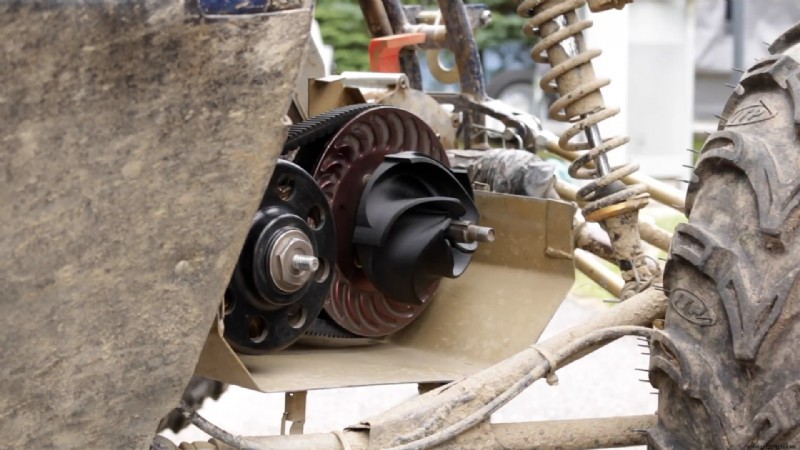
The Olin College Baja Team uses the Mark Two and Onyx to keep their transmission from overheating.
What the Digital Forge Makes Possible in an Academic Lab
The practical question for academic institutions is not just which printer to buy but how the technology integrates into lab operations—rotating student users, variable skill levels, limited technician support, and the need for reliable parts.
The Digital Forge—Markforged’s integrated platform of hardware, software, and materials—was designed around exactly those constraints, even though its primary customer base is industrial. The features that make it work in a manufacturing environment are equally valuable in a university lab:
Self‑calibrating hardware: The FX10’s laser micrometer and vision‑based calibration system recalibrates the print bed before every job. The FX10 also features a heated print chamber and automated spool changeover, enabling large, dimensionally accurate parts without manual intervention and allowing both metal and composite printing. In a shared lab with many users, calibration drift is often the single biggest source of failed prints and wasted material. Removing that variable changes the entire lab’s reliability profile.
Cloud‑managed part library: Parts and print files reside in a controlled digital environment. Faculty can manage access, enforce version control, track print history, and ensure students work from approved files—the same audit capability that defense contractors rely on, applied to lab management.
Accessible training infrastructure: Markforged University offers structured, self‑paced training that any student or faculty member can complete independently, eliminating the need for a dedicated additive instructor.
Metal printing without the hazard: The FX10 metal system uses bound metal filament—metal powder in a polymer binder—that requires no special PPE during printing. A simple engine swap converts the FX10 from composite to full metal mode, giving a single machine access to materials including 17‑4PH stainless steel, 316L stainless steel, and H13 tool steel. Universities already print metal in shared student labs, making metal 3D printing accessible to students who would otherwise never encounter it outside a highly controlled industrial environment.
How to Teach Design for Additive: Start With the Problem, Not the Technology
Leading with the technology is one of the most common mistakes in additive manufacturing education—and in industry adoption.
“What can we 3D print?”
That framing yields a long list of potential applications but little clarity about which ones matter.
The more productive approach starts from the other direction: identify the most expensive or frustrating problems in the manufacturing process. Does additive manufacturing’s unique set of advantages address any of them?
This framework underpins Markforged University and translates directly into the classroom. Teaching students to first identify high‑impact problems produces engineers who deploy the technology effectively rather than enthusiastically. They evaluate whether additive manufacturing’s benefits—geometry freedom, on‑demand production, reduced lead time, material performance—match the problem’s requirements.
Teaching that 3D printing does not replace machining, welding, or other processes but works alongside them is equally important. The engineers who create the most value with additive are those who know when to use it and when not to.
Building an Additive Manufacturing Program at Your Institution
Markforged collaborates with academic institutions across the spectrum—from community colleges and CTE programs to research universities—to integrate additive manufacturing into curricula, labs, and extracurricular programs.
The team includes application engineers and solution consultants with both industrial and educational backgrounds who can design a lab environment that matches how your students actually learn. A broad network of institutions already running the Digital Forge—from student‑run makerspaces to research labs—provides valuable reference points.
Common Questions from Academic Programs
Do students need prior CAD or 3D printing experience to use Markforged equipment?
No. Markforged University offers structured, self‑paced training that takes users from zero experience to printing functional parts. The greater requirement is a shift in mindset—learning to identify where additive manufacturing adds value rather than simply learning to operate a machine. That mindset develops through use, not as a prerequisite.
How does a Markforged printer fit into a lab that already has CNC machines, laser cutters, and other fabrication tools?
As a complement, not a replacement. Strong academic labs treat the printer as one tool in an integrated rapid prototyping environment. Additive manufacturing excels at complex geometry, low‑volume production, and rapid design iteration. CNC machining excels at tight tolerances, basic geometries, and high‑volume production. Teaching students when to use each—and why—is itself a valuable part of the curriculum.
Is this equipment appropriate for community colleges and CTE programs, or is it primarily for four‑year universities?
Both. Markforged University was explicitly designed to be accessible without a four‑year engineering background. The curriculum focuses on practical opportunity identification and design for additive—skills directly applicable to manufacturing technicians, maintenance engineers, and plant operators.
Can students work with metal 3D printing in a shared lab environment?
Yes. The FX10 metal system uses bound metal filament—metal powder in a polymer binder—that requires no special PPE to handle. Debinding and sintering steps require a wash station and furnace, but the overall safety footprint is manageable in a standard university lab.
How does version control and file management work across a student population with many users?
Parts reside in a cloud‑managed digital library within the Eiger software platform. Faculty control access to files, enforce approved versions, and have full visibility into print history across every machine in the lab. The same traceability that defense contractors rely on for compliance is directly useful for managing a shared academic lab.
All of the blogs and the information contained within those blogs are copyright by Markforged, Inc. and may not be copied, modified, or adopted in any way without our written permission. Our blogs may contain our service marks or trademarks, as well as those of our affiliates. Your use of our blogs does not constitute any right or license for you to use our service marks or trademarks without our prior permission. Markforged Information provided in our blogs should not be considered professional advice. We are under no obligation to update or revise blogs based on new information, subsequent events, or otherwise.
Never miss an article
Subscribe to get new Markforged content in your inbox
3D printing
- Choosing the Right 3D Printing Materials: A Comprehensive Guide
- Choosing the Right Plastic for 3D Printing: A Comprehensive Guide
- MJF vs. SLS: Which 3D Printing Technology Wins for Polymers & Elastomers
- How to Pick the Ideal Heat Sink: 6 Essential Factors
- Fiberglass vs. Carbon Fiber: Choosing the Right Reinforcement for 3D Printing
- 3D‑Printed Injection Molds: A Comprehensive Overview of Design, Benefits, and Applications
- Designing a 3‑D‑Printed Tesla Turbine – Part 1: Recreating the Housing with Markforged
- Additive vs Subtractive Manufacturing: Key Differences & Applications
- Advanced Microfusion Casting with 3D‑Printed Burn‑Out Resin Molds
- Russian Astronauts Successfully Deploy First Fully 3D‑Printed Satellite from the ISS