



Decarbonizing Industrial Production: Proven 56% Carbon Savings with Composite Additive Manufacturing
For decades, the manufacturing mantra was simple: bigger, heavier, and more subtractive equated to better performance. Today, that mantra clashes with the urgent need to reduce greenhouse‑gas emissions. Traditional CNC machining and the heavy infrastructure that supports it generate a massive carbon footprint that no longer aligns with global decarbonization goals.
What if the solution lay not in tweaking existing factory lines but in re‑imagining how and where parts are produced? A recent, independent Life Cycle Assessment (LCA) by Bureau Veritas Sweden tested this premise by comparing conventional CNC aluminum machining to Markforged’s composite 3D printing platform.
The results are striking: a distributed digital manufacturing workflow can cut production carbon emissions by up to 56.4%. Below we unpack the data that makes this breakthrough possible.
Executive Summary
An ISO 14040/44, ISO 14025, and EN 15804‑compliant LCA, independently verified by Bureau Veritas Sweden, demonstrates that transitioning from CNC aluminum machining to Markforged composite 3D printing reduces carbon emissions by up to 56.4%. The study confirms that a distributed manufacturing strategy delivers deep decarbonization while preserving industrial‑grade performance.
The Infrastructure Disparity: 12 Tons vs. 122 Kg
Carbon intensity starts with the embodied carbon of the equipment used to create a part. The assessment considers the full Bill of Materials for both technologies.
Machine‑Level Comparison
| Engineering Metric | CNC Machining Center (S1) | Markforged FX10 (S2/S3) |
|---|---|---|
| Total Machine Mass | ~12,000 kg | 122 kg |
| Primary Structural Material | 6,000 kg cast iron | 80 kg steel |
| Electronics & PCBs | 120 kg | 8.5 kg |
| Reference Service Life | 10 years | 5 years |
The functional unit is a 5‑year industrial requirement. To match the 10‑year life of a single CNC machine, the analysis includes two FX10 printers.
Strategic Scenarios: Optimizing the Supply Chain
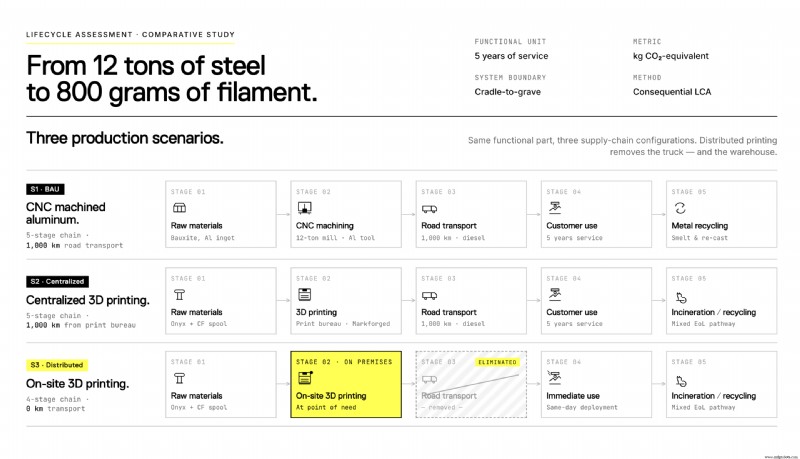
Three scenarios illustrate how logistics and production choices affect the overall footprint:
- Scenario 1 – Business‑as‑Usual (BAU): CNC machining of aluminum tools followed by regional road transport.
- Scenario 2 – Centralized Additive: Parts printed on a single FX10 at a central hub and shipped to the customer.
- Scenario 3 – Distributed Manufacturing: In‑house printing at the customer site—no distribution transport.
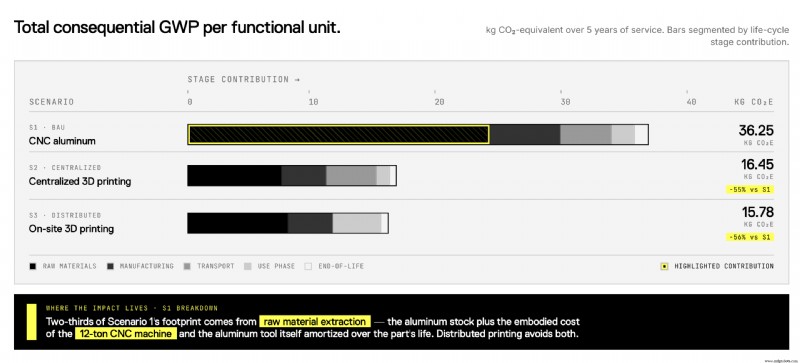
Consequential LCA Results: The Carbon Breakdown
All figures are Global Warming Potential (GWP) expressed in kg CO₂e per functional unit across the full cradle‑to‑grave lifecycle.
- Scenario 1 (CNC Aluminum): 36.2 kg CO₂e
- Scenario 2 (Centralized 3D Printing): 16.5 kg CO₂e
- Scenario 3 (Distributed 3D Printing): 15.8 kg CO₂e
The 56.4% advantage stems from the lightweight FX10 printer, the high material efficiency of Onyx reinforced with continuous carbon fiber, and the elimination of distribution logistics.
Technical Drivers of Sustainability
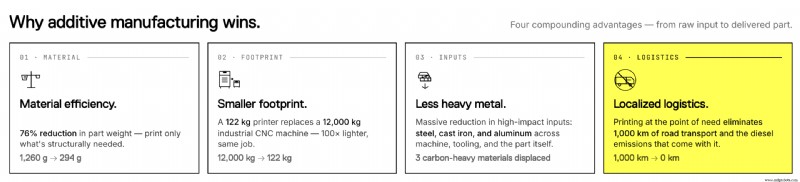
The Markforged platform outperforms traditional machining through three core pillars:
- Radical Material Efficiency: CNC subtracts 1,260 g of aluminum per tool, whereas additive uses only 294 g of composite—dramatically reducing the carbon required for metal extraction.
- Embodied Carbon Reduction: The 12‑ton CNC machine requires vast amounts of cast iron, steel, and copper. The FX10’s lightweight design slashes raw‑material demand, lowering the entry‑cost carbon footprint.
- The Zero‑Logistics Strategy: Printing on‑site means you ship the file, not the part. This removes the CO₂ debt associated with regional shipping and warehousing.
These findings demonstrate that sustainability in manufacturing transcends energy optimisation on the factory floor—it demands a fundamental rethink of infrastructure. With rigorous ISO and EN compliance, this LCA delivers the third‑party validation required for robust ESG reporting.
Methodology and Compliance
- Database: Ecoinvent 3.11, modeled in SimaPro 10.2.0.1
- Characterisation: JRC Environmental Footprint (EF) 3.1
- System Boundary: Cradle‑to‑grave, covering modules A1–A3, A4, C1–C4, and D
- Energy Mix: European electricity grid, including full upstream infrastructure
Independent LCA performed by Muhammad Arfan, Bureau Veritas Sweden. Standards: ISO 14040/44, ISO 14025, EN 15804.
Disclaimer: All content is © Markforged, Inc. and may not be copied, modified, or adopted without written permission. Use of this material does not grant rights to any service marks or trademarks. Information herein should not be considered professional advice. Markforged reserves the right to update or revise content at its discretion.
3D printing
- Rawlplug's SLS Printing Success: Transforming Production with Affordable 3D Solutions
- 10 Essential Features Every 3D Printing Workflow Software Should Offer
- Blacksmith Launches 2,000‑sqft Kendall Square Office to Accelerate AI‑Driven Adaptive Manufacturing
- 10 Key 3D Printing Trends Driving 2020 Innovation
- Revolutionizing 3D Printing with Advanced Resin Technologies
- Connecting GrabCAD Print to Your Stratasys 3D Printer – A Step‑by‑Step Guide
- Choosing Between In‑House and Outsourced 3D Printing: A Practical Guide
- Why ABS 3D Printing Requires an Enclosure: Boost Quality, Safety, and Longevity
- Markforged 3D Printing: The Secret Weapon Behind BattleBots Team Valkyrie
- 2020 3D Printing Hardware Market: Trends, Key Players, and Evolution