



ULTEM 1010 vs. ULTEM 9085: Choosing the Right FDM Resin for Your 3D Printing Needs
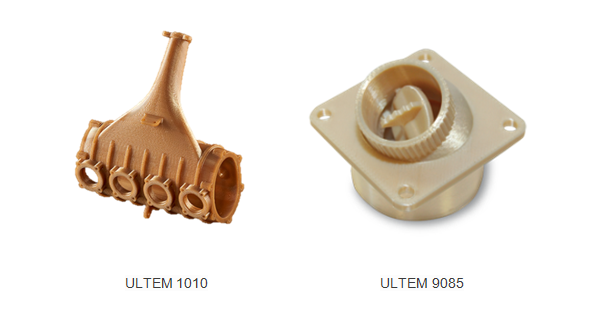
FDM technology empowers you to 3D print parts in a wide array of proven plastics. On Stratasys’ Fortus 400mc, 450mc, and 900mc production systems, ULTEM 1010 and ULTEM 9085 are two of the most frequently chosen resins. Below is a side‑by‑side look at the key performance differences to help you pick the right material for your application.
Temperature
For high‑heat environments, ULTEM 1010 offers a heat‑deflection temperature (HDT) of 216 °C (412 °F), while ULTEM 9085 tops out at 153 °C (307 °F).
Strength
ULTEM 1010 is the strongest FDM resin available. Its tensile strength in the XZ orientation reaches 9,300 psi, compared with 6,800 psi for ULTEM 9085.
Toughness & Flexibility
When a component needs controlled flexibility—think panels, jigs, fixtures, or clips—ULTEM 9085 is often the better choice. With a flexural strength of 16,200 psi, it offers a slightly more forgiving, ductile response than the stiffer ULTEM 1010.
Chemical Resistance
Both resins resist many chemicals, but ULTEM 1010 handles a broader spectrum of aggressive environments, making it the safer pick for chemically demanding parts.
Thermal Expansion
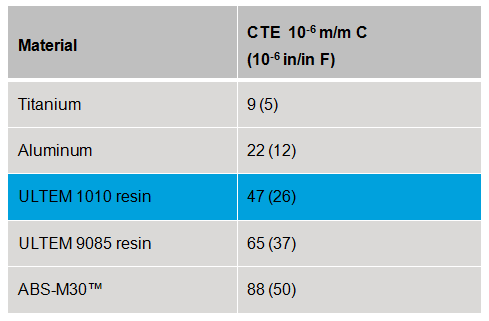
Lower coefficients of thermal expansion (CTE) are critical for tooling and precision parts. ULTEM 1010 consistently shows a smaller CTE than ULTEM 9085. The chart below highlights the comparison.
Beyond these metrics, the two resins have subtle differences that can influence your final choice. With Stratasys’ expanded FDM library, you now have the flexibility to tailor material selection to your exact requirements. Stay tuned for the next generation of high‑performance resins!
Tags: 3D Printing, FDM Materials, Ultem 1010, Ultem 9085
3D printing
- ULTEM & PEEK: Mastering High‑Performance 3D Printing Materials
- FDM 3D Printing: ASA, PETG, and PC Filaments Compared – Expert Guide to Performance & Applications
- Modix BIG Meter – 1 m³ DIY Large‑Scale FDM Printer for Prototyping & Manufacturing
- A Comprehensive Guide to Metal 3D Printing Technologies
- A Comprehensive Guide to CNC Machine Types and Their Applications
- Additive vs Subtractive Manufacturing: Key Differences & Applications
- Pulumi vs Terraform: A Comprehensive Comparison of Key Features
- Steel vs. Aluminum: Which Metal Offers Superior Ductility & Performance?
- AISI 1010 Hot Rolled Steel: Properties & Applications
- AISI 1010 Cold Drawn Steel – Key Properties & Performance