



High‑Strength 3D Printing with Carbon‑Fiber Nylon Composite
Carbon fiber’s exceptional strength‑to‑weight ratio makes it ideal for producing lightweight yet robust components. When blended with nylon, the resulting composite delivers a material that is not only strong and stiff but also heat‑resistant and dimensionally stable across a wide temperature range.
These CF‑Nylon filaments are abrasive and require meticulous print settings—varying temperatures, infill densities, and flow rates—to maintain consistent quality. Our patented Advanced Fusion Plastic Modeling (AFPM) technology adapts on the fly to each part’s geometry, ensuring reliable results where standard 3D printers fall short.
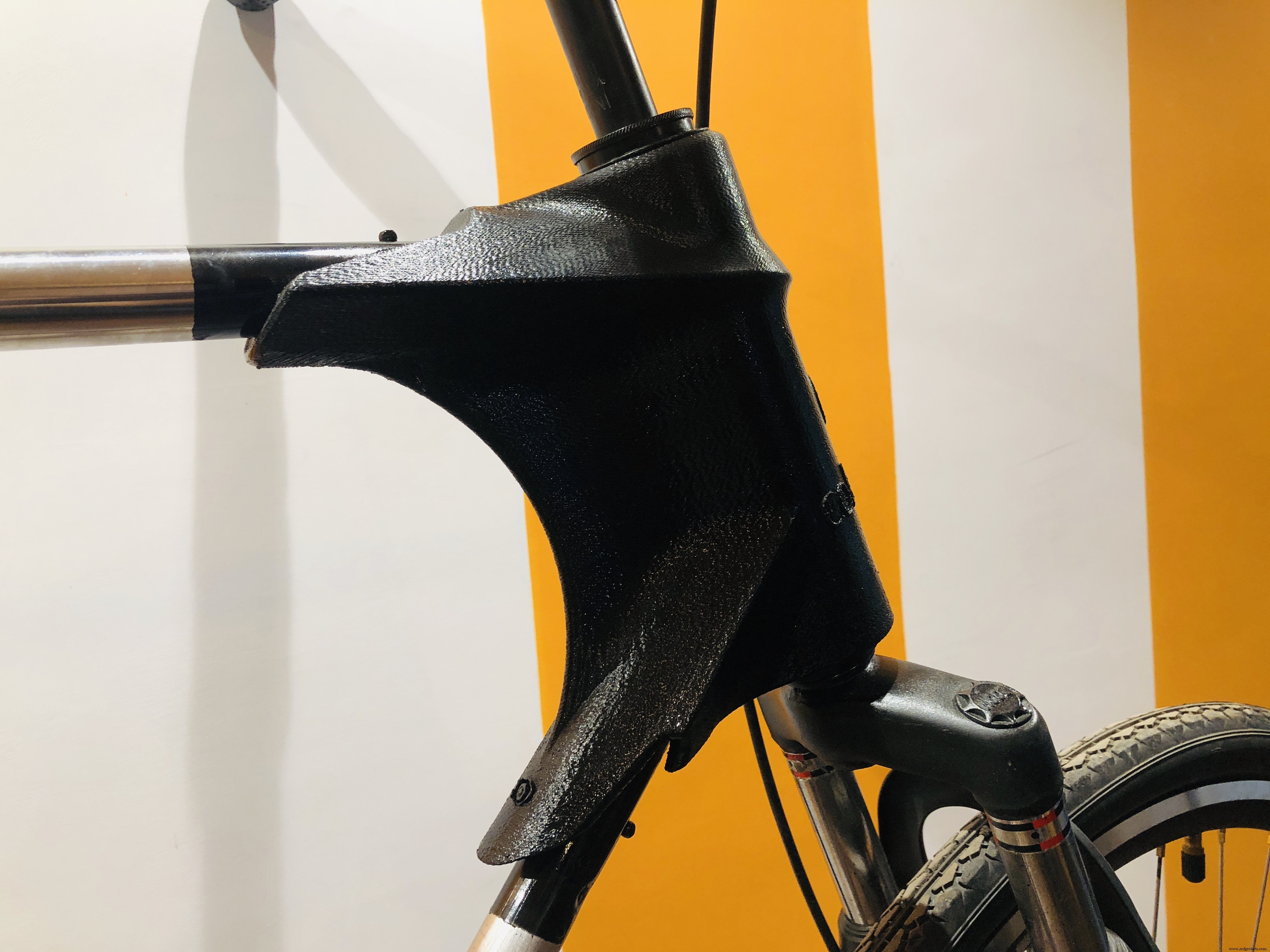
Material Properties
| Property | Value | Unit | Test Method | |||
| Physical | ||||||
| Density | 1.4 | g/cc | ISO 1183 | |||
| Humidity absorption (23ºC,50% RH) | < 2.0 | % | ||||
| Mechanical | ||||||
| Tensile Strength | 107 | MPa | ISO 527 | |||
| Tensile Elongation at Break | 2.0 | % | ISO 527 | |||
| Charpy Impact Strength (unnotched) | 37 | kJ/m2 | ISO 179 | |||
| Thermal | ||||||
| Continuous Service Temperature | 120 | °C | UL 746B | |||
Compared to conventional thermoplastics, CF‑Nylon excels in heat resistance, stiffness, and dimensional stability. Its low thermal conductivity and superior impact resistance also translate to reduced shrinkage during cooling, making it ideal for high‑precision parts.
Key Applications
- Aerospace: fixtures, UAV components, tooling, and rapid prototyping
- Automotive: bumpers, brackets, and mounting hardware
- Consumer goods: prototypes and end‑use parts that demand durability
- Manufacturing aids: tooling, fixtures, and other production accessories
Advantages
- Exceptional impact and abrasion resistance for demanding environments
- High strength-to-weight ratio allows metal‑grade performance at lower weight
- Superior chemical and temperature tolerance expands design freedom
- Lower thermal conductivity reduces dimensional drift and shrinkage
Limitations
- Nylon CF is hygroscopic; moisture absorption can degrade print quality
- Filament must be properly dried before use to ensure consistent results
CF‑Nylon in the COVID Era
During the pandemic, demand surged for rapid, on‑demand manufacturing of critical components. Our high‑speed 3D printing solutions, coupled with CF‑Nylon’s low cooling time and negligible shrinkage, enabled industries to meet tight lead times while keeping costs down.
About Divide By Zero Technologies
Divide By Zero (DBZ) is India’s leading home‑grown 3D printer manufacturer, the first local brand to export globally. The company recently shipped India’s first high‑speed 3D printers to Houston, Texas, and holds dual patents in India and the U.S. DBZ partners with over 800 brands and institutions—including TATA, Mercedes‑Benz, Samsung, DRDO, Godrej, HUL, Eicher—and supports 1,000+ startups worldwide. With a strong focus on education, DBZ has helped incubate more than 500 startups across the country.
Compatible 3D Printers
CF‑Nylon can be printed on the Aeon400 V3 and Aion series. These machines feature extruders that reach 400 °C and integrated active filament dryers that remove moisture, guaranteeing smooth, accurate prints.
Contact us to discover how CF‑Nylon can transform your product development and manufacturing.
3D printing
- Choosing the Right Plastic for 3D Printing: A Comprehensive Guide
- HP Multi Jet Fusion: Mastering 3D Printing for Speed, Quality, and Precision
- 3D Printing with Resins: A Comprehensive Guide to Technologies, Materials, and Applications
- How Metal 3D Printing Is Revolutionizing Lightweight Parts for Aerospace and Automotive
- Titanium 3D Printing: Applications, Benefits, and Emerging Technologies
- In‑House Production: The Fuse 1 Builds Its Own Parts
- Revolutionizing Rapid Prototyping with AFPM
- High‑Speed 3D Printing with the AION500 MK3 – Unmatched Speed, Precision, and Strength
- Mastering Isotropic Fiber 3D Printing: Build Ultra‑Strong Parts with the Mark Two
- Precision 3D Printing: Micro Features with SLA’s MicroFine Material