



Understanding Conductor Size: Wire Gauges, Cross‑Sectional Area, and Practical Applications
Understanding Conductor Size
In electrical engineering, the ease with which electrons flow through a conductor is governed largely by the conductor’s cross‑sectional area. Just as a larger straw allows liquid to pass more readily than a narrow one, a thicker wire provides a greater path for electrons, reducing resistance and improving current‑carrying capacity.
Solid vs. Stranded Wire
Electrical conductors come in two primary forms:
- Solid copper wire – a single, continuous strand of copper.
- Stranded wire – many thin strands twisted together to form one conductor.
Measuring Wire Size
Although diameter is often mentioned, the critical factor for electrical performance is the area of the conductor’s cross‑section. Two units are commonly used in the industry:
- Mil – one thousandth of an inch; used to express diameter.
- Square mil – area unit derived from the diameter (square of the diameter in mils).
- Circular mil (cmil) – a simplified area metric that removes the need for π in the calculation. It is defined as the area of a circle with a diameter of one mil, which equals 1000 π mils² ≈ 3 141.59 square mils.
For a circular wire of diameter 0.1019 in, the area is:
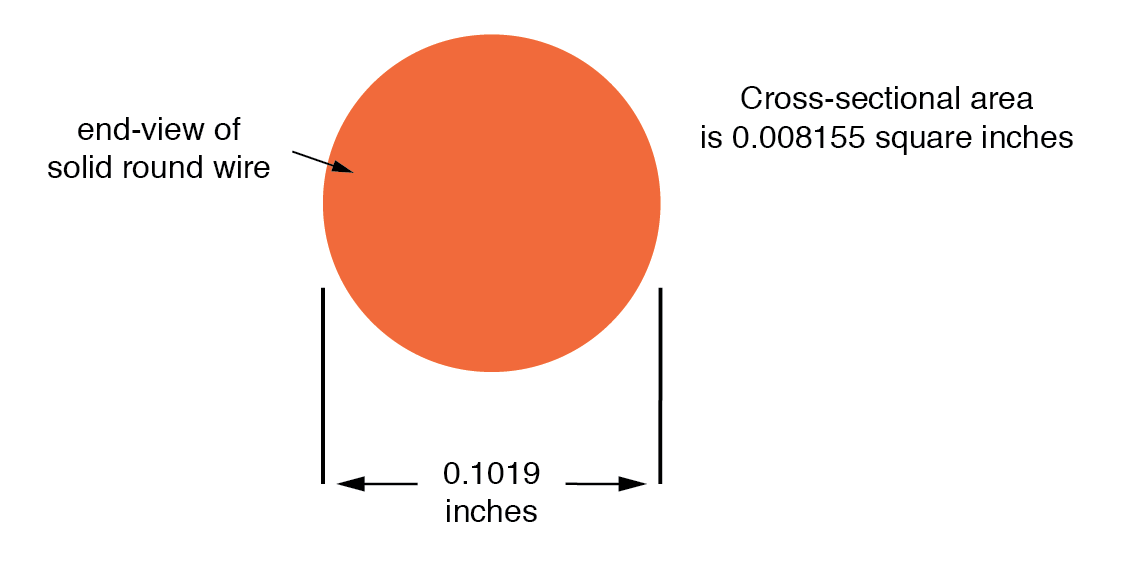
Using the formula Area = πr², we obtain 0.008155 in² (or 8 155 square mils). Converting to circular mils is simply d² = 101.9² = 10 380 cmil.
Why Circular Mils?
Because the circular mil removes π from the equation, it simplifies calculations for engineers. For example:
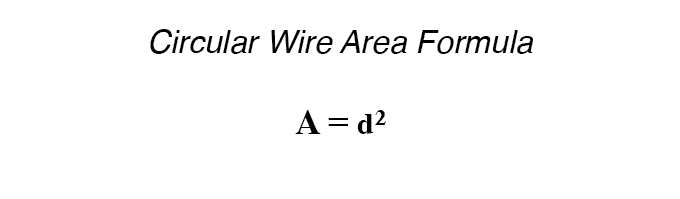
The conversion between square mils and circular mils is a fixed ratio: 1 cmil = 4 π sq mils ≈ 12.566 sq mils.
Gauge – A Convenient Scale
The American Wire Gauge (AWG) system assigns an integer to each wire size. Larger gauge numbers mean thinner wires. The gauge scale follows a logarithmic progression: every 3‑step increment approximately doubles the cross‑sectional area (and the weight per unit length). This relationship is handy for quick estimations:
- AWG 10 = 10 380 cmil
- AWG 12 = 6 530 cmil
- AWG 14 = 4 107 cmil
Wires larger than 4/0 gauge are often measured in thousands of circular mils (MCM) and are typically fabricated as stranded or bar conductors rather than solid round wire.
Solid, Round Copper Conductors – AWG Table
| Size | Diameter (in) | Area (cmil) | Area (in²) | Weight (lb/1000 ft) |
|---|---|---|---|---|
| 4/0 | 0.4600 | 211,600 | 0.1662 | 640.5 |
| 3/0 | 0.4096 | 167,800 | 0.1318 | 507.9 |
| 2/0 | 0.3648 | 133,100 | 0.1045 | 402.8 |
| 1/0 | 0.3249 | 105,500 | 0.08289 | 319.5 |
| 1 | 0.2893 | 83,690 | 0.06573 | 253.5 |
| 2 | 0.2576 | 66,370 | 0.05213 | 200.9 |
| 3 | 0.2294 | 52,630 | 0.04134 | 159.3 |
| 4 | 0.2043 | 41,740 | 0.03278 | 126.4 |
| 5 | 0.1819 | 33,100 | 0.02600 | 100.2 |
| 6 | 0.1620 | 26,250 | 0.02062 | 79.46 |
| 7 | 0.1443 | 20,820 | 0.01635 | 63.02 |
| 8 | 0.1285 | 16,510 | 0.01297 | 49.97 |
| 9 | 0.1144 | 13,090 | 0.01028 | 39.63 |
| 10 | 0.1019 | 10,380 | 0.008155 | 31.43 |
| 11 | 0.09074 | 8,234 | 0.006467 | 24.92 |
| 12 | 0.08081 | 6,530 | 0.005129 | 19.77 |
| 13 | 0.07196 | 5,178 | 0.004067 | 15.68 |
| 14 | 0.06408 | 4,107 | 0.003225 | 12.43 |
| 15 | 0.05707 | 3,257 | 0.002558 | 9.858 |
| 16 | 0.05082 | 2,583 | 0.002028 | 7.818 |
| 17 | 0.04526 | 2,048 | 0.001609 | 6.200 |
| 18 | 0.04030 | 1,624 | 0.001276 | 4.917 |
| 19 | 0.03589 | 1,288 | 0.001012 | 3.899 |
| 20 | 0.03196 | 1,022 | 0.0008023 | 3.092 |
| 21 | 0.02846 | 810.1 | 0.0006363 | 2.452 |
| 22 | 0.02535 | 642.5 | 0.0005046 | 1.945 |
| 23 | 0.02257 | 509.5 | 0.0004001 | 1.542 |
| 24 | 0.02010 | 404.0 | 0.0003173 | 1.233 |
| 25 | 0.01790 | 320.4 | 0.0002517 | 0.9699 |
| 26 | 0.01594 | 254.1 | 0.0001996 | 0.7692 |
| 27 | 0.01420 | 201.5 | 0.0001583 | 0.6100 |
| 28 | 0.01264 | 159.8 | 0.0001255 | 0.4837 |
| 29 | 0.01126 | 126.7 | 0.00009954 | 0.3836 |
| 30 | 0.01003 | 100.5 | 0.00007894 | 0.3042 |
| 31 | 0.008928 | 79.70 | 0.00006260 | 0.2413 |
| 32 | 0.007950 | 63.21 | 0.00004964 | 0.1913 |
| 33 | 0.007080 | 50.13 | 0.00003937 | 0.1517 |
| 34 | 0.006305 | 39.75 | 0.00003122 | 0.1203 |
| 35 | 0.005615 | 31.52 | 0.00002476 | 0.09542 |
| 36 | 0.005000 | 25.00 | 0.00001963 | 0.07567 |
| 37 | 0.004453 | 19.83 | 0.00001557 | 0.06001 |
| 38 | 0.003965 | 15.72 | 0.00001235 | 0.04759 |
| 39 | 0.003531 | 12.47 | 0.000009793 | 0.03774 |
| 40 | 0.003145 | 9.888 | 0.000007766 | 0.02993 |
| 41 | 0.002800 | 7.842 | 0.000006159 | 0.02374 |
| 42 | 0.002494 | 6.219 | 0.000004884 | 0.01882 |
| 43 | 0.002221 | 4.932 | 0.000003873 | 0.01493 |
Busbars for High‑Current Applications
When currents exceed the practical limits of round conductors, solid metal bars—known as busbars—are employed. Commonly made of copper or aluminum, busbars are usually uninsulated and mounted on insulating standoffs. While a square or rectangular cross‑section is typical, busbars can also be round. Their area is still expressed in circular mils for consistency with wire sizing.
Key Takeaways
- Large‑diameter conductors reduce resistance because they offer more cross‑sectional area for electron flow.
- Wire diameters are often quoted in mils (1/1000 in) to avoid decimal fractions.
- Cross‑sectional area can be expressed in square inches, square mils, or circular mils.
- The circular mil metric simplifies calculations by eliminating π.
- AWG gauge numbers decrease as wire diameter increases; the scale is logarithmic, with every 3 steps roughly doubling the area.
- Very large conductors are rated in thousands of circular mils (MCM) and are usually stranded or fabricated as busbars.
- Busbars are solid, high‑current conductors often used in industrial power distribution.
Further Resources
- Wire Types and Sizes Worksheet
Industrial Technology
- Hands‑On Electromagnetism Experiment: Build and Test a Simple Electromagnet
- Construct a Basic Transformer: Step‑by‑Step Guide
- Understanding Ladder Diagrams: Design, Wiring, and Safety in Industrial Control Systems
- Understanding Conductor Ampacity: How Wire Size, Insulation, and Standards Determine Current Capacity
- Real‑World Inductor Behavior: Skin Effect, Losses, and the Q Factor
- Barbed Wire Explained: History, Construction, and Modern Uses
- How to Determine the Proper Size of Earth Conductors, Earthing Leads, and Earth Electrodes
- Standard Wire Gauge (SWG) Calculator – Size Chart & Cable Properties
- AWG Wire Gauge Calculator & Size Chart – Accurate Wire Specs & Current Ratings
- Comprehensive AWG Wire Size & Ampacity Guide – Standard Chart for Accurate Electrical Sizing