



VS1838B Infrared Receiver LED Production – Precision & Performance
An IR receiver, sometimes referred to as a photodiode, collects IR rays from a source’s transmission (for example LED), then uses the rays to generate an electrical signal. In turn, the signal control devices, for instance, household appliances. Recently, the emergence of infrared products has contributed to a rise in the circuitry and current industry whereby complex applications such as CNCs are in use. And so, in today’s article, we will discuss how we can use a known type of infrared receiver, VS1838b IR sensor, to make an infrared receiver module.
1. What is vs1838b?
A vs1838b IR receiver LED is a high-quality infrared sensor operating on a 38kHz frequency. Generally, it is a small model of an infrared receiver commonly applicable in remote control projects. In addition, you can use it in devices that might need ambient light rejection.
To work, it requires a preamplifier, PIN diode and a specific signal conditioning circuitry often merged into the IR receiver package. Hence, the device using the vs1838 will effectively have an interconnection with a microcontroller.
2.Features and Specifications of VS1838B
The vs1838b datasheet contains the features and specifications below of the infrared chip;
Features:
- Support 3-5V input voltage,
- The infrared frequency should be 38kHz 1838 NEC code,
- It can sustain a reception distance that goes up to 18 meters,
- High-level voltage: 4.5V,
- Low-level voltage: 0.4V,
- Length at 5.20 mm,
- Width at 0.28inches,
- Height at 7.86 mm,
- Weight at 0.02 oz, and
- Reception angle: 35 degrees.
Specifications:
- Operating voltage: 2.7V to 5.5V,
- Efficient transmission code: RC5 code, NEC code,
- Lead from: 2.54 mm,
- Reception angle: 35-45 degrees,
- Should be CMOS and TTL compatible,
- The shielding should be of high quality to prevent electric field disturbance, and finally,
- Strong against ambient light.
3. Vs1838b Application Circuit and Schematic Diagram
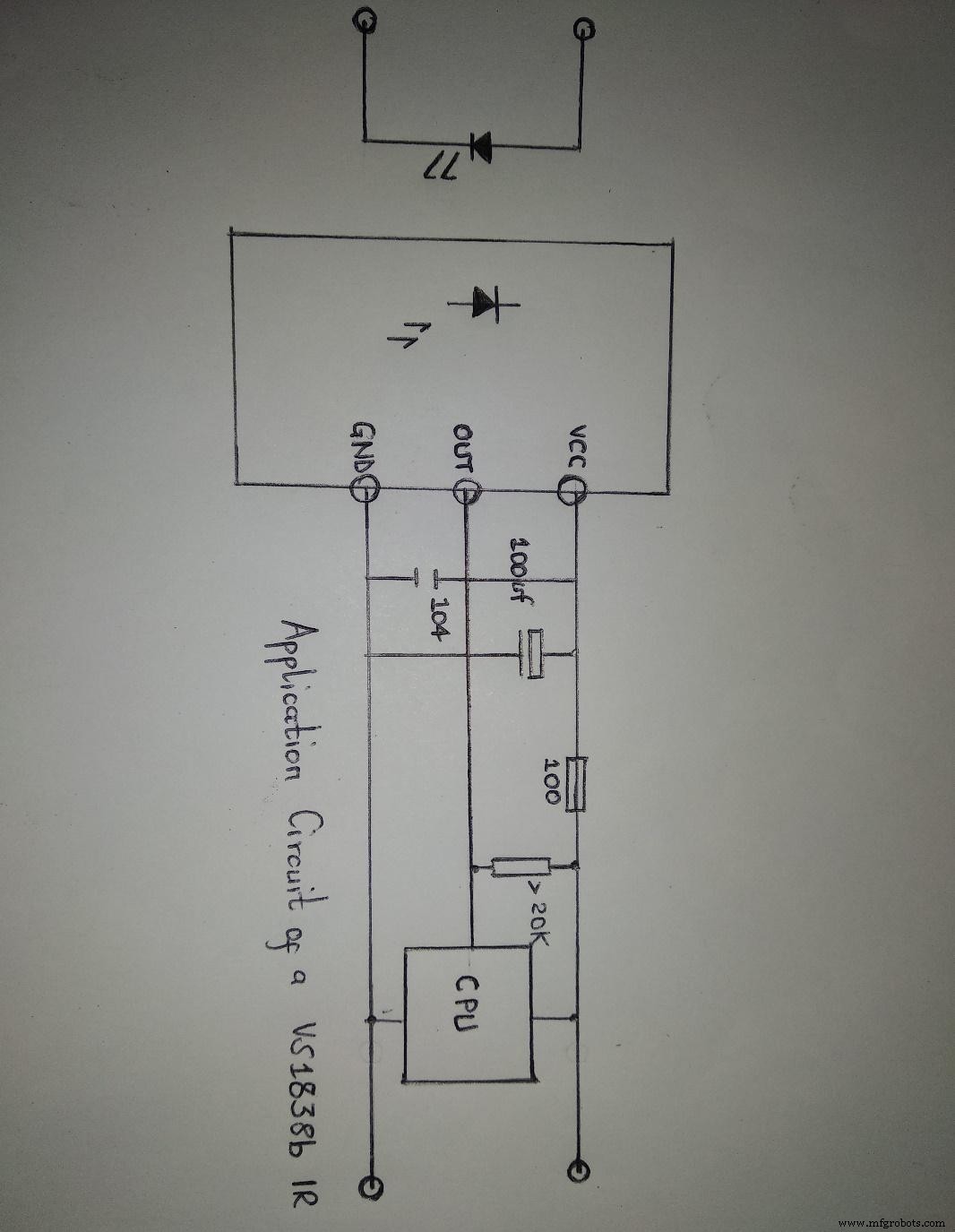
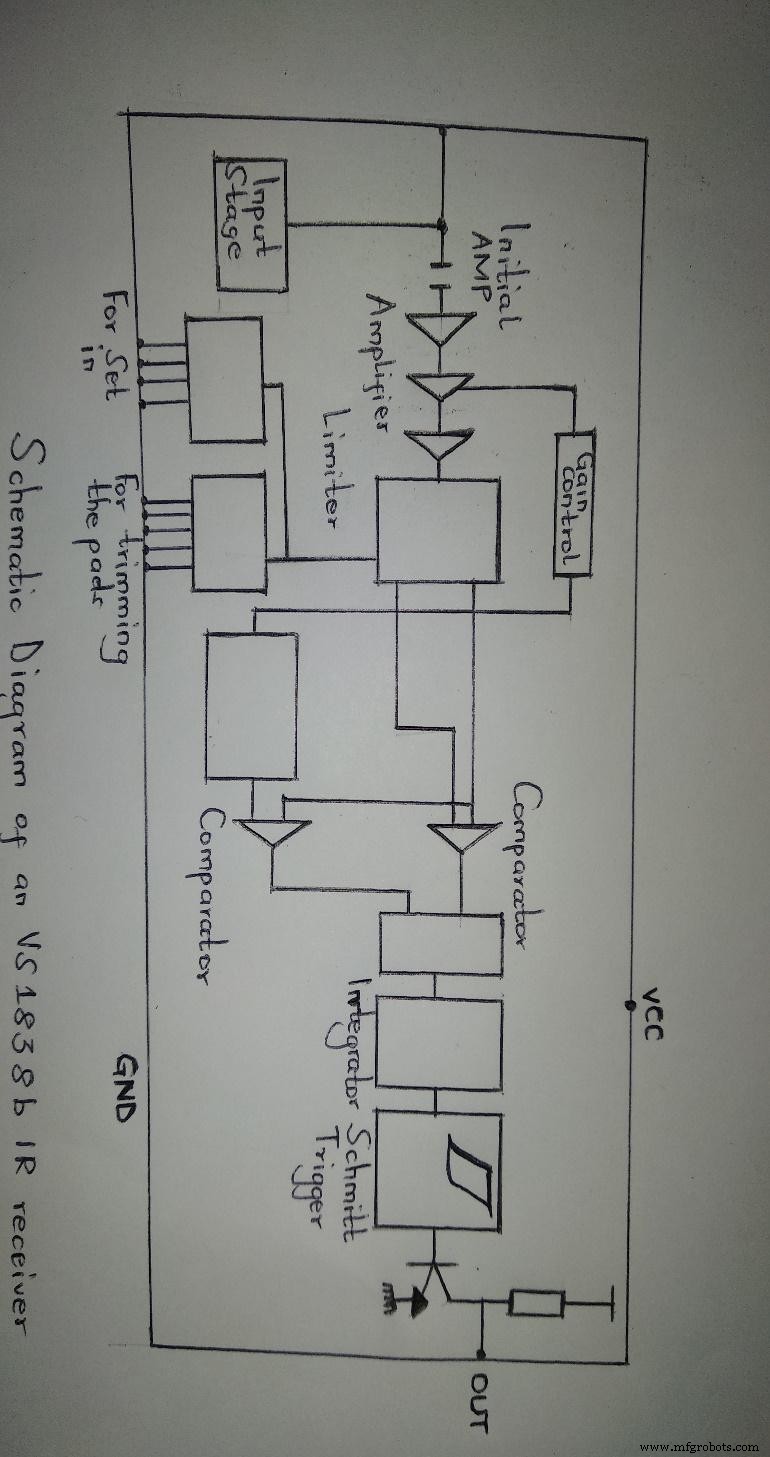
4. VS1838B Pin Arrangement
A vs1838b has about three pinouts, and each carries out different functions as follows;
Pin 1/ Out pin; The first pin functions to give the infrared sequence. Often, it depends on the detected IR signal.
Pin 2/ Ground pin; It mostly has a connection with the circuit’s ground.
Pin 3/ VCC pin; It connects to voltages such as 2.5V, +5V, and 5.5V.
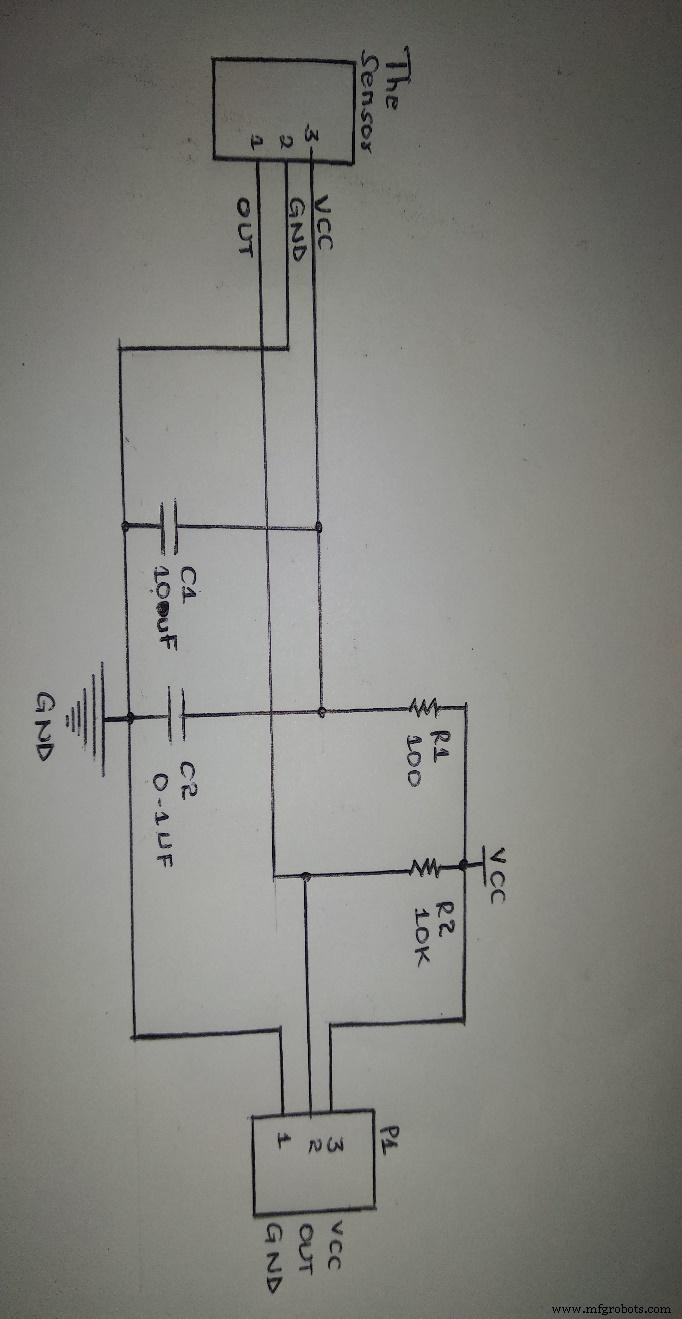
The diagram above shows the schematic pin arrangement of a vs1838b.
5. VS1838B Infrared Receiver LED
- The component list
The part list of a vs1838b IR sensor includes the following components;
- A USB cable of 5v,
- 47 uF capacitor,
- 220-resistor device,
- IR receiver PCB/breadboard/Vero-board,
- Vs1838b sensor,
- 2-pin terminal block, and
- A BC547 transistor.
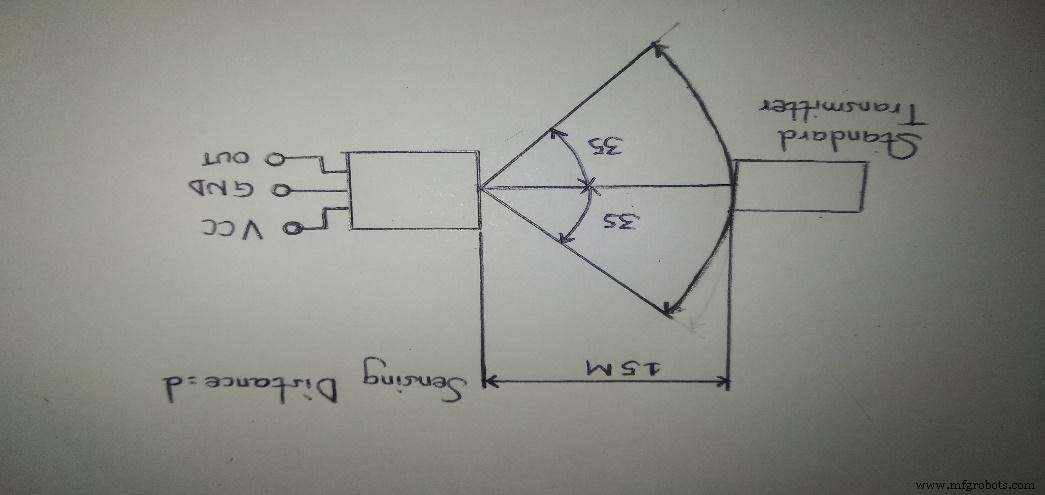
The receiving angle is recommendable at 35°
Limit parameter value
We have indicated the limit parameter values in the table below.
| Project | Specs | Symbol | Unit |
| Supply voltage | 6.0 | Vcc | Voltage |
| Storage temp. | -40 to 125 | Tstg | Degree Celsius |
| Operating temp. | -25 to 85 | Top | °C |
| Soldering temp. | 240 | To | °C |
- In the first step, begin by soldering the vs1838b IR receiver on the available vero/breadboard.
- Then, continue by soldering the BC547 transistor on the same Vero-board.
- Afterward, solder the light-emitting diode.
- Next, repeat the same soldering with a 47uF capacitor on the board.
- Finally, on the soldering, finish up with the output block connector and 470 Ohm resistor.
- Lastly, you may test the circuit by powering it up with a Direct current supply voltage.
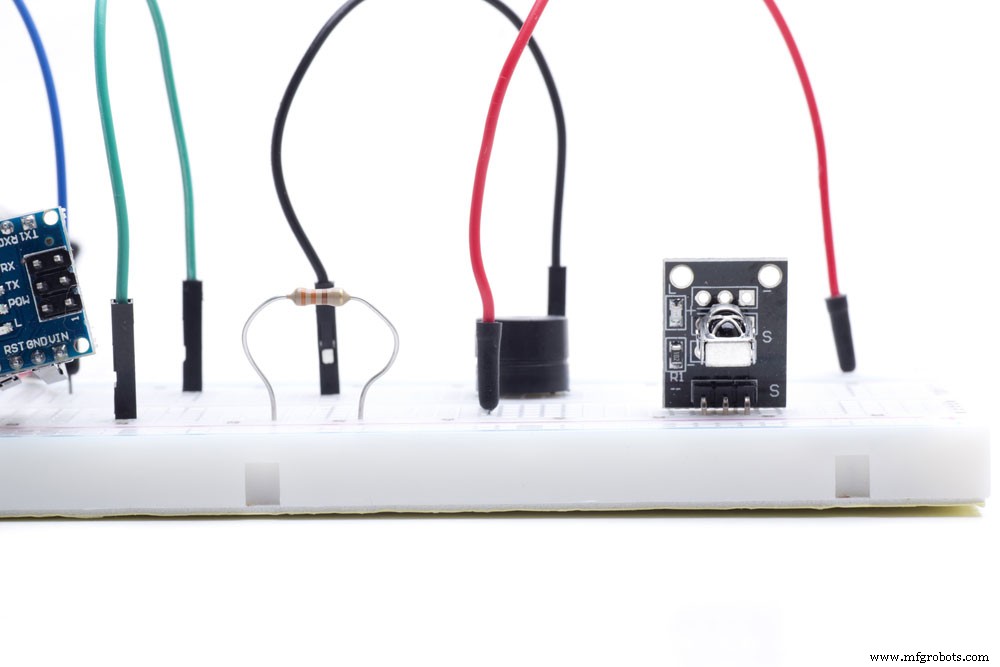
(an IR receiver assembled in a protoboard)
How the vs1838b will work
Consider the explanation below when establishing the working principle of your sensor-friendly product.
At all times, when a TV remote or IR LED transmits an IR ray, the IR receiver gathers the rays. Then, there is a generation of the receiver’s output signal at the Q pin of the IR receiver.
Note; The receiver output is a control signal on the BC547 transistor’s base.
Therefore, any device connected to the BC547 collector terminal, such as LED, gets triggered by the output signal. To conclude, using a 5V to 9V battery is sufficient in powering up the circuit.
Precautions for use
- First of all, you should try and keep off emitters giving off visible light.
- Again, during the adjustment of pulses, ensure the ratio or on time to pulse time is at 40% or 0.4 on the duty cycle.
- Further, using the instructions on the code, cautiously proceed by experimenting manually. It is because some photo-transistors may be of poor quality hence require careful handling.
- Besides, the emitter needs to have a 940nm wavelength.
Vs1838b Equivalents and Replacement
At times, you may need to use an alternative sensor if you lack a VS1838b. Under such circumstances, an IR receiver LED or TSOP17-xx are the better options.
Common applications of VS1838b
You can apply vs1838b in the following areas;
- First, in optical switches.
- Then, in household appliances such as the air conditioner, CATV set-top boxes, and fan.
- Also, you can use it in the part of remote control of some AV instruments that detect light, for instance, in DVDs and TVs.
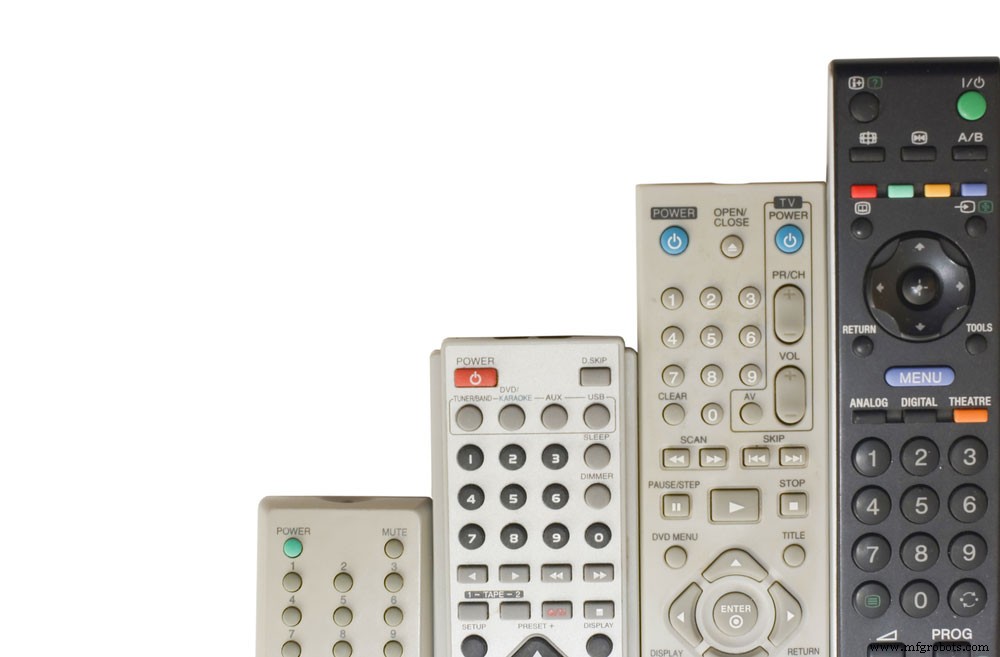
(remote control applying the vs1838b)
Conclusion
To sum up, the vs1838b sensor is becoming common in applications involving disrupted ambient lighting. Furthermore, it can protect against unrestrained output pulses. Thus, for the reasons stated and many more, it has proven to have excellent performance.
Briefly, the above content will educate you on making your DIY product using the VS1838b receiver LED. However, if there are still queries on the same, do reach out to us.
Industrial Technology
- Using a Transistor as an Electrically Controlled Switch
- Pulsed‑Light Sensor: Amplify LED Light Pulses into Audible Sound
- Build an LED Sequencer with 555 Timer & 4017 Counter – Frequency Division & Debounce
- APDS‑9960: A Multi‑Sensor IC for Gesture, Proximity, Light and Color Detection
- Integrating Lean Production with Industry 4.0: A Path to Sustainable Efficiency
- Decode RC Receiver PPM Signals with Arduino: A Step‑by‑Step Guide
- Infrared Eye‑Motion Tracking with Arduino Pro Mini – LED Control Demo
- Industrial Production of Diethyl Ether: Process & Applications
- Esterification Process for Ethyl Acetate Production: Efficient Methods & Industrial Applications
- 433 MHz Radio Band Explained: A Comprehensive Guide to Low‑Power Wireless Communication