



Pulsed‑Light Sensor: Amplify LED Light Pulses into Audible Sound
Parts and Materials
- Two 6‑volt batteries
- One NPN transistor—2N2222 or 2N3403 (Radio Shack catalog # 276‑1617 offers a 15‑pack ideal for this and similar experiments)
- One light‑emitting diode (Radio Shack catalog # 276‑026 or equivalent)
- Audio detector with headphones
If you don’t already have an audio detector, you can build a sensitive one with a closed‑cup headphone set and a 120 V/6 V step‑down transformer. Connect the headphone stereo plug to the transformer’s 6 V secondary as shown:
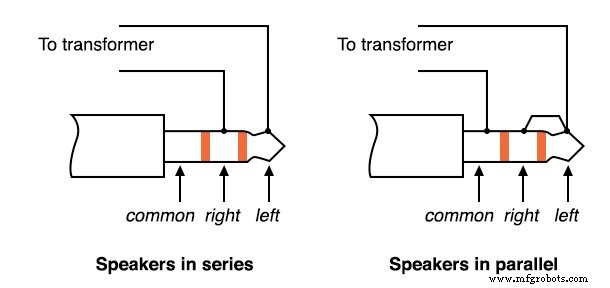
Try both series and parallel configurations for maximum volume. A dedicated audio detector, built as described in the DC and AC experiment chapters, is a valuable addition to any hobbyist’s kit.
Cross‑References
Lessons In Electric Circuits, Vol. 3, ch. 4: “Bipolar Junction Transistors”.
Learning Objectives
- Use a transistor as a basic common‑emitter amplifier
- Employ an LED as a light sensor
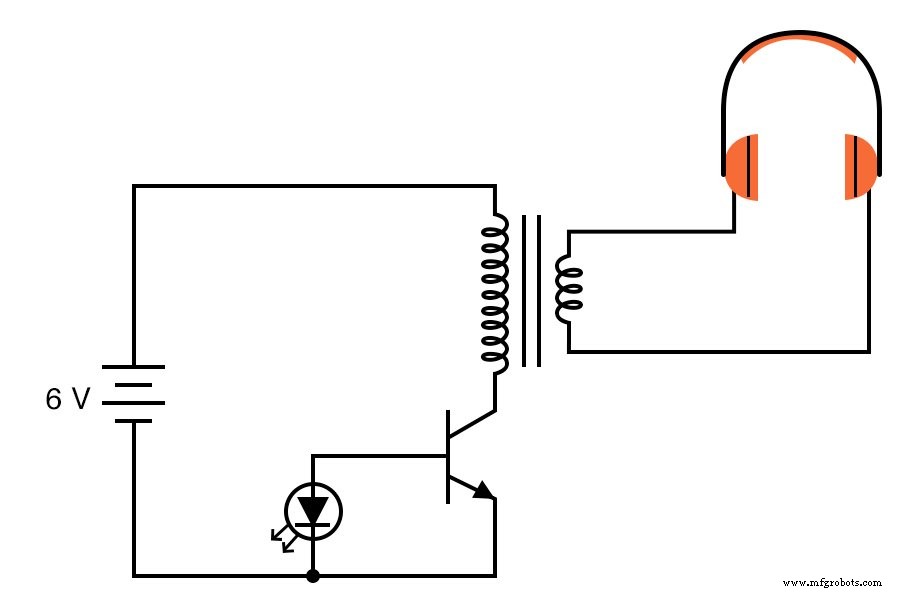
Schematic Diagram
Illustration
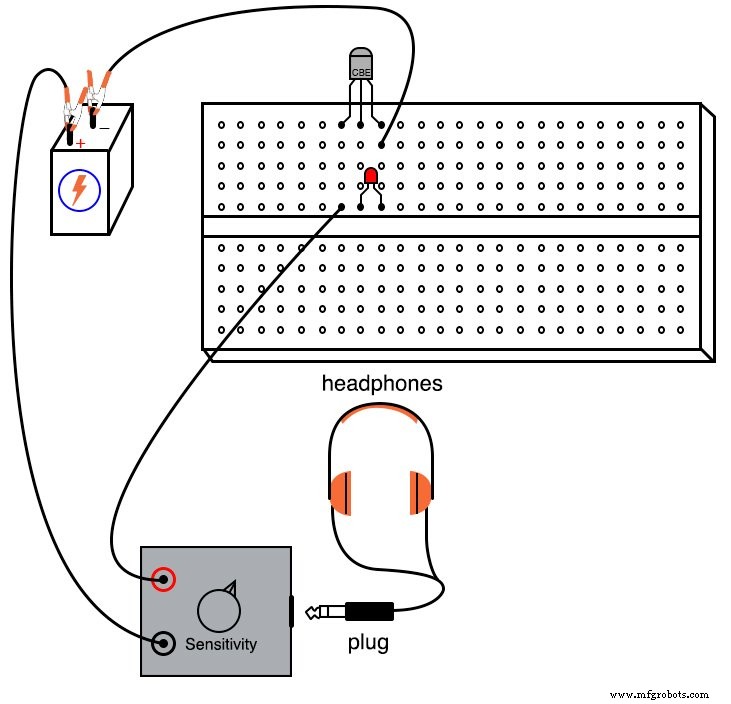
Instructions
This circuit detects pulses of light striking the LED and converts them into audible signals via a transistor amplifier. LEDs generate current when illuminated—much like a miniature solar cell—so the transistor amplifies the weak LED signal enough to drive the headphones.
Expose the LED to pulsed light sources such as fluorescent or neon lamps that flicker at 60 Hz, or use a steady bright source and create moving shadows with your fingers. The resulting light pulses produce a distinct buzzing tone in the headphones. Because LEDs are narrow‑band devices, they respond best to wavelengths close to their own emission. Near‑infrared LEDs can also detect infrared remote‑control signals, yielding a recognizable audio cue.
With a transmitter that modulates an LED using an audio waveform, this receiver demonstrates how light pulses can carry music or speech—illustrating the fundamental concept behind optical audio transmission.
Industrial Technology
- Using a Transistor as an Electrically Controlled Switch
- Pulsed‑Light Sensor: Amplify LED Light Pulses into Audible Sound
- Build a Low‑Frequency Astable Multivibrator Audio Oscillator with Discrete Transistors
- Build a High‑Performance Class B Push‑Pull Audio Amplifier with TL082 Op‑Amp
- Build an LED Sequencer with 555 Timer & 4017 Counter – Frequency Division & Debounce
- Understanding the Oxygen (O2) Sensor: Role, Placement, and Failure Signs
- RGB LED Backlight with MSGEQ7 Audio Visualizer for TV and Desk
- Infrared Eye‑Motion Tracking with Arduino Pro Mini – LED Control Demo
- Precision Bearing Temperature Sensor – Accurate Detection & Monitoring
- Mastering LED Strip Accessories: Connect, Control, and Customize Your Lighting