



APDS‑9960: A Multi‑Sensor IC for Gesture, Proximity, Light and Color Detection
Automation is reshaping everyday devices—from smartphones to robotics—by making tasks more intuitive, efficient and reliable. Key to this transformation are sensors that can sense a variety of environmental cues. Traditional designs often require separate chips for touch, proximity, gyroscope or gesture detection, which inflates size, cost and power consumption. Multipurpose sensors solve this by integrating several sensing elements into one compact package. The APDS‑9960 is a leading example, offering proximity, gesture, ambient light and RGB color detection all on a single die.
What is the APDS‑9960?
The APDS‑9960 is a digital, low‑power sensor that combines proximity, gesture, ambient light and RGB color sensing. Designed for high integration, it is commonly found in modern smartphones, tablets, wearables and robotics. Its low‑profile 3.94 × 2.36 × 1.35 mm LGA package fits comfortably in tight spaces while delivering accurate, real‑time data for user interfaces and environmental awareness.
Block Diagram
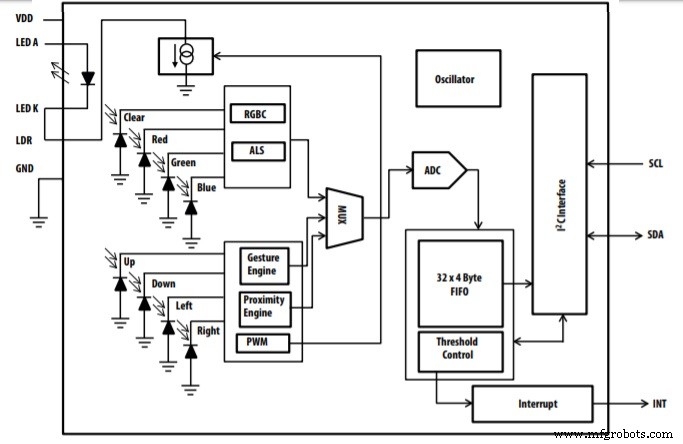
The chip contains a proximity engine, an ambient light sensor, an RGB color sensor and a gesture detection module. Communication is handled via a standard I²C interface, making integration straightforward with most microcontrollers.
An on‑chip infrared LED emits a modulated IR signal. When an object or hand moves in front of the sensor, the reflected light is captured by four dedicated photodiodes. By analyzing the intensity and timing of the returned signal, the APDS‑9960 determines distance, gestures and color.
Circuit Design Considerations
The internal LED can draw currents exceeding 100 mA in rapid bursts, which may introduce supply‑rail noise. To mitigate this:
- Use a clean, low‑noise analog supply for VDD and a separate noisy supply for the LED drive.
- Place a 1 µF, low‑ESR decoupling capacitor directly at the VDD pin.
- At the LED driver output, add a bulk capacitor and a second decoupling capacitor on the LEDA pin.
- When powering from a single supply, run a 22 Ω series resistor on the VDD line and place a 1 µF low‑ESR capacitor across it to filter residual ripple.
Pinout
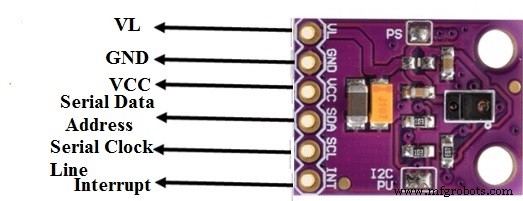
The 8‑pin LGA package is defined as follows:
- Pin 1 – SDA: I²C data line.
- Pin 2 – INT: Active‑low interrupt output.
- Pin 3 – LDR: LED driver input for the proximity LED.
- Pin 4 – LEDK: LED cathode.
- Pin 5 – LEDA: LED anode, tied to VLEDA on the PCB.
- Pin 6 – GND: Ground.
- Pin 7 – SCL: I²C clock.
- Pin 8 – VDD: Supply voltage (2.4 – 3.6 V).
Key Specifications
- Integrated ambient light, proximity, RGB color and gesture sensing.
- Factory‑trimmed IR LED driver eliminates the need for end‑device calibration.
- Programmable gain and integration time for light and color measurement.
- Dedicated offset registers to correct for stray IR reflections.
- High‑sensitivity detection behind dark glass.
- Automatic ambient light subtraction and saturation flag in proximity engine.
- Four directional photodiodes for robust gesture detection, with cross‑talk cancellation.
- 32‑sample FIFO and power‑saving interconversion delay.
- Fast‑mode I²C (up to 400 kHz) and 7‑bit addressing.
- Compact LGA: 3.94 × 2.36 × 1.35 mm; available as tape‑and‑reel.
- Operating voltage up to 3.8 V; LED supply up to 4.5 V.
- Temperature range –40 °C to +85 °C.
Typical Applications
- Smartphone touchscreens and proximity‑based power‑off.
- Gesture‑controlled interfaces in robotics and consumer electronics.
- Ambient light‑aware backlight adjustment for TVs, laptops and displays.
- RGB color calibration and temperature measurement.
- Medical instrumentation requiring reliable proximity and color detection.
- LCD and OLED display modules for eye‑friendly illumination.
Alternatives
Other compact proximity or gesture ICs that can replace the APDS‑9960 include the GY‑7620, VL53L0X (time‑of‑flight), and TCRT5000 (optical proximity). Each offers similar functionality but with different feature sets and form factors.
For complete electrical data, consult the APDS‑9960 datasheet. Which sensing capability have you explored in your projects?
Sensor
- HC‑SR04 Ultrasonic Sensor: How It Works and Key Applications
- ICM-20608-G: Compact 6‑Axis Motion Sensor for High‑Performance Applications
- BH1750 Ambient Light Sensor: Specs, Features, and Practical Applications
- VL53L0X Laser Distance Sensor: Pinout, Circuit, Specs & Practical Applications
- Arduino Sensors: Types, Applications, and Real‑World Projects
- Piezoelectric Sensors: How They Work, Key Specs, and Arduino Integration
- Complete Guide to the Arduino Nano Pinout: Specs, Pin Functions & Programming Tips
- SG3524 Modulator IC: Pinout, Specs, and Practical Applications
- LM335 Temperature Sensor: Complete Guide to Specs, Setup, and Real-World Uses
- Roll Pin Punches: Key Applications & Industrial Uses