



Using Sacrificial Tooling for Complex and Hollow Parts
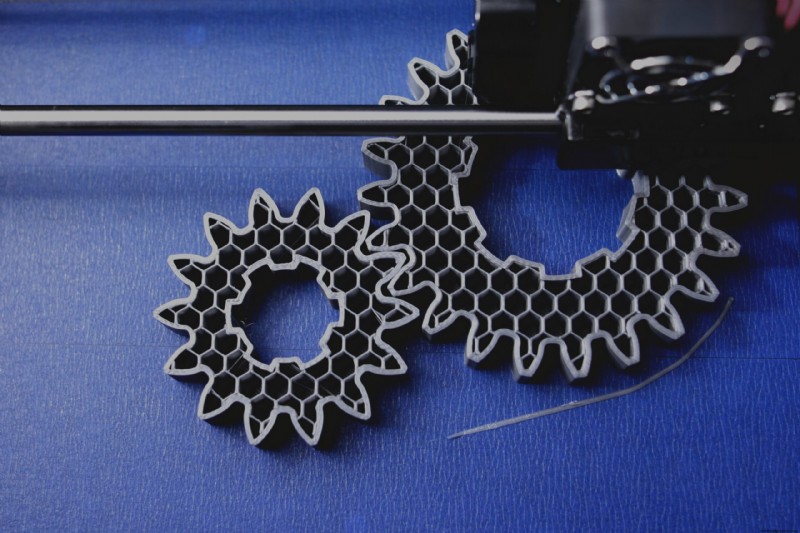
Though traditional manufacturing techniques can effectively produce basic shapes with uniform cross-sections, creating parts with hollow interiors or complex geometries presents unique challenges. However, with sacrificial tooling, designers and engineers don’t need to compromise on shape or material integrity.
Sacrificial tooling involves printing a structure in a soluble material, which is then used to create complex structures. This technique enables designers and engineers to easily create complex or hollow structures — featuring any kind of undercut — with smooth interiors out of numerous materials. Sacrificial tooling is usually performed via fused deposition modeling (FDM), which enables high accuracy and repeatability.
How sacrificial tooling works
Sacrificial tooling begins with a two-part design: a design of the tool, and a design of the final part. Of course, these two designs are essentially flip sides of the same coin; the sacrificial tool is designed to fill the interior of the final part. The tool should be built first, with allowances to promote fluid flow once it comes time to dissolve the tool.
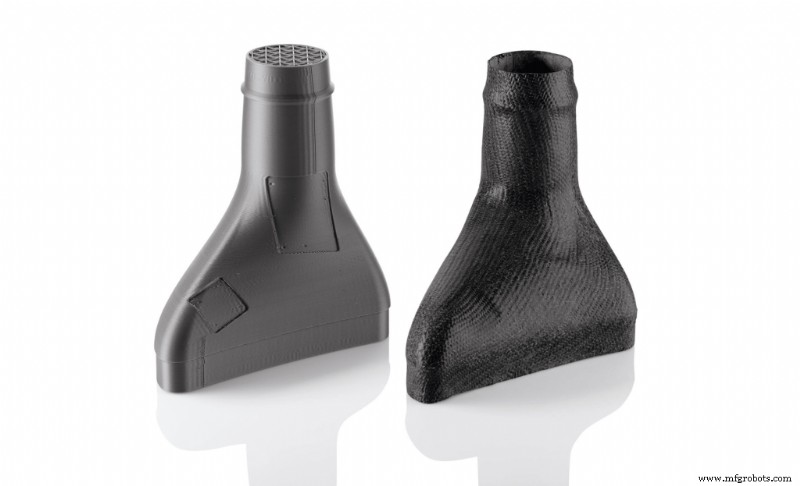
Once the tool has been constructed and the final part fitted around it, no further preparation is needed besides sanding to improve the surface’s finish and the application of resin to encourage even dissolution of the tool. With that complete, the part should be fully submerged into a removal detergent, which will dissolve the tool and leave the final part intact.
Advantages and limitations of sacrificial tooling
Sacrificial tooling is often favored by designers and engineers not only because it allows for the creation of complex structures with any number of materials, but also because it guarantees a shorter production time than many other manufacturing methods. In addition, it results in a product with no bonded seam. Other advantages of sacrificial tooling include:
- Forms undercuts without the need for complex slides in the tool
- High heat- and pressure-resistance
- Eliminates need for additional tooling
- Offers ability to quickly iterate designs
- Limited manual labor required
- Shortened lead time for low volumes
- Design-to-part time of days, rather than months
- Increased allowance for product complexity
- Improved economic sustainability
Best-fit applications for sacrificial tooling
Certain industries and applications are especially well-suited for sacrificial tooling, particularly those that require complex parts made of strong, heat-resistant materials, but that don’t require high production volume. Further, sacrificial tooling is ideal for creating products that fully enclose the part. FDM technology is most commonly used to create complex parts with hollow interiors, such as complex ductwork.
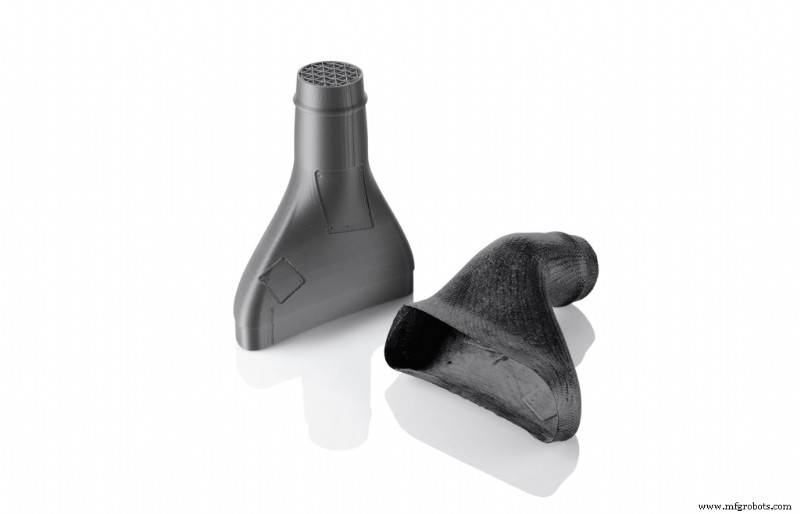
The aerospace and automotive industries see a range of common use cases for sacrificial tooling. Aircraft require incredibly strong, highly detailed parts, and sacrificial tooling helps achieve both of those goals. Similarly, the motorsports industry requires complex, specialized, strong, and lightweight parts.
Key design considerations for sacrificial tooling
When considering sacrificial tooling, designers and engineers should pay particular attention to two material characteristics: the coefficient of thermal expansion, and the cure temperature and pressure pairings.
Beyond the material’s characteristics, designers and engineers need to choose between two design styles: a sparse interior fill pattern or shell style. Sparse style is most commonly used, and in most cases, provides the optimal balance between build time and tool strength. Shell style, however, uses less build material and is especially effective when using an envelope bagging process.
It’s also important to choose the optimal orientation when manufacturing a part via sacrificial tooling. Tools can be built in a vertical or horizontal orientation, but the selected orientation will affect build speed, surface quality, support material requirements, and overall performance. The tool’s end-use application should be carefully considered during the design phase to determine the best build orientation.
A partner in FDM sacrificial tooling
For designers and engineers looking to build complex parts with hollow interiors, FDM sacrificial tooling offers a reliable, simple, and cost-effective method. Unlike traditional tooling methods, which require complex assembly or expensive, fragile wash-out tools, FDM sacrificial tooling is hands-off, versatile, and relatively simple.
At Fast Radius, we’re committed to helping our customers build excellent products in the most efficient manner possible. Our design and development engineering teams consist of experts who work closely with our clients during every stage of the manufacturing process, from concept to delivery.
If you’re interested in leveraging FDM sacrificial tooling for an upcoming project, contact us today or check out our resource center to learn more about our service offerings and materials.
Ready to make your parts with Fast Radius?
Start your quoteIndustrial Technology
- Mastering Signed and Unsigned Types in VHDL: A Practical Guide
- Remote Commissioning: Unlocking Efficiency and Flexibility in Industrial Operations
- Effortlessly Integrate Haas Tooling into Fusion 360: A Step‑by‑Step Guide
- Mastering the IR Blaster: How to Use Infrared Remotes on Your Phone
- Mastering the Raspberry Pi Camera Pinout: A Complete Guide to Setup and Usage
- PIC18 Microcontrollers: Features, Performance, and How to Use Them
- Complete 74HC00 Pinout Guide: Where & How to Use the NAND IC
- 2N3055 Transistor: Comprehensive Guide, Features, and Applications
- Arduino SD Card 101: Setup, Connection, and Usage Guide
- Understanding Reference Designators: How to Label PCB Assembly Connections