



Mastering G17, G18, and G19 Plane Selection for Ultra‑Smooth 5‑Axis CNC Machining
In precision manufacturing, delivering a flawless surface finish and tight dimensional tolerance during 5‑axis simultaneous milling hinges not only on step‑over distances and feed rates but also on the subtle art of plane selection. For CNC machining service engineers, correctly choosing between G17, G18, and G19 determines how the controller interprets motion, ultimately influencing vibration, chatter, and tool‑path continuity.
The Technical Role of G17, G18, and G19 in Multi‑Axis Machining
In 3‑axis milling, the plane selection is straightforward: G17 for the XY plane, G18 for the ZX plane, and G19 for the YZ plane. These commands instruct the controller which axes participate in arc commands (G02/G03) and radius compensation (G41/G42).
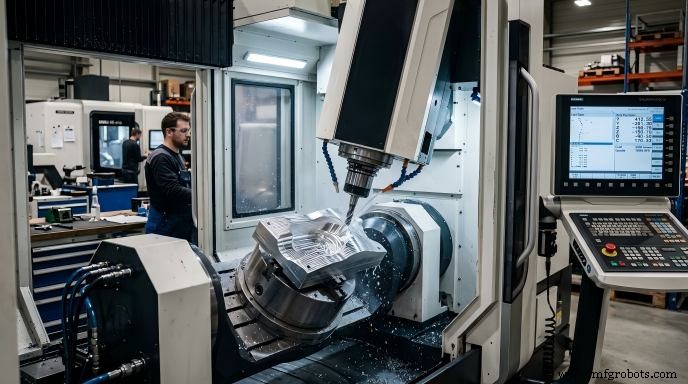
During 5‑axis simultaneous milling, the tool axis vector is constantly changing relative to the workpiece. Many CAM programs default to thousands of tiny G01 straight‑line segments to approximate a curve. While accurate geometrically, this forces the controller to accelerate and decelerate at each point, overloading the look‑ahead buffer and creating jerky rotary‑axis motion. By leveraging G17, G18, and G19 appropriately, engineers enable the controller to recognize local arcs in 3‑D space, switching from point‑to‑point to smooth arc motion and dramatically reducing computational load.
Strategies for Plane Optimization and Motion Smoothing
1. Enable Arc Filtering in the Post‑Processor
Arc filtering is the most effective way to improve surface finish. A post‑processor that supports plane switching scans the toolpath, identifies segments that can be represented as arcs, and emits G02/G03 commands in the correct plane.
- Linear vs. Circular Interpolation: A path made of 100 G01 lines can never match the smoothness of a single G02 or G03 arc. Defining the correct plane (e.g., G19 for a vertical radius on a cylinder) allows the controller to maintain constant velocity.
- Vector Consistency: In 5‑axis motion, the plane is a “tilted working plane.” Modern controllers handle these tilted planes. Aligning the G17–G19 command with the local coordinate system of the feature is essential for high‑speed accuracy.
2. Synchronize with RTCP (Rotation Tool Center Point)
RTCP (Fanuc G43.4 or Heidenhain M128) lets the programmer define the path based on the tool tip rather than the machine pivot. Proper plane selection ensures the controller can apply tool‑radius compensation without micro‑adjustments that cause surface vibration.
3. Leverage Advanced Contour Control and Pre‑Processing
Controllers such as the Fanuc 31i series and Siemens 840D offer AICC II and Top Surface features that look ahead hundreds of blocks to predict direction changes.
- Buffer Management: Frequent, unnecessary plane switches can break the look‑ahead buffer, forcing the controller to reset interpolation logic.
- The “Global G17” Approach: For highly complex surfaces like aero‑engine blades, staying in G17 and using Nano‑ or Spline interpolation prevents hesitation during plane switching.
System‑Specific Implementation and Best Practices
Fanuc Systems: High‑Speed Processing
With Fanuc, focus on the interaction between plane selection and the G05.1 Q1 (AI Nano Workpiece Interpolation) command. When the CAM output defines arcs using G17/G18/G19, the AICC program can more easily find acceleration/deceleration curves.
Siemens Systems: CYCLE832 and Compressor Functions
Siemens CYCLE832 works alongside compressor functions (COMPCAD or COMPSURF). Correct plane definition lets the compressor recognize geometric features, preserving sharp corners while maintaining high feed rates.
Heidenhain: PLANE Spatial and M128
Heidenhain’s PLANE SPATIAL command lets engineers define a working plane in 3‑D space. Combined with M128, the controller internally manages G17/G18/G19. The TCPM settings then prioritize speed versus contour accuracy.
Case Study: Impeller Machining and Surface Quality
In a recent aerospace titanium impeller project, we compared two programming methods:
- Standard G01 lines with a fixed G17 plane.
- Optimized post‑processor that used G18/G19 for the leading‑edge radii.
Results:
- Surface Finish: Ra dropped from 1.6 µm to 0.8 µm.
- Processing Time: Consistent feed rates cut cycle time by 12%.
- Data Volume: G‑code size shrank 40% thanks to fewer G01 segments.
The Engineer’s Checklist for Plane Optimization
- Post‑processor check: Verify that it can generate G17, G18, and G19 based on local geometry.
- Arc‑fitting tolerance: Set the CAM filtering tolerance tighter than the part tolerance.
- Controller parameters: Confirm AICC II, Top Surface, or CYCLE832 settings recognize circular interpolation in the current plane.
- Consistency: Avoid plane switches within a single continuous cut unless the tool vector changes significantly.
Mastering the transition from G17 to G18 and G19 unlocks the full potential of 5‑axis simultaneous milling, delivering superior surface finish, shorter cycle times, and smaller G‑code files—critical advantages in aerospace, medical, and mold‑making industries.
FAQ
Q1: Why must I choose G17/G18/G19 planes in 5‑axis simultaneous milling even when using RTCP?
A1: Plane selection dictates how the controller interprets G02/G03 and G41/G42. Correct planes enable arc‑fitting, preventing the need to process thousands of tiny G01 blocks.
Q2: Should I always use arc filtering to switch planes in my post‑processor?
A2: It depends on geometry. For parts with distinct local radii, arc filtering is highly effective. For extremely organic surfaces, maintaining a global G17 with advanced features like Fanuc Top Surface or Siemens COMPSURF often yields better feed‑rate stability.
Q3: How does improper plane selection cause chatter marks?
A3: It forces the CNC to approximate curves with high‑frequency G01 blocks, causing rapid acceleration/deceleration and micro‑vibrations. Misaligned planes also lead to inconsistent rotary‑axis micro‑movements, resulting in faceting.
Related Guides
Industrial Technology
- Gripping Torque: Evaluating the True Measure of Toolholder Effectiveness
- Key Electrical Design Challenges in Modern Power Plants: A Comprehensive Overview
- Leveraging Shipping Data to Deliver Superior E‑Commerce Customer Experience
- The Future of Packaging: How Automation Is Transforming the Global Landscape
- Expert Guide to Godown Wiring Circuits in Tunnels & Warehouses
- Touchscreen vs. Button Interfaces in Aviation: Capacitive vs. Resistive Touchscreens and Haptic Feedback
- Understanding the Cost Differences Between Rigid‑Flex and Flex PCBs
- Optimizing Solar Panel and Battery Wiring: Series-Parallel Configurations Explained
- Future-Proof Your Business with Digital Buyer Technologies
- Step-by-Step Guide to Cable & Wire Harness Assembly