



Bird Cages: Design, Materials, and Manufacturing Insights
Background
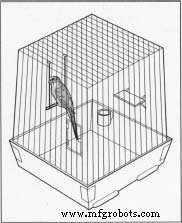
Bird cages provide a safe, comfortable enclosure that balances freedom of flight with containment. They are typically made from welded wire mesh that is precisely spaced to prevent a bird’s head from slipping through. The standard mesh size for most domestic species is 1.5 × 1 in. (3.8 × 2.5 cm), while larger birds such as parrots often require tighter mesh no larger than 1 × 1 in. (2.5 × 2.5 cm).
The design varies widely: small cages for single or dual birds are usually rectangular or square, while decorative polygonal models add aesthetic appeal. Many models feature a removable plastic or metal tray beneath an open bottom to simplify cleaning and reduce wire contact on the bird’s feet. Breeding cages differ significantly, often wide with a removable divider that is only removed once the birds acclimate to one another.
History
Birdcaging dates back to ancient Egypt, where doves and parrots were prized and depicted in hieroglyphics. In India, the mynah has been revered for over two millennia. Early cages were likely constructed from natural materials such as twigs, rope, reeds, or bamboo. By the Roman era, birds were cared for by slaves, and during the Middle Ages, ownership was limited to the affluent. The arrival of exotic birds in the American colonies introduced bamboo and wooden cages, while the Victorian era saw the rise of ornamental wire cages that remain popular today.
Raw Materials
American manufacturers primarily source wire mesh from specialized suppliers. Mesh rolls, typically 100–200 ft. (30–61 m) long, are produced with tolerances tighter than 0.13 in. (3.2 mm) over a 10‑ft span to ensure uniform spacing. Mesh width is tailored to the bird species: larger birds receive slightly larger apertures, but all cages maintain a tight mesh for safety. The metal is usually galvanized steel, balancing durability and cost. Stainless‑steel options exist for premium cages, though they can be up to five times more expensive.
The Manufacturing Process
- Large rolls of wire mesh are fed into a cold‑roller press to flatten the mesh if the design calls for non‑rounded wire. This press uses pressure, not heat, to maintain wire integrity.
- Computer‑controlled cutters trim side panels, tops, doors, and specialty parts from the flattened mesh, producing exact dimensions.
- Hydraulic punches separate the cut panels from the roll, producing clean, uniform pieces.
- Door panels receive an additional wire reinforcement to eliminate sharp edges and strengthen hinges.
- Panels are assembled with ferrules and metal clips; the door is slightly larger than the front panel opening and is hinged using multiple ferrules for stability.
- Owners typically prefer cages with open bottoms; a detachable plastic or metal tray is inserted to streamline cleaning. Plastic trays are injection‑molded from pellets; steel trays are die‑cast and punched from thin sheets.
- Finished cages are shipped flattened to reduce shipping costs. Simple metal clips allow end‑users to assemble the cage at home.
Quality Control
Each manufacturing step includes inspections for sharp edges, burrs, and mesh misalignment. A sander removes burrs, and panels are tested for secure fit. Raw materials are certified, and mesh with excessive galvanizing drips is rejected to prevent potential zinc toxicosis, a condition linked to high zinc ingestion.
Byproducts/Waste
Metal waste from punching and cutting is collected and recycled into new wire, minimizing environmental impact.
The Future
Global competition, especially from countries with lower labor costs, has challenged domestic manufacturers. Imported cages are often less robust and may lack stringent galvanizing controls. American producers are exploring innovative designs, materials, and manufacturing efficiencies to remain competitive and meet safety standards.
Where to Learn More
Books
Garrett, Elisabeth Donaghy. At Home: The American Family Home 1750-1870. New York: Harry N. Abrams, 1998.
Other Resources
“Bird”. Encyclopedia Britannica CD Edition. Encyclopedia Britannica, Inc., 1994-1998.
Dale, Steve. “The History of Birds as Pets.” The Pet Project Web Page. December 2001. https://ecol.webpoint.com/pets/birdhist.htm.
Oral interview with Willis Kurtz, President of Safeguard. New Holland, PA. October 2001.
Oral interview with Guy Cone, President of Quality Cage Company. Portland, OR. October 2001.
Nancy EV Bryk
Manufacturing process
- Mastering Mesh Current Analysis: A Comprehensive Guide
- Bluetooth Mesh: A Practical Protocol for Industrial IoT Connectivity
- Mesh Topology Explained: How Mesh Networks Connect Devices
- Bluetooth Mesh Node Communication: Designing Robust Mesh Networks
- Bluetooth Mesh Design Choices: Module vs. Discrete Device
- Why Gas Cylinder Cages Are Essential for Safety and Compliance
- Build an Arduino Flappy Bird Clone: Step‑by‑Step Game Project with TFT Touch Screen
- Flexible Wireless Transmitter for Wearable Medical Sensors
- Premium Hexagonal Wire Netting Machine for Agriculture & Poultry
- High-Speed Expanded Metal Machine – Precision Mesh Fabrication for Industrial Use