



Mayonnaise: History, Ingredients, and Production Secrets
Background
Mayonnaise is a cold emulsified sauce commonly used as a condiment or base for creamy salad dressings. It is crafted by blending egg yolks with oil, then incorporating vinegar, mustard, herbs, and spices for flavor.
History
Food historians propose four main theories about mayonnaise’s origin. The most widely cited story dates back to June 28, 1756, when the French Duke of Richelieu captured Port‑Mayen on Minorca. During the victory feast, his chef substituted olive oil for cream in a sauce and, delighted by the result, named it “mahonnaise” after the locale of triumph.
Other scholars trace the word to the French verb manier (to stir) or to the Old French moyeu (egg yolk). A third theory claims the sauce originated in Bayonne, southwestern France, where it was first called bayonnaise before evolving into mayonnaise.
Regardless of its roots, mayonnaise quickly gained popularity across Europe. In the early 1900s, German immigrant Richard Hellmann opened a delicatessen in New York City. His wife’s homemade mayonnaise became a bestseller, and customers soon requested the sauce itself. Hellmanns began producing it in bulk, selling it in wooden butter‑measuring vessels before shifting to glass jars in 1913 when they opened their first factory in Astoria.
In 1932, Best Foods Inc. of California acquired the Hellmanns brand, and a year later National Dairy Products introduced a cooked variation—later known as Kraft’s Miracle Whip—at the 1933 Century of Progress World’s Fair in Chicago.
Raw Materials
The U.S. Food and Drug Administration’s Standard of Identity requires mayonnaise to contain at least 65 % oil by weight, vinegar, and egg or egg yolks. Allowed seasonings may include spices and herbs, but turmeric and saffron are excluded to prevent an artificial yellow hue that could mislead consumers about egg content.
For salad dressings, the Standard specifies 30 % vegetable oil, 4 % egg yolk, vinegar or lemon juice, and spices.
Soybean oil is the most frequently used oil. Vinegar is typically distilled from alcohol, while lemon or lime juice is diluted with water. Eggs undergo pasteurization—heating without cooking—to ensure safety.
Low‑fat mayonnaise substitutes egg whites for yolks and adds modified starches (corn, gums, or agar‑agar) to preserve the creamy texture. Salt is added at roughly 1/16 tsp per tablespoon of mayonnaise, and preservatives such as calcium disodium EDTA extend shelf life.
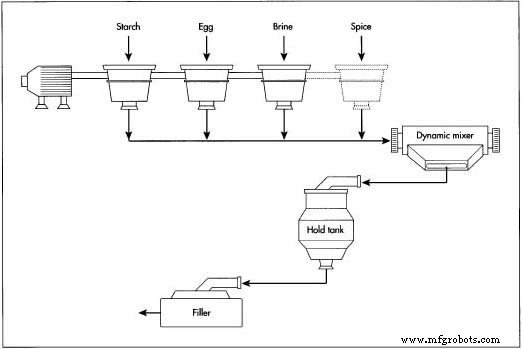
A diagram depicting the continuous blending system used to manufacture mayonnaise.
The Manufacturing Process
Creating the emulsion
- Mayonnaise is formed through a continuous blending system that maintains the proper degree of emulsification. An emulsion—technically a colloid—occurs when oil and vinegar are blended so that one liquid forms microscopic droplets dispersed throughout the other.
- The blended mixture travels through a series of positive‑replacement pumps equipped with rotary impellers. As the cavities fill and empty, the impellers transfer the fluid, ensuring a consistent emulsion.
Adding ingredients
- Pre‑measured components—vinegar, oil, egg, spices, and seasonings—are piped into the system via side openings or overhead spigots.
Bottling the mayonnaise
- The finished product is pumped to a bottling station where pre‑sterilized jars travel on conveyor belts. Exact volumes of mayonnaise are dispensed into each jar, which are then sealed with metal screwcaps. The containers are not vacuum‑sealed.
Quality Control
Every raw material undergoes a freshness check upon arrival and is periodically tested while stored. Throughout production, samples of mayonnaise are taken and taste‑tested to ensure consistent flavor and texture.
Manufacturing process
- What is VMC Machining? An Expert Overview of Vertical Machining Centers
- Mayonnaise: History, Ingredients, and Production Secrets
- Eggs: Nutrition, Production, and Quality Control in the U.S. Industry
- IoT: The Real Golden Ticket for Business Growth—or Just a Goose with a Golden Egg?
- How Modern Technology Has Revolutionized Easter Egg Carving
- Burnbrae Farms Boosts Egg-Processing Safety and Efficiency with Food‑Grade Lubricants
- Egg‑Albumin Assisted Hydrothermal Synthesis of Mesoporous Co3O4 Quasi‑Cubes: High‑Performance Supercapacitor Electrode
- The Zen of Python: 19 Timeless Principles for Elegant Coding (PEP-20)
- Kirigami‑Based Robot Grippers Safely Handle Egg Yolks
- Mastering Maintenance Documentation: A Trusted Approach to Protecting Your Assets