



Eggs: Nutrition, Production, and Quality Control in the U.S. Industry
Background
Unfertilized eggs are a staple protein source worldwide, offering 0.21 oz (6 g) of complete protein per 2‑ounce egg while containing 0.42 oz (12 g) of fat—almost all in the yolk. Separating yolk and white yields a fat‑free, protein‑rich option. Eggs also provide iron, vitamins A, D, riboflavin, and thiamine, though nutrient levels vary with the hen’s diet. In the late 1990s, U.S. consumers averaged 245 eggs per person annually, a figure that reflects the product’s enduring popularity.
Domestic chickens dominate the market, with 235 million laying hens producing roughly 300 eggs each per year. Farmers manage flocks of varying ages to ensure a continuous supply, optimizing feeding, housing, and health care to maximize yield and longevity.
Nutrition & Culinary Uses
The egg’s protein coagulates when heated, making it ideal for structural roles in baking, meringues, soufflés, and cakes. Egg whites expand when beaten, providing lift, while whole eggs add moisture and texture. Eggs also act as thickeners in soups and sauces and stabilize ice cream against crystal formation. Beyond processed dishes, eggs are consumed boiled, poached, fried, scrambled, or baked for their distinct flavor and nutritional value.
Production & Processing
Raw Materials
The hen itself is the key raw material. Breeds such as the Single Comb White Leghorn are prized for early maturity, high output, and efficient feed conversion. Feed typically consists of an all‑mash blend of sorghum, corn, and cottonseed or soybean meal, carefully balanced for protein, fat, carbs, vitamins, and minerals. Federal approval is required for all additives; hormones are not used, though antibiotics may be administered as needed. On average, a hen consumes about 4 lb (1.8 kg) of feed per dozen eggs, with a Leghorn eating ~0.25 lb (0.113 kg) daily.
Farm‑Level Operations
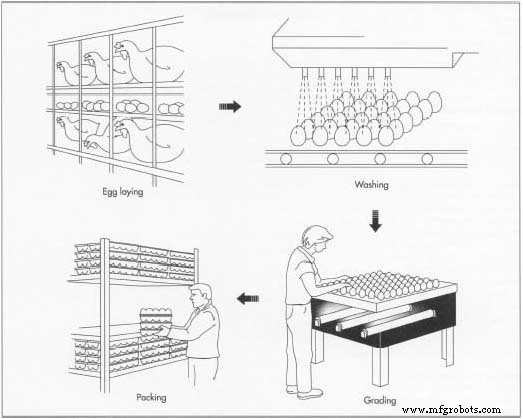
- Hens are kept in cage groups of three to five. After laying, eggs roll into collection bins for rapid harvesting—usually twice daily using automated or manual methods. Early cooling is critical; eggs are refrigerated immediately to preserve freshness.
- Eggs are packed on skids composed of layered flats. A single skid can hold about 900 dozen eggs and is then transported to the processing plant.
- In the plant, eggs are washed with a USDA‑approved cleanser. A system of brushes, water jets, and suction cups moves each egg onto a conveyor, where it is cleaned, rinsed, and dried by a fan.
- Candling follows: a dark booth with penetrating light allows trained candlers to assess age, albumen thickness, yolk clarity, and shell integrity. Eggs are graded A (household retail), B (bakery use), or C (break‑down for other products). Cracked, non‑leaking eggs are earmarked for liquid or powdered egg production; visibly leaking eggs are removed.
- Each egg is weighed to assign U.S. size categories—Extra Large ≥2.24 oz (64 g), Large ≥1.96 oz (56 g), Medium ≥1.72 oz (49 g), Small ≥1.47 oz (42 g). Cartons are then assembled based on weight, using recycled cardboard or colored polystyrene.
- Packaged cartons are loaded onto refrigerated trucks for distribution. For example, a major Pennsylvania plant processes 45,000 dozen eggs daily.
Quality Control & Safety
Farmers ensure hens receive a balanced diet rich in calcium, vitamin D, and other minerals to strengthen shells. Clean, cool water and controlled lighting (14–17 h/day) support optimal production. Facilities are windowless to manipulate light and are well ventilated and insulated. Many operations still use cages for ease of egg collection, though free‑range systems are also common.
Candling is the cornerstone of quality assessment, revealing shell condition, age, and internal clarity. Salmonella remains a risk, yet approximately 90 % of eggs are Salmonella‑free at lay. Proper washing with government‑approved soaps removes most contaminants from the shell surface.
Government standards for grade and size are rigorously enforced. Extension services provide ongoing education to farmers on best practices.
Byproducts & Sustainability
Cracked or broken eggs are diverted from retail lines. Non‑leaking cracked eggs are pasteurized and converted into liquid egg products or powdered eggs for bakery use. Broken eggs are often sold for pet food or used as animal feed.
Recognizing the environmental impact of polystyrene cartons, many processors now promote recycling initiatives, reducing landfill waste and supporting a circular economy.
Images
Manufacturing process
- What is VMC Machining? An Expert Overview of Vertical Machining Centers
- Mayonnaise: History, Ingredients, and Production Secrets
- Eggs: Nutrition, Production, and Quality Control in the U.S. Industry
- IoT: The Real Golden Ticket for Business Growth—or Just a Goose with a Golden Egg?
- How Modern Technology Has Revolutionized Easter Egg Carving
- Burnbrae Farms Boosts Egg-Processing Safety and Efficiency with Food‑Grade Lubricants
- Egg‑Albumin Assisted Hydrothermal Synthesis of Mesoporous Co3O4 Quasi‑Cubes: High‑Performance Supercapacitor Electrode
- The Zen of Python: 19 Timeless Principles for Elegant Coding (PEP-20)
- Kirigami‑Based Robot Grippers Safely Handle Egg Yolks
- Mastering Maintenance Documentation: A Trusted Approach to Protecting Your Assets