



Matryoshka Dolls: A Journey Through Russian Heritage and Handcrafted Artistry
Background
The matryoshka doll is a timeless emblem of Russian culture, originating over a century ago as a prized collectible art form. A nested toy that splits into two halves, each larger doll contains progressively smaller versions of itself. Typical sizes range from 2‑12 inches (5‑30 cm) for the largest, with some pieces reaching several feet, down to minuscule dolls under 0.25 in (0.6 cm).
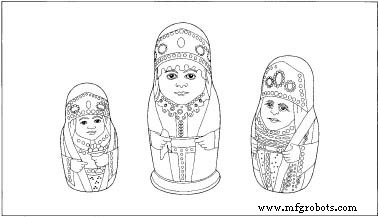
Paintings usually depict a woman in traditional Russian dress—often a mother—named Matryona or Matryoshka, both deriving from the Latin *mater* (mother). The imagery evokes a mother holding her children, a motif that celebrates fertility and maternal nurture.
While each doll in a set mirrors the others, variations in costume color, accessories, and symbols—bread, salt, beets, strawberries—add narrative depth. Floral motifs represent the city of origin, with designs on shawls and aprons reflecting local folklore. Some high‑value sets forego faces, instead telling Russian fairy tales around the entire exterior.
Sets vary from three to twenty‑five dolls; historically, some reach 1,800 pieces. Modern souvenir versions feature a wide array of subjects: Russian leaders, pets, Santa Claus, folk tales, and iconic landmarks like St. Basil’s Cathedral or the Hermitage. International themes such as American sports figures or Renaissance art also appear, showcasing Russian artists’ global appeal.
History
The “Russian” matryoshka arrived from Japan in the late 19th century. Amid Russia’s economic boom and burgeoning national identity, the 1896 St. Petersburg exhibition of Japanese art introduced a Buddhist wise‑man doll, Fukuruma, which could be split in half—an early prototype of the nested concept.
Russian industrialist Savva Mamontov and his brother Anatoly played pivotal roles. Mamontov’s Abramtsevo studio united folk craftsmen and professional artists, preserving Russian folk traditions. The Children’s Education Workshop produced the first Russian set: a mother holding a red‑combed rooster with seven children, crafted by Vassily Zviozdochkin and painted by Sergei Maliutin.
Although the first set may have had Japanese roots, Russian artists cemented the matryoshka as a national symbol. Influenced by regional woodcraft, embroidery, and folk motifs, artists like Maliutin drew on ethnographic sources to create authentic depictions of Russian dress and scenery.
Following the closure of the Children’s Workshop, the craft migrated to Sergiyev Posad, a centuries‑old toy‑making center near Moscow. Known for its “Trinity” wooden toys, the town embraced matryoshka production, giving rise to the renowned Sergiyev Posad (Zagorsk) style.
Russia showcased its dolls at the 1900 Paris World Exhibition, earning accolades. By 1911, matryoshka dolls—referred to as “la Russe”—were sold in fourteen countries. The Soviet era shifted focus to mass production, but the 1980s openness restored artistic individuality. Today, collectors prize individual artists’ works over generic styles.
Key production hubs include Semyonov, Nizhegorod’s villages (Polkhovsky Maidan, Krutets), and the Mordvinia, Vyatka, and Tver regions. The craft’s influence extended to former Soviet republics such as Ukraine, Mari El, and Belarus.
Raw Materials
Matryoshka dolls are carved from light, fine‑grained woods: lime (preferred), balsa, alder, aspen, and birch. Trees are selected in early spring, felled in April, and stripped of bark—except for a protective inner layer. Logs are stacked with air gaps and seasoned for at least two years to prevent cracking.
Once seasoned, trunks are cut to size, transported to artisans, and treated with oil and a starch‑based glue primer before painting. Artists use tempera, oil, gold leaf, and occasionally watercolors. Lacquer, wax, or varnish provide final protection.
Design
Wood grain influences the doll’s dimensions, but master turners select optimal pieces to achieve desired shape and thickness. Each artist chooses themes—folklore, historical figures, or contemporary subjects—and applies unique stylistic flourishes, from delicate lace to bold color blocks.
The Manufacturing Process
Turning
All dolls in a set originate from a single log to ensure consistent moisture and dimensional stability. Production starts with the smallest, solid doll, whose shape dictates the larger ones. Each doll is turned at least fifteen times, with careful carving of a snug ring that connects halves.
The craft relies on a lathe, a range of chisels, and seasoned intuition—no measurements are taken; skill ensures perfect fit.
Treating
After turning, the wood is oiled to lock in moisture, cured, then primed with a starchy glue coat to create a smooth painting surface.
Painting
Early dolls prized woodcraft over color; by the 1980s, painting became the primary value driver. Artists balance facial detail and costume intricacy, often drawing on iconography skills. Mediums include gouache, high‑quality tempera, oil, and, less frequently, watercolor.
Some artists use aniline dyes for a lighter, child‑like aesthetic. Unique techniques—poker burnings, gold leaf accents, or unprimed wood backgrounds—add depth.
All painted dolls receive a lacquer coat; artistic sets may receive up to five layers.
Finishing
Artists sign the largest doll’s base and note the set’s number of nests. Protective lacquers seal the work; rare examples use wax or varnish.
Byproducts/Waste
Production generates minimal waste. Seasoning and carving are performed with precision, and painters achieve high efficiency, leaving little paint or lacquer residue.
The Future
Post‑Soviet liberalization spurred a renaissance in matryoshka artistry. Collectors prize unique, artist‑handcrafted sets, often auctioned by Sotheby’s for up to $2,000 per piece. Simpler versions remain available to tourists, though the price disparity is stark.
Challenges include sustaining a small pool of highly skilled artists amid rising demand. Nevertheless, matryoshka dolls continue to embody Russian cultural identity and artistic heritage.
Manufacturing process
- What is VMC Machining? An Expert Overview of Vertical Machining Centers
- Expert Guide to Aluminum Laser Marking: Precision, Durability, and Industry Applications
- MIG vs. TIG Welding: Selecting the Right Arc Welding Technique for Your Project
- Comprehensive Guide to Laser Marking: Types, Benefits, and Applications
- Tomsk Polytechnic University Breaks Ground with Cost‑Effective, Waste‑Based Tungsten Carbide Production
- Matryoshka Dolls: A Journey Through Russian Heritage and Handcrafted Artistry
- Premium Plastic Dolls: From Playtime to Collectible Art
- Build a Squid Game‑Themed Interactive Doll with Arduino UNO – DIY Project
- Russian Startup Apis Cor Secures $6 M to Expand 3D-Printed Housing Capabilities
- ATC CNC Routers Empower Russian Businesses to Expand into New Markets