



The Art and Science of Lollipops: From History to Modern Manufacturing
Background
Lollipops, also called suckers, are hard candies mounted on a short stick. The stick—typically a tightly wrapped, wax‑coated paper—serves as a handle, while the candy is either sucked or bitten until it dissolves. The range of styles is impressive: tiny “Dum Dum” lollipops, the larger Tootsie Pop with a chewy center, the gum‑filled Blow Pop, and massive carnival‑style sucers that can take hours to finish. All varieties are primarily composed of sugar, water, corn syrup, and flavorings.
Making lollipops at home is surprisingly simple. A sugar‑corn syrup solution is heated until it reaches the hard‑crack stage—about 310 °F (154 °C). The molten candy is poured into molds of various shapes; as it cools, it hardens into a glass‑like shell. Home makers can add colors and flavorings just before pouring. Modern hobbyist molds are readily available online.
While most people buy pre‑made sucers from local stores, lollipops also play a role in health. Adults use them to replace the hand‑to‑mouth motion of smoking, and manufacturers produce over one billion Dum Dums annually. Tootsie Roll Industries alone churns out 16 million lollipops each day, making it the world’s largest producer.
History
The exact origin of the lollipop is unclear. Charles Dickens mentioned candy on a stick in the mid‑1800s, and early cookbooks describe homemade lollipops formed by inserting a wooden stick into hot syrup and letting it set on wax paper. The term “lollypop” was first popularized by candymaker George Smith, who named his creation after his racehorse Lolly Pop.
The first commercial lollipops appeared with the Akron Candy Company in 1924, which introduced the brand name “Dum Dum.” The Spangler Candy Company acquired Akron in 1953 and expanded the line. By 1931, Tootsie Roll Industries had added its signature chewy center, a variation that remains popular today. Over the decades, lollipops have evolved to include jawbreakers, gum cores, sour centers, sizzling fillings, and even interactive versions that play music when sucked. Sugar‑free and flexible‑stick options have also emerged to address dental health and safety concerns.
Raw Materials
Typical ingredients for a plain hard‑candy lollipop are water, sugar, corn syrup, natural or artificial flavorings, and malic or citric acid. Sticks are usually bright white paper wrapped tightly and coated with a thin wax layer. Some brands use clear cellophane or printed waxed paper for packaging.
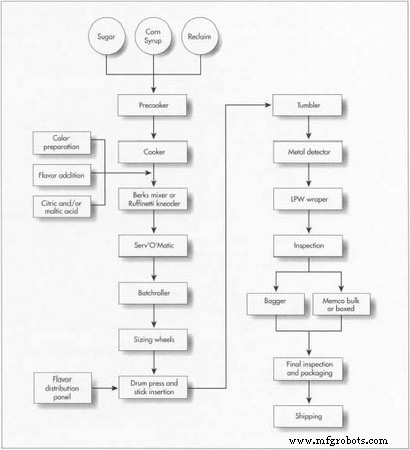
The Manufacturing Process
- 1. Raw Sugar Preparation: Bulk sugar is loaded onto gondola cars, then mixed with 180 °F (82 °C) water. Dissolving 180,000 lb (81,650 kg) of sugar can take up to nine hours.
- 2. Corn Syrup Integration: Corn syrup, delivered in large trucks, is pumped into the pre‑cooker, creating a 55% liquid sugar / 45% corn syrup mixture.
- 3. Pre‑Cooking: The slurry is heated to ~228 °F (109 °C) in a coil‑type pre‑cooker powered by steam.
- 4. Final Cooking: The mixture is pumped to a vacuum cooker where it reaches ~290 °F (143 °C) over four minutes. The vacuum removes moisture and stabilizes the candy.
- 5. Flavor & Color Addition: Just before mixing, liquid flavors, colors, and acids are added. Citrus acid sharpens citrus flavors and balances sweetness; malic acid enhances non‑citrus varieties. Skilled operators hand‑measure these additives to ensure consistency.
- 6. Mixing: Two large arms knead the candy, distributing flavor and reducing temperature while expelling air bubbles. Human touch is essential to confirm the correct viscosity.
- 7. Extrusion & Sizing: The cooled candy is extruded through a batch roller, then reduced to a rope by sizing wheels.
- 8. Forming: A forming machine shapes the candy into a sphere and inserts the stick in a single pass. Production can reach 1,000 lollipops per minute.
- 9. Cooling: Lollipops travel through a slow‑rotating drum where cool air brings them to room temperature in about four minutes.
- 10. Wrapping: Conveyed into a wrapping machine, each lollipop is automatically wrapped and then boxed or bagged for retail.
- 11. Stick Production: Many plants manufacture sticks in‑house. Paper strips (2.5‑in × 15‑in) are wet, rolled into a pencil‑like shape, dried, and waxed to resist saliva.
Quality Control
Quality assurance occurs in the lab and on the floor. Laboratories test raw ingredients—sugar purity, corn syrup color, and moisture content—to ensure they meet specifications. In‑plant operators monitor temperature, weight, and machine performance; any defective heads or improperly inserted sticks are discarded. Random product checks maintain consistency.
Byproducts & Waste
Off‑spec candy is either recycled—ground, melted, filtered, and re‑introduced into the pre‑cooker—or disposed of in landfills. Drop‑offs that cannot be consumed are similarly redirected for reprocessing.
The Future
Innovation continues through systematic flavor development. Companies employ a hedonic taste panel to evaluate new concepts, ranking them on multiple criteria. Promising flavors advance to a second, trained panel for group testing. Decisions are based on aggregated scores, ensuring only the most appealing products reach market launch.
Manufacturing process
- What is VMC Machining? An Expert Overview of Vertical Machining Centers
- Expert Guide to Aluminum Laser Marking: Precision, Durability, and Industry Applications
- MIG vs. TIG Welding: Selecting the Right Arc Welding Technique for Your Project
- Comprehensive Guide to Laser Marking: Types, Benefits, and Applications
- Key Considerations for High‑Volume Swiss Machining
- CNC Prototyping Guide: Precision, Speed, and Cost‑Effective Production
- Expert Shaft Manufacturing: Precision Processes & Custom Solutions
- Fiber Laser Marking: Precision, Speed, and Versatility for Modern Industries
- Electropolishing vs. Passivation: Choosing the Right Stainless Steel Finishing
- The Art and Science of Lollipops: From History to Modern Manufacturing