



The Parachute: History, Design, and Future Innovations
Background
A parachute is a device designed to reduce the velocity of a person or object falling or moving through the air. Primarily used for safe descents from high altitudes—such as spacecraft re‑entry or aircraft drops—parachutes can also be configured for horizontal deployment to slow race cars or other vehicles after their run.
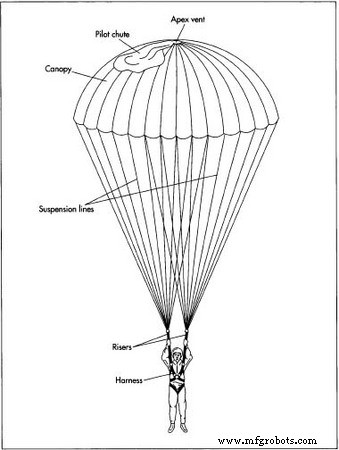
Two core designs exist. The first is a dome‑shaped canopy made from fabric that can range from a hemisphere to a cone. The second is a rectangular parafoil (ram‑air canopy) that operates like a wing, allowing jumpers to steer toward a target. Both types weigh under 15 lb (7 kg) and cost between $1,200 and $1,500.
For personal use, a harness is integrated with a container that holds the canopy. The container is usually a backpack but can be designed so the user sits on it. A deployment device—most commonly a ripcord—opens the container, releasing a small pilot chute (~3 ft/1 m diameter) that pulls the main canopy from its bag. A deployment sleeve or similar device moderates the canopy’s opening to reduce shock to the equipment and user.
History
Early Chinese records from the 12th century describe rigid, umbrella‑like parachutes used for entertainment, allowing people to jump from high places and float safely to the ground. Leonardo da Vinci sketched the first modern parachute in 1495—a pyramid‑shaped linen canopy supported by a wooden frame—proposed as an escape device for burning buildings, though it was never tested.
The first real experiments began in the 18th century. In 1783, French physicist Louis‑Sebastien Lenormand leapt from a tree holding two parasols. Two years later, Jean‑Pierre Blanchard used silk to create the first non‑rigid canopy, reportedly testing it from a hot‑air balloon. André‑Jacques Garnerin conducted multiple balloon jumps starting in 1797, reaching altitudes of 8,000 ft (2,400 m) with a silk or canvas canopy that weighed about 100 lb (45 kg). His early jumps were plagued by oscillations, which were mitigated in 1804 by Joseph Lelandes’s introduction of an apex vent—a circular hole that allowed air to escape and stabilized the canopy.
In the United States, Charles Broadwick introduced a cord‑linked pack in 1901 that automatically deployed when the line broke. Captain Albert Berry performed the first parachute jump from a moving airplane in 1912. Parachutes became standard equipment for U.S. military pilots after World War I, following widespread use by German pilots during the war’s final year.
World War II saw parachutes used not only for pilot safety but also for troop deployment. In 1944, Frank Derry patented a steerable design that incorporated slots along the canopy’s outer edge.
The record for the highest jump was set in 1960 by Joe Kittinger, who ascended in a balloon to 102,800 ft (31 km) and jumped using a 6‑ft (1.8 m) canopy. He experienced four minutes and 38 seconds of free fall, reaching 714 mph (1,150 km/h), before deploying a 28‑ft (8.5‑m) canopy at 17,500 ft (5.3 km). The entire descent lasted nearly 14 minutes.
Raw Materials
Early canopies were made of canvas, but silk proved superior due to its thinness, light weight, strength, fire resistance, and springiness. During World War II, U.S. manufacturers switched to nylon after the Silk embargo. Nylon’s elasticity, mildew resistance, and lower cost made it the dominant material. Modern canopies are typically constructed from ripstop nylon, woven with a double or extra‑thick thread at regular intervals that form a pattern of small squares, preventing tear propagation.
Other components—reinforcing tape, harness straps, suspension lines—are also made from nylon. Metal connectors are forged steel plated with cadmium to resist corrosion, while ripcords use stainless‑steel cable.
One production plant reports monthly usage of over 400,000 sq yd (330,000 m²) of fabric, 500,000 yd (455 km) of tape and webbing, 2.3 million yd (2,000 km) of cord, and 3,000 lb (1,400 kg) of thread.
Design
A dome canopy may be a flat circle or a conical/parabolic shape that does not lay flat when spread. An apex vent allows airflow, and mesh panels near the edge aid steering. Suspension lines can run continuously across the canopy’s span or be segmented, attaching only to the outer edge and vent.
The Manufacturing Process
Assembling
- Ripstop nylon is laid on a long table and cut to pattern pieces using computer‑guided cutting or a round‑bladed electric knife.
- Four trapezoidal panels are sewn into a wedge‑shaped gore (≈13 ft/3.96 m). A two‑needle industrial machine stitches parallel rows with a French‑fell seam that folds the edges for strength. Some gore sections may use mesh instead of ripstop nylon.
- Typically 24 gores are sewn side‑by‑side to form the circular canopy, with seams sewn identically to Step 2.
- Every panel and seam is inspected on a lighted table for proper folding, stitching, and absence of defects. Defects are recorded and repaired before proceeding.
Finishing
- Top seams are reinforced with tape sewn over each radial seam.
- The central vent is reinforced by rolling the fabric around webbing and stitching four parallel rows with a four‑needle machine.
- The outer skirt (2–3 ft/0.5–1 m wide) is finished like the vent.
- V‑shaped tabs are sewn into the skirt with a specialized automatic machine to ensure uniformity.
- Suspension lines (20 ft/6 m) are threaded through each V‑tab, then zig‑zag stitched to the hem and seam for 4–10 in (10–25 cm).
- 12 apex lines (1 ft/30 cm) are sewn to the central vent, each crossing the vent and attaching to V‑tabs on opposite seams.
Rigging
- The canopy is tied to the harness via steel connector links. Lines must remain untwisted and in the correct order.
- Knots or Chinese finger‑trap methods secure line ends, with zig‑zag stitching preventing accidental release.
- All operations undergo a final inspection. Approved parachutes receive a serial number, manufacturing date, and inspection stamp.
- A FAA‑licensed rigger assembles the canopy, suspension lines, pilot chute, and activation device (e.g., ripcord) into the pack.
Quality Control
Manufacturers must comply with FAA civil and military aviation standards. Quality control includes lighted inspection tables, tensile test machines to measure fabric and seam strength, permeameters to assess air permeability, and precision measuring tools for stitch counts.
The Future
Ongoing research seeks better materials and designs. A notable advancement is the potential use of parachutes for emergency aircraft descent. Ballistic Recovery Systems Inc. (BRS) produces General Aviation Recovery Devices (GARDs) for small aircraft. Their canopies are 1,600 sq ft (150 m²), vacuum‑packed into a 15×10×6‑in (38×25×15 cm) bag weighing 25 lb (10 kg), and are activated by a small rocket to ensure deployment even at low altitude.
By the late 1990s, over 14,000 light and ultralight airplanes had GARDs costing $2,000–$4,000 each. BRS documented 121 lives saved as of June 1998, and the FAA approved the system for two Cessna models.
A proposal for a five‑parafoil system on Boeing 747s would create a controllable glide path for emergency descent, though its practicality remains unproven.
Manufacturing process
- What is VMC Machining? An Expert Overview of Vertical Machining Centers
- Expert Guide to Aluminum Laser Marking: Precision, Durability, and Industry Applications
- MIG vs. TIG Welding: Selecting the Right Arc Welding Technique for Your Project
- Comprehensive Guide to Laser Marking: Types, Benefits, and Applications
- Key Considerations for High‑Volume Swiss Machining
- CNC Prototyping Guide: Precision, Speed, and Cost‑Effective Production
- The Parachute: History, Design, and Future Innovations
- Designing a Ballistic Parachute Recovery System for UAVs
- Clean Sky Project Completes Advanced Carbon‑Fiber Canopy for Airbus RACER Demonstrator
- Aeration Blowers Vlog 3: How Cool Canopies Protect Equipment from Heat