



Pita Bread: From Ancient Origins to Modern Manufacturing
Background
Every civilization has baked some form of bread. As early as 10,000 years ago, prehistoric peoples mixed grain, water and fire to create the first flatbreads. In Mesopotamia, now Iraq, stone‑milled grains were combined with water and cooked over open flames.
Archaeological digs in ancient Egypt reveal wheat and barley baked into thin flatbreads. Egyptians likely discovered leavened bread when a grain‑water mixture fermented naturally, producing a puffed dough. Prior to commercial yeast, bakers set aside a portion of dough that would naturally ferment from airborne yeasts; this “starter” was later mixed with fresh dough to leaven it.
In 1665, a baker experimented with brewer’s yeast to accelerate fermentation. Grain grinding evolved from manual stone rubs to water‑ and wind‑powered mills, culminating in the Swiss steel roller mills of the late eighteenth century, which dramatically improved consistency.
Commercial bakeries first emerged during the Middle Ages. These brick ovens, heated by wood or coal, baked loaves for sale while also allowing customers to bring their own dough for communal baking. The loaf was handled with a long‑handled wooden shovel called a peel.
Bedouin traders are credited with inventing pita. After long desert journeys, they mixed powdered grain and water, formed round loaves, and baked them over open fires. Pita served both as a utensil and a staple food.
Today, many Arab villages still bake bread in backyard stoves, while community ovens provide scheduled baking hours for families. In the 1970s, Middle Eastern immigrants introduced pita to the United States, where its low‑fat profile and minimal additives made it popular. By the 1990s, the wholesale pita market approached $80 million annually, largely supplied by specialty bakeries across the East, West, and Midwest. Commercial pitas are baked with unbleached all‑purpose or whole‑wheat flour and typically measure 4–10 in. (10–25 cm) in diameter.
Raw Materials
Pita is produced from grain flour, water, salt, and baker’s yeast. Grain is first milled; the resulting flour can be whole wheat (bran, germ, and endosperm) or white (only endosperm). White flour is often enriched with vitamins and minerals to compensate for removed nutrients. Mills sell bulk flour, which bakeries store in 100,000‑lb (45,400 kg) silos until needed.
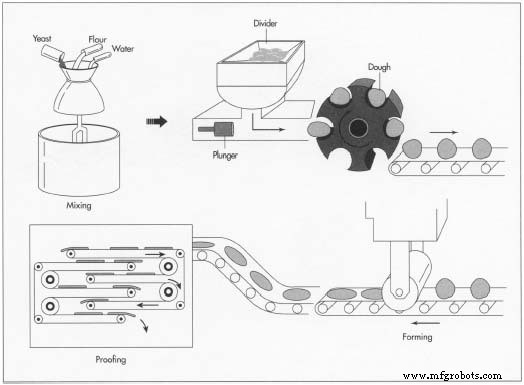
After pre‑measuring the ingredients, the dough is kneaded in commercial mixers. Once dough reaches the desired elasticity, it is fed into an extruder that forms it into tennis‑ball‑sized portions. The dough balls rest (proof) for about 15 minutes before being flattened into circles.
Yeast is a single‑cell fungus that ferments starches or sugars, producing carbon dioxide and leavening the dough. Commercial yeast is cultivated on molasses‑rich solutions, then dried into cakes or powdered and blended with corn‑meal before sale.
Water purity is critical; processors typically filter water to achieve medium hardness (50–100 ppm) and neutral pH to ensure consistent dough behavior.
The Manufacturing Process
Mixing the dough
- Flour, salt, water, and yeast are blended in commercial mixers in several‑hundred‑pound batches. Some bakeries add a mold retardant, such as calcium propionate, to prolong shelf life. Large motorized arms knead the dough until it attains the right elasticity.
Extruding the dough
- The mixed dough is scooped and fed into an extruder that forms it into tennis‑ball‑sized portions, which are then placed in cups on a conveyor belt.
First proofing
- The dough balls rise in the cups for ~15 minutes, or in continuous layers before being segmented into individual portions.
Cutting and forming the pitas
- The dough is transferred to a sheeter on a linear conveyor. Rollers press it to the desired diameter, typically 0.125 in. (0.3175 cm) thick. Die‑cuts then separate the dough into circles. About 10 % of excess dough is recycled back into the extruder.
Second proofing
- The circles rise a second time in a rotating proofer before moving to the oven.
Baking the pitas
- Ovens are preheated to 800–900 °F (426–482 °C). The loaves travel quickly through the oven, exposed to high heat for ~1 minute. The rapid temperature rise turns internal moisture into steam, creating the signature pocket as the crusts separate.
Cooling and flattening the loaves
- After baking, loaves circulate on conveyor belts for ~20 minutes to cool. Workers manually flatten the puffed loaves. Defective loaves are discarded.
Slicing the loaves
- For sliced pitas, loaves are conveyed to a rotating‑blade slicer. Loaves can be sliced individually or stacked in six‑high piles before slicing.
Packaging
- Whether sliced or whole, pitas are stacked and sealed in pre‑printed plastic bags. Workers may use twist ties or a zipper tear‑strip for heat sealing. Packaged pitas are loaded into trays or cartons for shipment. If not shipped immediately, they are flash‑frozen and stored at a constant –12.2 °C (10 °F) in industrial freezers.
Quality Control
As a regulated food product, pita must comply with government standards on additives, sterilization, and sanitation. Quality checkpoints are built into every stage: appearance, texture, and taste are inspected.
With a moisture content of 38–40 %, pita is prone to fungal growth. While baking kills most microbes, post‑packaging contamination can occur. Plant operators use fungicides and ultraviolet lighting to mitigate spoilage.
Labeling laws require the plant, batch number, baking date, ingredients, and net weight. Organic pita must follow the Organic Foods Production Act, which restricts seed treatments and mandates strict controls on yeast and other commodities.
Manufacturing process
- What is VMC Machining? An Expert Overview of Vertical Machining Centers
- Expert Guide to Aluminum Laser Marking: Precision, Durability, and Industry Applications
- MIG vs. TIG Welding: Selecting the Right Arc Welding Technique for Your Project
- Comprehensive Guide to Laser Marking: Types, Benefits, and Applications
- Key Considerations for High‑Volume Swiss Machining
- CNC Prototyping Guide: Precision, Speed, and Cost‑Effective Production
- The Toaster: From Ancient Fire to Smart Kitchen Appliance
- Pita Bread: From Ancient Origins to Modern Manufacturing
- Bread: From Ancient Grains to Modern Production
- The Science Behind Leavening Agents: How They Make Dough Rise