



The Ultimate Guide to Bowling Ball Design and Performance
Background
Every year, 65 million Americans roll bowling balls down lanes at speeds up to 20 mph. At first glance, these balls look simple – finger holes and bright colors – but their construction is far more sophisticated than a plain sphere. Prices range from under $50 to around $300, reflecting the advanced engineering behind each ball.
Balls are engineered to perform optimally on varying lane conditions and to match a bowler’s style and strength. Bowling lanes are treated with mineral oil to protect the wood; typically, the first two‑thirds of the lane receive heavy oil while the final third is lightly oiled. A properly released ball slides straight until it reaches the less‑oiled section, where it hooks toward the pins. Matching a ball’s rotational characteristics to a bowler’s release yields the best results.
History
Lawn and pin bowling have been played for millennia. A 5,200‑year‑old Egyptian burial contained a set of stone pins, evidence of early bowling. Lawn bowling was popular in medieval Europe, yet in 1366 King Edward III outlawed the game to focus troops on archery. In the early 1800s, nine‑pin bowling was banned in Connecticut and New York due to gambling concerns; a tenth pin was added to circumvent the law, creating the modern triangular layout.
Lawn‑bowling balls are either weighted or asymmetrically shaped to induce curvature. Pin‑bowling balls must be perfectly round but contain hidden weights that influence balance and rotation. They also feature finger holes – two for the thumb and middle finger or the more common three‑hole configuration – drilled to fit the bowler’s hand.
Structural Evolution
Early balls were made from Lignum vitae, a very hard wood. The first rubber ball, Evertrue, debuted in 1905, followed by Brunswick’s rubber Mineralite in 1914. Rubber dominated until the 1970s when polyester balls were introduced. The 1980s saw the arrival of urethane, and by 1990, core design revolutionized ball behavior. Reactive urethane (resin) coverstocks soon followed, dramatically enhancing performance. In the 1991–92 season, perfect games rose by nearly 20% – from 14,889 to 17,654 – as reported by the American Bowling Congress.
Core shapes include lightbulb, spherical, and elliptical. Combination cores nest one shape inside another or add collars and counter‑weights. Since 1993, manufacturers use computer‑aided design to refine cores, often tailoring different core designs for various ball weights (e.g., 12–13 lb, 14 lb, 15–16 lb). A 1996 Design News article quoted a developer: “We now need new designs constantly; a good ball no longer lasts two years.”
Raw Materials
Coverstocks come in three primary plastics:
- Polyester: The most affordable; produces the least hook on the back third of the lane because it’s less affected by oil variation.
- Urethane: Offers more hook than polyester, while remaining durable and requiring less maintenance than reactive urethane.
- Reactive urethane (resin): Provides the greatest hook and delivers maximum power on impact.
Manufacturers partner with chemical suppliers to blend resins with urethane, creating proprietary coverstocks. Cores are built with heavy materials such as bismuth graphite or barium added to resin or ceramic. Fired ceramic cores produce harder hitting balls because they absorb no energy upon impact, whereas millable ceramic alloys can be drilled and are softer, absorbing energy when striking pins.
Some balls incorporate 2–4 oz (56.7–113.4 g) of iron oxide as a weight block to shift the center of gravity, while zirconium is used by certain brands for counterweights.
The Manufacturing Process
From the 1800s to the early 1990s, most balls used a three‑piece construction: a dense pancake‑like core, a less‑dense core material, and a surrounding coverstock. Faball Inc. pioneered a two‑piece construction in the early 1990s, which has since become standard.
Making the Core
- 1. A mold matching the computerized core design is created. The chosen material is poured and hardened. The solid core is then removed.
- 2. If necessary, the core is finished. Fired ceramic cores are kiln‑baked; compound cores are formed by inserting the first core into a second mold and surrounding it with material of a different density.
Forming the Shell
- 3. The core sits inside a spherical coverstock mold, with a pin projecting inward to hold it in position. A pin pointing toward the center indicates a “pin‑in” core; a tilted pin indicates “pin‑out.”
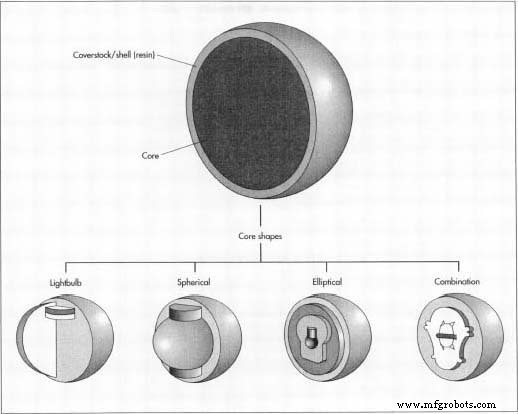
- 4. Coverstock material is poured around the core and cured. Thickness ranges from 1 in (2.54 cm) to 2 in (5.08 cm), depending on the ball’s design.
Filling the Gaps
- 5. After the mold is opened, a plastic dowel fills the pin hole and is cemented in place. The pin’s color differs from the coverstock, serving as a guide for drilling finger holes that align with the core’s design.
- 6. Fill material is added to the logo imprint, which may match the pin color or differ. The logo sits above the ball’s center of gravity.
Finishing
- 7. The ball is sized to specifications by turning it on a lathe or grinding it to the desired roundness.
- 8. Surface texture is achieved by sanding to a matte finish or polishing to a grit between 240 and 600.
- 9. The finished ball is boxed and shipped to distributors.
Quality Control
The American Bowling Congress (ABC), founded in 1894, set equipment specifications to standardize the sport. Current rules require a diameter of 8.500–8.595 in (21.6–21.8 cm) and a maximum weight of 16 lb (7.3 kg); minimum weight is not specified, with some balls weighing as little as 6 lb (2.7 kg). To earn the ABC/WIBC seal, manufacturers must send sample balls for testing to verify compliance.
In response to 1990s design changes, the ABC added regulations in 1994, limiting the ball’s radius of gyration to 2.430–2.800 in (6.2–7.1 cm). Other specs cover coefficient of restitution, surface hardness, and hooking potential.
The Future
Innovations since the early 1990s have leveled the playing field for bowlers of all sizes. In Popular Mechanics, John G. Falcioni described newer balls as “cheaters” but acknowledged that engineering and physics now play a larger role than muscle training in achieving strikes. The sport has become so sophisticated that a deep understanding of materials science can be more valuable than traditional strength training.
Manufacturing process
- Understanding Ball Bearing Races: Structure, Function, and Types
- The Three Core Components of a Ball Bearing
- What Is a Ball Mill? A Comprehensive Guide to Definition, Function, and Differences from Traditional Milling Machines
- Basketball: From Naismith’s 1891 Invention to Modern Production Techniques
- The Soccer Ball: From Ancient Games to Modern Innovation
- The Evolution and Craftsmanship of Modern Bowling Pins
- The Evolution and Craftsmanship of American Football: From Ancient Games to Modern NFL Standards
- Golf: A Global Sport With Rich Heritage & Modern Appeal
- Ball Bearings: Evolution, Manufacturing, and Quality Assurance
- Advanced Raspberry Pi Table Tennis Ball Tracking with OpenCV