



Linen: From Flax to Fabric – The Complete Production Guide
Background
Linen yarn is spun from the long, slender fibers located just behind the bark in the multi‑layer stem of the flax plant Linum usitatissimum. The woody stem and the inner pith—known as pectin—are left to rot, freeing the cellulose fibers that are then spun into thread, cordage, or twine. From this yarn, fine toweling, dress fabrics, and durable household linens are woven. Linen’s natural breathability and cool feel make it ideal for warm‑weather apparel, while its strength and durability have earned it a reputation as a premium bedding material.
Flax thrives in cool, humid climates and well‑drained, fertile soil. Although cultivation is straightforward, the labor required to separate the delicate fibers from the stalk is intensive. Modern production still relies on skilled handwork for the final stages, as mechanized processes risk damaging the fibers. Hand‑retted linen is often regarded as the gold standard for quality.
European and Atlantic nations—including Poland, Austria, Belgium, France, Germany, Denmark, the Netherlands, Italy, Spain, Switzerland, and the British Isles—continue to grow flax for linen. Belgium is widely acclaimed for producing the finest fibers, with Scottish and Irish varieties following closely. In the United States, linen is almost entirely imported, as domestic production remains limited to niche hand spinners and weavers.
History
Flax cultivation dates back at least five millennia. The earliest depictions of linen spinning appear on ancient Egyptian wall paintings. By 3,000 B.C., the Egyptians were producing a fine white fabric—540 threads per inch—that wrapped the mummies of pharaohs. The Bible references linen, and the Middle East has long valued it for its coolness. Greek and Roman societies prized linen as a luxury commodity, and Finnish traders introduced it to Northern Europe, where it has been grown for centuries.
In the New World, settlers planted flax in the 17th century because it was easy to grow. However, the tedious process of retting and spinning limited its widespread use. By the late 18th century, cotton’s mechanical processing made it far cheaper, and American linen production largely ceased by the 1850s. A few New Englanders of Scottish or Irish descent maintained flax cultivation for high‑end domestic linens, but most Americans shifted to inexpensive cotton.
Raw Materials
Only the cellulose fibers of the flax stem are needed to create linen. Retting—either water‑ or chemical‑based—separates the fibers from the bark and is washed away before the fibers reach the final product.
Design
Yarn thickness is the primary design decision in linen production. The desired gauge depends on the linen grade and the end‑use, from lightweight toweling to heavy‑weight upholstery.
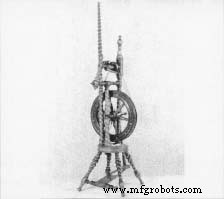 European flax wheel used to spin flax into linen thread. (From the collections of the Henry Ford Museum & Greenfield Village, Dearborn, Michigan.)
This classic European “flax wheel” was brought to the New World by Irish settlers, including Henry Ford’s grandmother. The wheel’s vertical distaff and treadle system allowed a spinner to manually rotate the wheel, producing fine linen thread for home use. The wheel’s ornate bone or ivory inlay earned it the nickname “castle” or “parlor” wheel.
Nancy EV Bryk
The Manufacturing Process
Cultivating
- Flax requires roughly 100 days from seed to harvest. It cannot tolerate high temperatures, so planting dates are calculated by counting back 100 days from the optimal harvest period. In some regions, farmers sow in winter to avoid early spring heat.
- Spring plowing and careful seedbed preparation—discing, harrowing, rolling—ensure shallow seed placement. Mechanical row planting is common, but hand broadcast is still used in small‑scale operations.
- Flax is a poor competitor against weeds; effective weeding or herbicide use is essential to maintain fiber yields.
- Three months after planting, slender stalks reach 2–4 ft (61–122 cm) with blue or white flowers, the latter yielding the finest fibers.
Harvesting
- When leaves wither and stems yellow, indicating maturity, the stalks are pulled from the ground intact to preserve sap and fiber luster.
- Harvesters carefully tug at the seed heads, ensuring tapered ends remain intact for smooth yarn production.
- Stalks are bundled into “beets” and transported to retting facilities; mechanized pullers also exist for larger operations.
Releasing the Fiber from the Stalk
- Stalks pass through coarse combs to remove seeds and leaves—a process called scutching. This also separates fibers by length.
- Retting—whether by moisture‑based, chemical, or vat methods—decomposes the pectin that binds fibers to the stem. Proper retting prevents fiber damage; too little leads to difficulty separating fibers, too much weakens them.
- After retting, fluted rollers break the stalks, separating outer bark (shives) from bast fibers. Scutching removes shives, leaving clean fibers.
- Fibers are then combed and straightened, separating short tow fibers from longer, luxury linen fibers (12–20 in, 30–51 cm).
Spinning
- Long linen fibers are combined in spreaders, laid parallel, and formed into a sliver. Rollers compress the sliver into roving, ready for spinning.
- Rovings are drawn on a spinning frame, elongated, and wound onto bobbins. The environment—warm, humid—facilitates the wet‑spinning technique that bonds fibers with hot water, producing fine, strong yarn.
- After drying, yarns are wound onto reels or spools. The “cut” measurement—1 lb (453.59 g) of flax yielding 300 yd (274.2 m) of yarn—is used to grade yarn fineness; a higher cut number indicates finer yarn.
- Finished yarn is then shipped to looms for weaving into fabrics, toweling, or rope.
Byproducts and Waste
The most significant environmental concern is the chemical runoff from retting. These chemicals must be neutralized before discharge. Organic residues—stalks, leaves, seed pods—are not hazardous unless saturated with retting chemicals. Hand‑retted linen is noted for its strong odor, but this is typically mitigated in modern, closed‑loop processes.
Manufacturing process
- What is VMC Machining? An Expert Overview of Vertical Machining Centers
- Expert Guide to Aluminum Laser Marking: Precision, Durability, and Industry Applications
- MIG vs. TIG Welding: Selecting the Right Arc Welding Technique for Your Project
- Comprehensive Guide to Laser Marking: Types, Benefits, and Applications
- Linen: From Flax to Fabric – The Complete Production Guide
- Sicomin’s GreenPoxy Resins Propel GREENBOATS’ Flax-Fiber Reinforced 27-Day Sailboat
- Flax Fiber Woven Tapes: Superior Mechanical Strength & Eco‑Friendly Design
- LivMatS Biomimetic Flax Fiber Pavilion Opens to Public – A Sustainable Architectural Milestone
- BP21NPG Phenolic Sheet: Superior Wear Resistance & Mechanical Strength
- Phenolic NP325 Sheet – Premium Graphite‑Lubricated Linen Laminate