



The Evolution and Manufacturing of School Buses
Background
A school bus is a motor vehicle designed to transport students to and from educational institutions. By definition, a bus must carry at least 10 passengers; in the United States, roughly 85% of all school buses weigh over 10,000 lb (4,500 kg) and accommodate more than 16 passengers.
Prior to motor vehicles, horse‑drawn buses—capable of carrying 25 to 50 passengers—served public transit. France employed them as early as 1828, and in 1830 British inventor Sir Goldworthy Gurney introduced a steam‑powered bus. Despite these innovations, horse‑drawn vehicles remained dominant throughout the nineteenth century.
In 1832, New York City laid metal rails to smooth the ride for horse‑drawn coaches. These rails later supported cable cars, steam locomotives, and electric trains, anchoring rail‑based transit until motor vehicles rose to prominence in the early twentieth century.
Public schools had already begun transporting students by the nineteenth century. The first U.S. legislation authorizing public funds for student transport was enacted in Massachusetts in 1869, paying local farmers to move children in horse‑drawn wagons. Vermont followed in 1876, and by 1919 all 48 states had similar laws.
Two drivers underpinned these laws: compulsory attendance required all children to attend school, and consolidation statutes merged small rural schools into larger central schools. The resulting need to move larger student populations over greater distances made school buses indispensable.
Early school wagons were simple wooden farm wagons, later covered with canvas tarps for weather protection and heated with stoves in winter.
The transition to motorized transport began with internal combustion engines: Belgian mechanic Étienne Lenoir (1860), and German pioneers Karl Benz and Gottlieb Daimler (1885). By the 1890s, automobiles proliferated across Europe and the U.S.
In Germany, an internal‑combustion engine powered an eight‑passenger bus in 1895. Daimler built the first motor truck in 1896. Until the 1920s, buses and trucks shared chassis designs. In 1921, the Fageol Safety Coach Company introduced a dedicated bus chassis—wider, longer, and lower than truck frames—which remains the foundation for modern school buses.
Henry Ford’s 1913 assembly line revolutionized production: standardized parts moved along belts, dramatically cutting costs and making vehicles accessible to the middle class. By the late 1920s, steel bodies replaced wooden ones, yielding the robust design seen today.
School bus importance surged during the post‑World War II era as consolidation continued. From over 100,000 districts at the war’s end to about 17,000 by the early 1970s, the U.S. public school bus system grew to become the world’s largest public transportation network, moving more than 22 million students daily by the late 1980s.
Raw Materials
Steel is the cornerstone of bus construction, providing chassis and body strength. It is produced from iron ore, coke, and limestone; coke supplies carbon, limestone removes impurities, and oxygen blasts eliminate excess carbon and residual elements. Laminated glass—two glass layers bonded over a plastic interlayer—protects passengers by retaining fragments when broken. Tires combine natural or synthetic rubber, carbon black, sulfur, and other chemicals to achieve desired traction and durability. Additional metals and plastics create numerous smaller components essential to the final vehicle.
The Manufacturing Process
Making Premade Components
- 1. School buses comprise hundreds of parts, many fabricated by specialized suppliers, some of which are subsidiaries of the bus manufacturer.
- 2. Laminated glass is produced by melting silica and oxides, floating molten glass on molten tin to achieve a flat surface, then tempering. Two tempered layers are bonded with a clear plastic interlayer under heat and pressure.
- 3. Tires begin as a "green tire": rubber, carbon black, sulfur, and additives are mixed, heated, and layered into a shell. The shell is molded against a tread pattern with an inflatable bladder, then cured to lock in the design.
- 4. Metal components are precision‑machined using drills, lathes, or casting into molds, depending on material (e.g., aluminum cast parts).
- 5. Plastic parts are formed via injection molding—plastic is melted, pressurized into a mold, then cooled to shape.
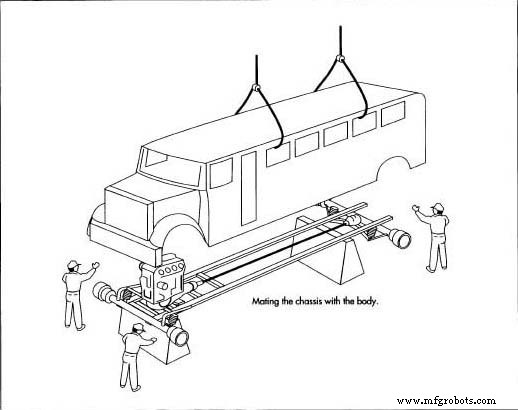 Once all components are ready, the chassis and body are assembled together.
Making the Chassis
- 6. Steel sheet metal arrives in specified thicknesses; cutting and stamping machines shape it into chassis components, which are bolted together as the assembly line progresses.
- 7. The frame is assembled first, followed by suspension, braking, exhaust, engine, drive shaft, wheels, and tires. A temporary driver’s seat allows a preliminary road test of the powertrain.
Making the Body
- 8. Body panels are formed from steel sheets, bolted or welded together on a dedicated assembly line.
- 9. Panels create the bus’s floor, sidewalls, and roof; doors are then attached.
- 10. The body undergoes a cleaning cycle, phosphate treatment for rust resistance, primer application, baking, paint coating, and a second bake to cure the finish.
- 11. Windows are fitted, interior components (instrument panel, seats) installed, and exterior features (door handles, lights) added.
Assembling the School Bus
- 12. A crane lifts the body onto the chassis; the two are bolted together. Electrical wiring, final adjustments, and a comprehensive inspection complete the vehicle before it is shipped on purpose‑built transport trucks.
Quality Control
All pre‑manufactured parts undergo defect inspection. Steel sheets are stored covered to prevent corrosion. Each cut piece is verified for shape and size. The chassis undergoes a brief drive test; the fully assembled bus receives a full road test to catch operational flaws.
Water spray tests detect leaks, and a detailed final inspection ensures every item on a rigorous checklist is approved before shipping. Safety remains paramount: federal regulations mandate stringent standards for brakes, emergency exits, floor strength, seating, windows, mirrors, fuel systems, and crashworthiness. These regulations have proven that school buses are significantly safer than other modes of transport for children.
The Future
The U.S. government continuously revises safety standards. One debated change is mandatory seat belts; a 1989 study estimated a $40 million annual cost to save one life per year. Emerging trends include natural gas and electric propulsion, improved climate control with air conditioning, and advanced electronic instrument panels that enhance driver situational awareness.
Manufacturing process
- The Art and Craft of Headstones: History, Materials, and Modern Manufacturing
- The Spork: Evolution, Materials, and Modern Manufacturing
- The Evolution and Craft of the Modern Swimsuit: From Ancient Pools to High‑Tech Fabric
- The Art and Evolution of the Corkscrew: From Ancient Tool to Modern Engineering
- Footbag: From Ancient Training Tool to Global Sport
- The Craft and Science Behind Everyday Shoelaces
- Skateboarding: History, Design, and Modern Manufacturing
- Doorknob: History, Design, and Modern Manufacturing
- The Carousel: From Ancient Revolving Rides to Modern Craftsmanship
- Sofa: From Ancient Luxury to Modern Comfort – A Comprehensive Guide