



Bulletproof Vest: History, Materials, and Manufacturing Process
Background
Bullet‑resistant vests are lightweight armor designed to protect vital organs from firearm projectiles. Historically, armor evolved from multi‑layer linen in ancient Mycenaean and Persian societies to metal mail and scale armor across Europe, Asia, and the Americas. By the 16th and 17th centuries, brigandine jackets—light, quilted jackets with interlocking metal plates—served as a forerunner to today’s vests.
When firearms emerged, armor makers reinforced cuirasses with thicker steel plates, but the weight and bulk limited field use. The mid‑20th‑century plastics revolution finally produced effective protective gear for police and military.
In the 1940s, ballistic nylon dominated until 1965 when chemist Stephanie Kwolek at Du Pont invented Kevlar, a high‑strength aramid fiber. Kevlar quickly replaced nylon in vests. In 1989, Allied Signal introduced Spectra, a polyethylene fiber that offers lighter, stronger protection. Both materials remain the backbone of modern ballistic armor.
Raw Materials
A vest’s core panel is composed of multiple layers of woven Kevlar, Spectra Shield, or, in some markets, Twaron or Bynema. Woven fibers are stitched with Kevlar thread, while non‑woven Spectra is bonded with resins such as Kraton and sandwiched between polyethylene film.
The panel sits inside a breathable shell—typically a polyester/cotton blend or nylon. The inner side is lined with an absorbent layer (e.g., Kumax) for comfort, and some vests include nylon padding for added impact resistance. Higher‑risk models feature pouches for interchangeable metal or ceramic plates and additional protection against stabbings or vehicle impacts.
Fastening systems vary: elastic webbing, cloth straps, or velcro closures secure the vest, with metal buckles for added durability.
The Manufacturing Process
Panel Fabrication
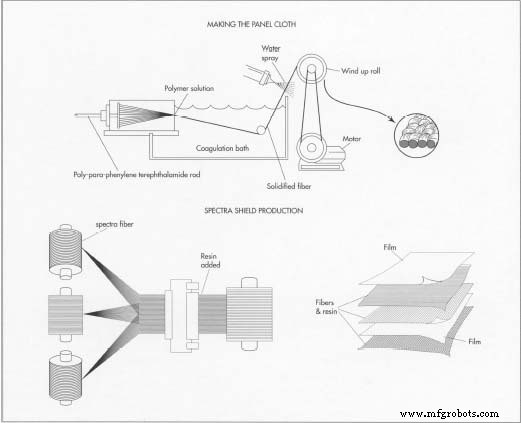
- Kevlar Production: Poly‑para‑phenylene terephthalamide is polymerized, extruded through a spinneret, cooled, stretched, and wound into yarn. The yarn is then woven into plain (tabby) cloth and dyed.
- Spectra Fabrication: Polyethylene filaments are spun, laid parallel, resin‑coated, and layered to form a non‑woven sheet. Two sheets are cross‑laminated, bonded, and encased in polyethylene film to create the vest‑shaped panel.
Cutting the Panels
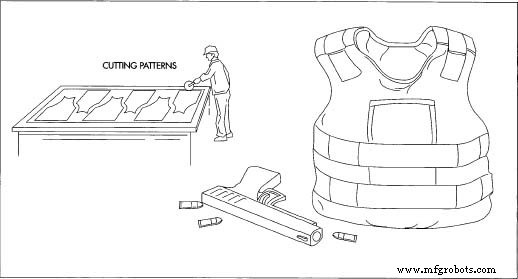
- Large rolls of Kevlar or Spectra cloth are unrolled onto cutting tables up to 32.79 yd (30 m) long.
- Pattern pieces are overlaid on the cloth; computer‑aided layout maximizes material use.
- Panels are cut with a 5.91‑inch (15 cm) wheel cutter, then stacked precisely for sewing.
Sewing and Assembly
- Kevlar panels may be quilt‑stitched or box‑stitched. Quilt stitching offers rigidity but is labor‑intensive; box stitching is quicker and allows more flexibility.
- For Spectra panels, stitching is typically unnecessary; panels are simply layered into hard‑pan pouch inserts.
- Stencils and chalk marks guide seam placement. After stitching, size labels and identification tags are affixed.
Finishing
- Shells are sewn with industrial machines; panels are inserted, and straps are attached.
- The completed vest is boxed, labeled, and shipped to the customer.
Quality Control
Manufacturers perform tensile tests on fibers, yarns, and finished cloth, ensuring each material meets specified strength limits. Vests undergo National Institute of Justice (NIJ) certification, classifying them from I to IV based on the caliber and velocity of bullets they can stop. Size labels must include protection rating, lot number, date, serial number, and a warning that lower‑rated vests do not protect against sharp objects or rifle fire.
Testing involves shooting a calibrated dummy at six target points—three at 0° and three at 30°—and verifying that no penetration occurs. A breach deeper than 1.7 in (4.4 cm) indicates failure. Approved models are archived for future reference, and field performance data confirms that police officers wearing compliant vests save hundreds of lives annually.
For more technical details on NIJ standards, visit NIJ.gov.
Manufacturing process
- Amber: From Ancient Resin to Scientific Treasure – History, Properties, and Modern Uses
- The Guillotine: History, Design, and Legacy
- Silicon: Properties, Production, and Market Outlook
- The Ukulele: From Portuguese Roots to Modern Craftsmanship
- The Complete Guide to the U.S. Chicken Industry: History, Production, and Quality Control
- Compost: The Ultimate Soil Enrichment Solution
- Gelatin: From Ancient Protein to Modern Applications – Production, Uses, and Safety
- The Evolution and Manufacturing of Modern Pin‑Tumbler Locks
- Vodka: From Ancient Distillation to Modern Production
- Milk: Production, Processing, and Nutrition in the United States