



The Candle: From Ancient Origins to Modern Manufacturing
Background
Candles are among the oldest portable lighting solutions, providing reliable illumination across countless cultures. Archaeological finds reveal candle‑like objects in almost every ancient society, underscoring their universal importance.
Early scholars believe the first candles were created by primitive peoples who dipped dried branches into animal fat. This simple technique produced a slow‑burning, dependable light source that could be carried easily. Egyptian reliefs dating back to the Old Kingdom show scholars and priests lighting candles after sunset, illustrating the early religious and practical uses of this technology.
These early tapers were likely made from fibrous materials mixed with wax or tallow—the almost tasteless fat of cattle or sheep that also found use in soap, margarine, and lubricants. By 3000 B.C., dish‑shaped candles were already in use on the island of Crete, demonstrating the rapid spread of candle technology.
Candles have long served liturgical functions. The Bible references candle use, including the story of King Solomon, who lit ten candles to illuminate the Temple’s northern and southern ends after its completion. In the Middle Ages, candlemaking became a respected craft, evidenced by the establishment of numerous guilds across Europe. Candles also played a practical role in timekeeping: auction houses would insert a pin into a candle, allowing the wax to melt until the pin fell, thereby marking the end of the bidding period.
While candle materials have evolved, the core production methods remain surprisingly consistent with early practices. Originally, wicks were made from reeds or rushes; later, various natural fibers were employed. In 1824, Frenchman Jean‑Jacques Cambaraceres introduced the plaited wick, which burned more evenly than its predecessors. Twisted or plaited cotton continues to be the dominant wick material today.
Early candles used animal or vegetable fats, but beeswax soon became the preferred choice because of its pleasant scent and clean burn. After the American Revolutionary War, the whaling industry boomed. The sperm whale’s spermaceti—a waxy substance extracted from its oil—was prized for candle making because it emitted no acrid odor, remained firm in summer heat, and produced an even burn. Other materials such as ozokerite, a colorless mineral hydrocarbon wax, gained popularity in the 17th and 18th centuries. As candlemaking advanced, refined animal fats were separated to yield solid fatty acids like stearic acid, which offered brighter light and no odor. In the 1860s, paraffin, a petroleum‑derived wax, entered the market and was later blended with spermaceti and ceresin (a byproduct of refined petroleum oil) to create more durable candles.
The original production method was the dipping technique, dating back to the Middle Ages. This method involved dipping a wick—typically made from dried rushes stripped on all but one side to expose the pith—into molten wax until the desired thickness was achieved. Beeswax candles were crafted using both dipping and pouring methods. In the pouring technique, melted beeswax was poured over a suspended cotton wick while the wick was manually twirled. Once sufficient wax had accumulated at the base, the candle was flipped to pour from the opposite end.
Large‑scale production began in 1834 when Joseph Morgan unveiled the first mass‑production candle machine. Modern machines closely resemble Morgan’s original design, differing mainly in speed, precision, and finished quality.
Raw Materials
Candle wax formulations have changed dramatically over the centuries. Contemporary commercial candles typically contain 60 % paraffin, 35 % stearic acid, and 5 % beeswax. Some products incorporate small amounts of candelilla or carnauba waxes—derived from the carnauba palm—to adjust the melting point. Pure beeswax candles consist almost entirely of beeswax, with a touch of paraffin and a stiffening wax. The wick is usually high‑grade cotton or linen, woven or braided to burn directionally and maintain an optimal flame. Wire‑core wicks, featuring a metal spine, burn slightly hotter than cotton and stay upright in molten wax.
Decorative candles may use alternative waxes. Bayberry wax, extracted from the fruit of the bayberry bush, offers a distinct fragrance that is especially popular for Christmas. Non‑burning wax is employed in decorative shells or ornaments that are not intended to ignite.
The Manufacturing Process
Modern candle production follows a three‑step cycle: preparing the wick, preparing the wax base, and continuous molding or extrusion of finished candles.
Making the Wick
- 1. Cotton or linen wicks are braided and then treated with chemicals or inorganic salt solutions to achieve a 90° bend when burning. This angle keeps the wick within the outer mantle of the flame, ensuring a steady burn. Untreated wicks burn too quickly and can extinguish the flame, while excessively slow‑burning wicks expose too much of the wick, creating a safety hazard.
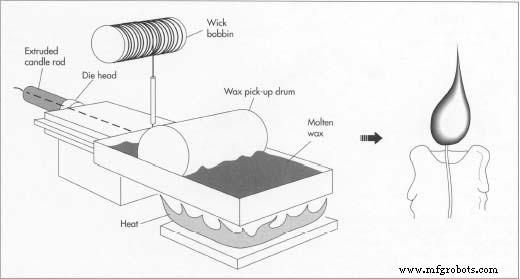
- 2. One method of forming candles is extrusion: wax is forced through a die of the desired shape, and a wick bobbin feeds the wick into the center. Unlike molding, extrusion creates a continuous length of candle that is later cut to size.
Preparing the Wax Base
- 2. Wax is heated in large metal kettles until it becomes a clear, near‑liquid state. Direct flame can darken the wax or leave carbon char; therefore, gentle heating is preferred. The molten wax is then filtered to remove impurities that could affect burning performance. Perfumes and dyes are added at this stage. Even manufacturers that receive wax meeting strict purity standards often filter it to guarantee a high‑quality final product.
Molding the Candle
- 3. Continuous molding machines, the descendants of Morgan’s original design, produce candles in batches ranging from 50 to 500 per load, taking roughly 30 minutes per load. Manual machines remain in use by some small‑scale producers.
- 4. Before pouring, the wick is threaded through the tip of the mold, which contains a hole allowing the wick to pass from a spool beneath the machine. Tin molds with polished interiors and slight tapers facilitate easy ejection.
- 5. Wax cooled to just above its melting point is poured onto a molding table above the pre‑heated molds. A jacket of cold water around each mold accelerates solidification. Once solidified, candles are lifted from the molds, wicks are re‑threaded for the next load, and excess wax is trimmed and recycled. This process accommodates cylindrical, tapered, or fluted shapes.
Extrusion
- 6. In extrusion, crushed paraffin is forced through a heated steel die under high pressure while the wax consolidates around the wick. Extrusion machines produce a continuous candle length that is then cut to specific sizes. Rotational cutters shape the candle tips, and the finished pieces are fed to automated packing machines.
Manufacturing process
- The Art and Craft of Headstones: History, Materials, and Modern Manufacturing
- The Spork: Evolution, Materials, and Modern Manufacturing
- The Evolution and Craft of the Modern Swimsuit: From Ancient Pools to High‑Tech Fabric
- The Art and Evolution of the Corkscrew: From Ancient Tool to Modern Engineering
- Footbag: From Ancient Training Tool to Global Sport
- The Craft and Science Behind Everyday Shoelaces
- Skateboarding: History, Design, and Modern Manufacturing
- The Evolution and Craftsmanship of Holiday Lights: From Ancient Traditions to Modern Engineering
- The Carousel: From Ancient Revolving Rides to Modern Craftsmanship
- Sofa: From Ancient Luxury to Modern Comfort – A Comprehensive Guide