



Understanding the Most Common Touch Panel Technologies
Touch panel is an input device and normally layered on the top of an electronic visual display of an information processor. The digital devices we use every single day are great examples of what are they.
There are a variety of touch panel technologies with different methods of sensing touch. Here are some of the most commonly seen ones in the industry:
1. Resistive touch panel
The resistive touch panel is the most widely used technology at present.
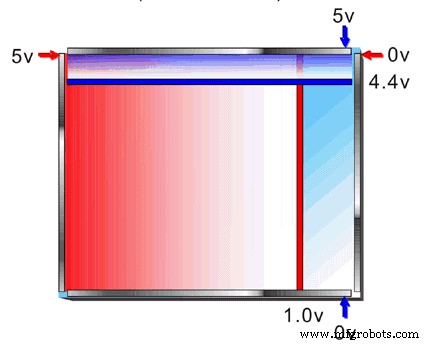
The resistive drive principle is to find the coordinate axis by voltage drop. When the resistive touch screen is touched, the voltage is dropped.
Because the loop is turned on, and the controller calculates the ratio of the voltage drop. Then calculates the coordinates.
2. Capacitive touch panel
The capacitive touch panel, compared with resistive type, is a completely different technology.
Also, the capacitive structure is relatively complex. It’s based on ITO (Indium Tin Oxide) glass and discharges at the four corners of ITO glass to form a uniform electric field on the surface.
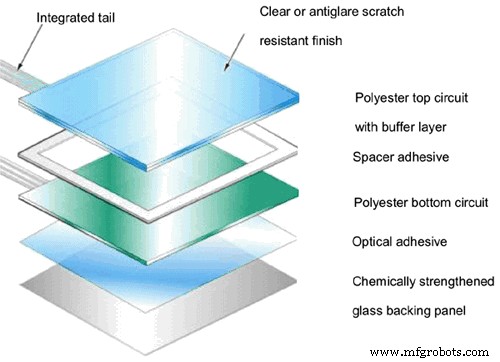
When a conductive object, such as a human finger, draws a small amount of current, the controller on the back will calculate the ratio of the current drawn. The results will be the numbers for the X-axis and the Y-axis.
3.Surface acoustic wave (SAW)
The surface acoustic wave technology uses ultrasonic waves that pass over the touch panel.
When the panel is touched, a portion of the wave is absorbed. After that, the change in ultrasonic waves is processed by the controller to determine the position of the touch event.

However, surface acoustic wave touchscreen panels can be damaged by outside elements like water and dust. Also, the Contaminants on the surface can also interfere with the functionality of the touch panel.
4. Optical imaging touch panel
The optical touch panels are a relatively modern development in touchscreen technology. Also, there two or more image sensors are placed around the edges of the screen.

Infrared backlights are placed in the camera’s field of view on the opposite side of the screen. A touch blocks some lights from the cameras. Similarly, the location and size of the touching object can be calculated.
Above all, you can have basic ideas of the touch panel. Here is a table showing more differences among the four touch panels:
| Resistive | Capacitive | Surface acoustic wave | Optical imaging | |
| Accuracy | High | Normal | Depend | Normal |
| Reaction time | 20ms | 3ms | Depend | Depend |
| Cost | High | Normal | Low | Normal |
| Functional | Doesn’t work with a scratch | Frame easy to break | Not waterproof or dust | Easy disrupt by the light |
| Image quality | Normal | Image distortion | Normal | Surface distortion |
In conclusion, the touch panel is widely used and make our life more and more convenient.
I guess you are using a smart device with a touch panel to read this post. Hope we give you a simple idea of the types of touch panels. You are welcome to contact us to get more information.
Note: We do not own the images used in this post. Feel free to contact us if they belong to you, and we’ll take them down as quickly as we possibly can.
Manufacturing process
- 4 Essential Types of Coil Springs Explained
- Understanding the Four Most Common Types of Plungers
- 5 Common Types of Knobs and Their Practical Applications
- Top 5 CNC Machine Types Every Manufacturer Should Know
- Understanding Panel Construction: The Future of Residential Building
- Explore the Key Types of Wall Panel Systems for Architecture and Energy Efficiency
- Four Essential CNC Machine Types for Precision Manufacturing
- Four Essential Metal Casting Processes Explained
- Essential Precision Measuring Instruments for High-Accuracy Manufacturing
- The Future of Touch Panel Technology: Innovations Shaping Our Digital World