



Understanding the Four Most Common Types of Plungers
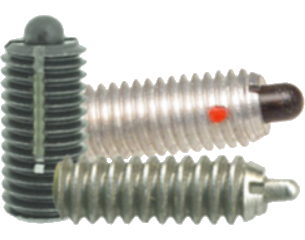
Plungers are essential positioning tools used across many machining and assembly processes. Though they share a basic rod‑shaped design, each type is engineered for specific operational needs. This guide details the four most widely used plunger variants, helping you select the right one for your application.
#1) Spring Plunger
Spring plungers incorporate a compression spring within the rod. The spring exerts a steady force on the nose, keeping it firmly seated in a part or machine. This passive locking mechanism allows for quick insertion and reliable retention, making spring plungers ideal for repetitive positioning tasks where minimal manual force is required.
#2) Ball Plunger
Ball, or ball‑detent plungers, feature a small ball that protrudes from one end of the rod. When inserted, the ball engages a recess or hole and holds the plunger in place. To release, the user applies pressure, causing the ball to retract and the plunger to disengage. This design offers precise positioning with a secure lock‑and‑release action, commonly used in CNC fixtures and handheld assembly tools.
#3) Press‑Fit Ball Plunger
Press‑fit ball plungers are a specialized form of ball plunger that lack external threading. Instead, the ball and body are sized to be pressed into a non‑metallic hole—such as those in wood or plastic components. The fit provides a secure, low‑profile attachment without the need for threading, which is advantageous in lightweight or delicate assemblies.
#4) Indexing Plunger
Also known as hard retractable plungers, indexing types feature a handle that, when pulled, retracts the nose into the rod. This quick‑release action enables rapid removal and repositioning, ideal for high‑throughput operations. The indexed design ensures consistent placement while simplifying tool changes.
Industrial equipment
- 4 Essential Types of Coil Springs Explained
- Understanding the Three Most Common Hose Clamp Types
- The 5 Most Common Non‑Ferrous Metals & Their Key Uses
- The 6 Most Common Screw Drives Explained – Torque, Usage, and Selection
- Understanding Ball Plungers: Design, Function, and Applications
- 6 Essential Woodworking Joints Every Craftsman Should Master
- 5 Common Types of Knobs and Their Practical Applications
- Spring vs. Ball Plungers: Key Differences & When to Use Each
- Top 5 CNC Machine Types Every Manufacturer Should Know
- Four Essential CNC Machine Types for Precision Manufacturing